Yongin 10 Fabs to Consume 94% of Hangang Water Supply... Spotlight on Southwestern Semiconductor Locations
Yongin Complex Requires 1.07 Million Tons of Water Per Day,
Only 80,000 Tons Remain as Surplus
10–16 GW Power Needed—Separate Power Plants Unavoidable
Southwestern Region's Power Self-Sufficiency at 210%,
Output Control Volume Accounts for 51.3%
If all 10 fabs at the Yongin Semiconductor Industrial Complex become operational, the contract rate for water from the Hangang River basin will reach 94%, leaving only about 80,000 tons of surplus water per day. By contrast, the southwestern region boasts a power self-sufficiency rate of 210%, with over half of the nation’s output control volume concentrated there.
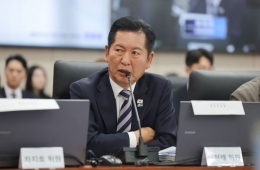
Heeseung Park, member of the Democratic Party of Korea (Namwon, Jangsu, Imsil, Sunchang), questioned Minister Kim Jeonggwan about the water and power conditions at the southwestern semiconductor cluster during the parliamentary audit of the Ministry of Trade, Industry and Energy held by the National Assembly’s Trade, Industry, Energy, SMEs and Startups Committee on October 6.

According to Assemblyman Park’s data, out of the 10 fabs in the Yongin Semiconductor Industrial Complex, six are Samsung Electronics fabs in the national industrial complex and four are SK hynix fabs in the general industrial complex. Once all are operational, daily water demand will reach 1.072 million tons. The water contract rate for the Hangang River basin will climb to 94%, leaving only about 80,000 tons of surplus water per day.
Securing additional water sources is also challenging. The construction of the Yanggu Suipcheon Dam, which was planned with a storage capacity of around 100 million tons, was canceled due to local opposition.
The power supply is also tight. The Yongin complex requires 10–16 GW of electricity, which equals the output of 10–16 nuclear power plants. As the existing power grid cannot supply this alone, a separate 3 GW LNG power plant is required for the national industrial complex and a 1 GW combined heat and power plant for the general industrial complex.
From January to May this year, the southwestern region accounted for 51.3% of the nation’s total output control volume. Its power self-sufficiency rate is 210%, and the share of renewable energy is 44.1%. Assemblyman Park argued that adopting a "produce locally, consume locally" approach—where electricity produced in the region is consumed in the same area—could alleviate pressure on transmission networks and reduce grid bottlenecks.
He also insisted that semiconductor production facilities should be distributed according to water, power, and land conditions, rather than being concentrated in one region. As an example, he cited Taiwan’s TSMC, which expanded its production sites from Hsinchu to Taichung, Tainan, and Kaohsiung.
Assemblyman Park also called for support for localities supplying water to the southwestern cluster. Of the dam water provided, 84.6% is sourced from the Seomjin River basin. Although 28 villages upstream in Jeongeup and Imsil, North Jeolla Province, endured dam submersion and drinking water source regulations, they have been excluded from local area support programs because they are not classified as water-adjacent zones.
Hot Picks Today
 "It Shut Down Just From Showing My Face"... 1,500 iPhone 18 Pros Exchanged; "Cause Is Confidential"
- Condoms Out of Stock... "Please Stop Having Kids": Country to Deliver Contraceptive Pills Door to Door
- "What Becomes of the Geniuses Who Devoted Their Lives?"... 722 Papers Released in Just 3 Hours Spark 'Shock and Awe' [Reading Science]
- JYP Bought a 75.5 Billion Won Site, Only to Face an 18-Story Building Right in Front? ... SH's "Surprise Rezoning" Makes JYP Pull Out
- "I Want to Look Like Glowing Koreans" ... The Trend Is Taking the World by Storm, but Experts Warn Against It
Assemblyman Park stated, "It was Samsung and SK hynix that chose the southwestern region for its abundance of water and electricity, not because anyone twisted their arms. Rather than turning site selection into a political issue, both parties should join forces to achieve a super-gap in competitiveness."
© The Asia Business Daily. All rights reserved. Unauthorized AI training and use prohibited.