[Nuri Fifth Launch] Nuri Successfully Separates All 15 Satellites, Completing Its Fifth Mission
Lift-off from Naro Space Center at 12:25 p.m.; Around 20 Minutes of Flight
Sequential Separation of Five NEONSAT and Ten CubeSats
Status of Orbital Insertion to Be Confirmed
[Naro Space Center, Goheung, Jeonnam=The Asia Business Daily Kim Joungho] The Korean launch vehicle Nuriho has successfully completed its scheduled mission for its fifth space flight, separating all 15 of its onboard satellites.

Nuriho, which carried the highest number of satellites to date into space, sequentially released 15 satellites, including five main payload microsatellite cluster satellites and ten CubeSats. The next step is to confirm whether they have actually entered their target orbits and to check the status of the satellites.
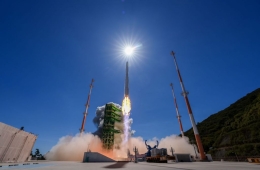
Nuriho lifted off from Launch Pad 2 at Naro Space Center in Goheung, Jeonnam at 12:25 p.m. on October 7, 2026. After liftoff, the first stage, payload fairing, and second stage were separated in sequence. The third stage then continued flight to reach the intended altitude for satellite deployment.
Subsequently, the five main payload microsatellite cluster satellites, NEONSAT-2 through NEONSAT-6, were separated one by one. To prevent collision, the five satellites separated from Nuriho at intervals of 35 to 40 seconds.
After completing separation of the five NEONSAT satellites, Nuriho began the process of releasing the ten CubeSats. The CubeSats were released in pairs, every ten seconds, in a total of five rounds. With the final CubeSat released, all 15 satellites on board Nuriho had been successfully separated.

The Korean launch vehicle Nuriho is being launched on the afternoon of the 7th at the Naro Space Center in Goheung-gun, Gwangju, Jeonnam. Nuriho embarked on its fifth space flight carrying a total of 15 satellites, including five microsatellite cluster satellites called 'NEONSAT'. Provided by Yonhap News Agency.
View original imageThis fifth launch is the flight in which Nuriho has placed the largest number of satellites into orbit so far. Eight satellites were carried in the third launch, 13 in the fourth, and in this launch, the number increased to 15, including five microsatellite cluster satellites and ten CubeSats.
It is not only the number of payload satellites that has increased. For the first time, Nuriho was tasked with carrying five main payload satellites—assigned the same mission—at once and releasing them in a precise order and at specific intervals.
The target orbit for the five NEONSAT main payload satellites is an altitude of approximately 570 km. The allowable margin of error for this target altitude is within 15 km, representing a higher requirement for orbital insertion accuracy than in the fourth launch.
After initial communications and functional checks, the five NEONSAT satellites will spend about two to three months adjusting their distances from one another to form a single satellite cluster. Once the cluster is completed, it will be able to observe the Korean Peninsula more than three times a day and reshoot the same area within 24 hours.
However, the fact that all 15 payload satellites have separated does not in itself confirm the final success of Nuriho’s fifth launch.
Hot Picks Today
 "Wasn't It Supposed to Be Gone? Alarming Surge in Cases Leads US to Declare Disaster Emergency"
- [Exclusive] "We Thought Bigger Debts Would Hurt More..." Business Owners With Less Than 100 Million Won Loans Have Higher Delinquency Rates Than Those With Over 500 Million Won
- [2026 Parliamentary Audit] "Order to Dissolve Korea Layer Association Was 'Violent'..." Song Miryeong: "Repeated Violations of Corporate Establishment Conditions"
- "This Isn't Right, Someone Could Throw Out Their Back"... Triple-Layered Garbage Bags Tightly Bound with Tape
- "Mom, You Didn't Throw Away My Old Clothes, Right?"... 20-Something and 30-Something Women Rediscover 20-Year-Old Fashion Styles
It is necessary to analyze Nuriho’s flight data to verify whether the targeted orbit has been accurately reached and also to comprehensively confirm that the five main payload NEONSAT satellites have been properly inserted into their target orbit. The Korea Aerospace Administration (KASA) is scheduled to hold a briefing later in the afternoon to officially announce the results of Nuriho’s fifth launch.
© The Asia Business Daily. All rights reserved. Unauthorized AI training and use prohibited.