Lee Hyung-il Holds First Meeting with Six Major Economic Organizations Since Taking Office: "Policy Solutions Will Come from Voices on the Ground"
Hyungil Lee, Deputy Prime Minister and Minister of Finance and Economy, met with the leaders of six major economic organizations for the first time since taking office to listen to the voices from the corporate front lines. This was the first meeting with the business community since the launch of the new economic team. Deputy Prime Minister Lee expressed his commitment to strengthening communication with the field in order to create policies that companies can truly feel.

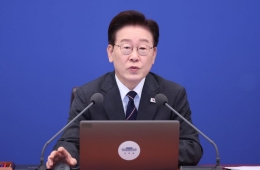
Deputy Prime Minister and Minister of Finance and Economy Lee Hyungil is speaking at the meeting of leaders of six major economic organizations held on the 7th at the Seoul Chamber of Commerce and Industry. Photo by Yonhap News.
View original imageAt the meeting of leaders of six major economic organizations held on the 7th at the Korean Chamber of Commerce and Industry in Seoul, Deputy Prime Minister Lee stated, "Real changes that companies feel begin with voices from the field," and added, "When the government and the private sector worry together and seek solutions at the field level, policies can translate into tangible results."
Attendees at the meeting included Taewon Choi, Chairman of the Korean Chamber of Commerce and Industry; Jin Ryoo, Chairman of the Federation of Korean Industries; Jinsik Yoon, Chairman of the Korea International Trade Association; Kim Kimoon, Chairman of the Korea Federation of SMEs; Jinsik Choi, Chairman of the Korea Federation of Middle Market Enterprises; and Donggeun Lee, Executive Vice President of the Korea Employers Federation. Deputy Prime Minister Lee explained the recent economic situation and the future direction of economic policy, stating that the government would actively reflect the business community’s on-site difficulties in policy.
The government, together with the six major economic organizations, has visited corporate sites to identify issues. Based on these findings, it announced the 'Field-Oriented Corporate Investment and Innovation Support Plan' twice in August and October. Representative measures include allowing the joint bidding of electricity and telecommunication works for semiconductor fabs, and reducing the approval period for Ulsan's internal combustion engine vehicle-to-electric vehicle conversion investment projects from three years to less than one year. The government has also worked to improve procedures for factory expansion approval in large-scale industrial complexes and established safety standards for fence-less operations involving collaborative and new-type robots, implementing regulatory improvements raised directly at corporate sites. Deputy Prime Minister Lee said, "We will continue to identify and swiftly resolve on-site difficulties raised by companies in cooperation with relevant ministries. As we pursue these policy tasks, I respectfully ask for your valuable input so that the government and private sector can work together and communicate to create better policies."
Regarding the Korean economy, he assessed that the growth trend has expanded thanks to the boom in semiconductors, but emphasized that structural challenges persist. He noted, "Despite challenging economic conditions, the growth trend is expanding thanks to the global semiconductor boom." Nevertheless, he pointed out several challenges to be addressed: the burden of cost of living such as inflation, a decrease in the working-age population, a decline in potential growth due to stagnating productivity, and polarization among sectors.
To address these, he declared that the government would focus policy capabilities on boosting the potential growth rate and mitigating polarization. In particular, through three mega-projects, the government aims to implement proactive and large-scale investments in the future and remove obstacles at corporate sites to establish a world-class business environment. He also stressed the need to concentrate available resources and policy tools on three key social policy areas—housing, jobs, and financial support for ordinary citizens—to help ease polarization.

Hyungil Lee, Deputy Prime Minister and Minister of Finance and Economy (third from left), is heading to his seat after taking a commemorative photo with attendees including Taewon Choi, Chairman of the Korean Chamber of Commerce and Industry, at the meeting of six economic organizations held at the Korean Chamber of Commerce and Industry in Seoul on the 7th. Photo by Yonhap News
View original imageThe business community called on the government for active support so that permits and infrastructure could be secured quickly in line with corporate investment schedules. Participants also suggested that customized artificial intelligence (AI) support for small and medium-sized businesses should be expanded in order to reduce the gap between large corporations and SMEs. On the topic of extending the retirement age, the opinion was expressed that, rather than a blanket extension, a more flexible system is needed—one that utilizes the experience of senior employees through post-retirement re-employment opportunities, while also securing employment opportunities for the younger generation.
Hot Picks Today
 "I Decided to Stop Ordering Delivery and Cook at Home, But Was Shocked by Grocery Prices"
- [Exclusive] "Bought at 7,000 Won, Now at 1,600 Won"...76% Stock Plunge Shatters Big Dreams [KOSDAQ Inflated Listings]②
- [2026 National Audit] Kang Shin-chul: "Strengthening Self-Reliant Defense Through OPCON Transition... Further Solidifying the ROK-US Alliance"
- "Buy Now and Get 17X Returns?"... Cathie Wood Makes Bold 1,665% Bitcoin Forecast by 2030
- "This Isn't Right, Someone Could Throw Out Their Back"... Triple-Layered Garbage Bags Tightly Bound with Tape
Jinsik Yoon, Chairman of the Korea International Trade Association, emphasized, "Policies to foster new industries such as mega-projects should be promoted with international market entry in mind from the start." He underscored the necessity of providing tailored support so that international standards and essential overseas certifications can be obtained from the technology development stage. Furthermore, highlighting the importance of fostering service exports to diversify and broaden the export structure, he called for a prompt overhaul of the export performance recognition system to accommodate new forms of service exports—such as online services, subscription and license contracts, and platform transactions—and for a substantial enhancement of financial and tax support frameworks.
© The Asia Business Daily. All rights reserved. Unauthorized AI training and use prohibited.