[Nuri Fifth Launch] Nuri Rocket Achieves Normal Flight Into Space... Next Challenge: "Private Launch Services"
5th Launch at 12:25 PM Today: Aiming for Multiple Satellite Deployment
Expanded Role for the Private Sector from the 6th Launch... Hanwha to Lead Starting with the 8th
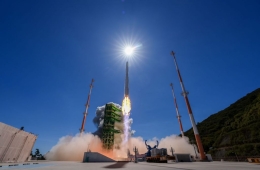
[Naro Space Center, Goheung, Jeollanam-do = The Asia Business Daily reporter Kim Joungho] At 12:25 PM on October 7, the Korean launch vehicle Nuri rocket lifted off carrying a total of 15 satellites, including five ultra-small cluster satellites and ten CubeSats.
On the morning of the 7th, the Korea Aerospace Administration held a launch management committee meeting and comprehensively reviewed the technical readiness of the launch vehicle, as well as weather, space environment, and the possibility of collisions with space objects. Based on this review, the launch time was set for 12:25 PM. After evaluating weather conditions at the Naro Space Center, upper atmospheric winds, solar activity-related space environment, and the risk of collision with the International Space Station (ISS), satellites, or space debris, the authorities determined there were no hazards significant enough to prevent launch. As a result, the Nuri rocket was launched as scheduled.

Beyond Deploying 15 Satellites: Building a Satellite Constellation
The core mission of the fifth Nuri launch is to deploy a total of 15 satellites into their target orbits: five main payloads—NEONSAT-2 through 6, which are ultra-small cluster satellites—and ten CubeSats. The five NEONSAT satellites will not simply operate independently after reaching orbit; instead, they will form a coordinated cluster at regular intervals. After initial communication and function checks, their spacing will be adjusted over the next two to three months. Once the cluster is complete, it will be capable of photographing the Korean Peninsula more than three times per day and revisiting the same area within a 24-hour period. This ability will be leveraged for repetitive monitoring of rapidly changing situations in disaster response (such as wildfires and flooding), maritime affairs, and national security. After five additional satellites are deployed in the sixth launch, a complete 10-satellite cluster constellation will be established.
Hyungjun Ahn, Head of the Space Public Sector Team at the System Innovation Office, Science and Technology Policy Institute (STEPI), said, "It is significant that we are expanding our independent launch capability to the point where we can deliver space assets critical to national security and disaster response into orbit on our own. This launch demonstrates not just simple satellite delivery but the mission-oriented capability to establish a cluster system." He emphasized that this launch brings with it the technical challenge of freely deploying multiple satellites into different orbits. Professor Jin Jeonggeun from the Department of Aerospace Engineering at KAIST explained, "A true multi-satellite orbital deployment requires ignition and re-ignition of the rocket's third stage, which is not yet included in the current Nuri rocket. While this launch deploys multiple satellites into a single orbit, it is a process of securing important technology for next-generation launch vehicles."
From the Eighth Launch, Private-Led: Transitioning to 'Launch Services'
The workforce from the system integrator Hanwha Aerospace participating in the fifth launch increased to 42 people compared to 32 during the fourth launch. Of the 22 launch vehicle-related consoles at the Launch Control Center (LCC), personnel from Hanwha Aerospace participated in 20, with 18 members directly operating the consoles themselves.

From the sixth launch, Hanwha Aerospace’s role will expand further. After assembling each rocket stage at its own dedicated assembly plant, Hanwha Aerospace will transport the finished stages by sea to Naro Space Center and handle comprehensive final vehicle assembly on-site. Through accumulating manufacturing and launch operation experience during the sixth and seventh launches, the goal is for the system integrator to take the lead in the eighth launch and beyond. Additionally, to evolve beyond repeatedly launching government-developed rockets into providing commercial launch services trusted by customers to carry satellites, Hanwha Aerospace must overcome the hurdles of reliability, cost competitiveness, and securing a domestic and international customer base.
Astrophysicist and science communicator Seongju Kang stated, "Launch vehicle technology cannot be perfected merely by receiving blueprints or manufacturing techniques; it requires accumulation of real experience through repeated launches, problem diagnosis and judgment, response to anomalies, and flight data analysis." Professor Jin also emphasized, "The accumulation of system integration and launch control experience by private companies through technology transfer is a crucial stepping stone for the realization of private launch services in the future." He stressed that successive launches must be continued to maintain and advance manufacturing, testing, and operation technologies until next-generation launch vehicles are introduced.
Hot Picks Today
 "Wasn't It Supposed to Be Gone? Alarming Surge in Cases Leads US to Declare Disaster Emergency"
- [Exclusive] "We Thought Bigger Debts Would Hurt More..." Business Owners With Less Than 100 Million Won Loans Have Higher Delinquency Rates Than Those With Over 500 Million Won
- [2026 Parliamentary Audit] Land Minister Hong Jiseon: "Orders Working-Level Talks With Seoul on Housing Supply; Consults on Urban Complex Project, Yongsan Park"
- "This Isn't Right, Someone Could Throw Out Their Back"... Triple-Layered Garbage Bags Tightly Bound with Tape
- "Mom, You Didn't Throw Away My Old Clothes, Right?"... 20-Something and 30-Something Women Rediscover 20-Year-Old Fashion Styles
It means that only when a company can repeatedly produce launch vehicles of consistent quality, reliably launch them on schedule, minimize costs, and secure customers, can the transition from 'launch vehicle development' to true 'launch services' be made. Ahn commented, "Repeated Nuri launches represent the process of converting independent launch capability into real mission execution, and of building a 'space transportation system' that connects national space missions with the broader industrial ecosystem. Through repeated manufacturing and launches, private companies must accumulate technical and operational experience, while supply chains and expert personnel are maintained."
© The Asia Business Daily. All rights reserved. Unauthorized AI training and use prohibited.