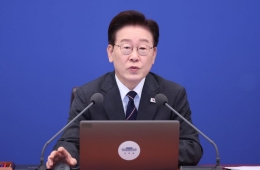
Kim Myungja, National Integration Committee Adviser: "In an Age When AI Handles IQ... What Does It Mean to Be Human?" [Power K Women]
From scientist, minister and lawmaker to leadership roles at
the Korean Federation of Science and Technology Societies, a major corporation and KAIST: first woman in each role
Highlights empathy, relationships and morality as human strengths in the AI era
Listening and communication are key to bridging generational divides
"What does it mean to be human in the age of AI?"
That is the question Kim Myungja, an adviser to the National Integration Committee, posed at a time when artificial intelligence (AI) is challenging the limits of human biological intelligence. She says that the faster AI solves problems and the more vast its memory becomes, the more important it is to have qualities such as empathy, the ability to build relationships, responsibility and morality.
Kim has long explored how technological change transforms people and society. In her 2019 book, Reading World History Through the Industrial Revolution, she examined how the Industrial Revolution has changed the world. At the same time, over the course of 55 years, she has worked in a range of organizations: she began as a professor teaching chemistry and the history of science in the 1970s, then served as minister of environment and a lawmaker, led science and technology organizations and a nongovernmental organization (NGO), chaired the board of a major corporation, and became chair of the KAIST board. Along the way, she set records as the longest-serving female minister in the nation's constitutional history, the first woman to chair the National Assembly Ethics Committee, the first woman in the 50-year history of the Korean Federation of Science and Technology Societies to serve as its president, the first woman to chair the board of a major private-sector company, and the first woman to chair the KAIST board.
Having experienced key organizations and sites of conflict in Korean society, she has reached one conclusion: people matter most. As minister of environment, she mediated countless conflicts between development and the environment. Now, for the third successive administration, she has examined complex conflicts involving generations and political camps as a member and adviser to the National Integration Committee. "There is very little we can accomplish alone in this complex world," she says, repeatedly emphasizing the power of listening, empathy and relationships.
As the AI boom prompts us to reconsider what it means to be human, Kim believes that the problems of a society divided by generational and class conflicts are closely connected to that question. The faster technological innovation advances, the more important it becomes to understand people and work with them. In leadership, too, EQ and the ability to bring people together are needed more than IQ, she says. The following is an edited interview with Kim.

Kim Myungja, an adviser to the Presidential Committee on National Cohesion, is being interviewed at The Asia Business Daily headquarters. Photo by Heo Younghan.
View original image-How do you view the evolution of AI technology?
▲I see it as a major turning point in the history of civilization. In 2016, the "Fourth Industrial Revolution" was a key topic. Now, we are seeing an AI revolution led by AI, which was one of the technological components of the Fourth Industrial Revolution. In May 1997, IBM's Deep Blue defeated chess champion Garry Kasparov, heralding a new civilization ushered in by AI. The 2016 match between Go master Lee Sedol and Google's AlphaGo was an even greater shock. We are now moving beyond generative AI toward agentic AI and physical AI. The emergence of artificial general intelligence (AGI) and artificial superintelligence (ASI) is only a matter of time, and AI will shake up the global economy, politics and industrial dominance. Technological innovation is moving so fast that institutions, education and labor markets cannot keep up, leaving society in disarray. Even more concerning is the possibility, as Bill Gates has pointed out, that AI systems themselves could pose physical risks through cyberattacks, fraud, misinformation and biological weapons. The question now should not be how quickly we can develop technology, but what values and rules should govern its use. Yet, amid widespread debate, we have not reached a clear direction.
-If AI takes over many tasks, what role will remain for people?
▲That is the most important question. Until now, when people talked about intelligence, they usually meant IQ: the ability to solve problems, calculate and remember. But AI is surpassing humans in speed and memory capacity. Going forward, the ability to ask questions, make judgments, empathize, cooperate and make decisions will become more important. EQ, creativity, human relationships, resilience in the face of failure, and the moral ability to distinguish right from wrong will matter more. The Harvard Study of Adult Development, which has been underway since 1938, tracked people's health, careers, families and happiness. It concluded that good relationships, more than wealth, fame or status, determine happiness and health. In the age of AI, the ability to build relationships with others and to care for, empathize with and understand one another will become a greater competitive advantage.
-There are also concerns about AI's impact on jobs.
▲We can expect structural upheaval. The World Economic Forum (WEF) report Future of Jobs 2025 forecasts that 170 million jobs will be created and 92 million will be eliminated by 2030. The important thing is not just to consider which occupations will disappear, but to look at which tasks within which occupations will go away and which new tasks will emerge. Law, healthcare, customer service, software and manufacturing will be hit hard. Young people are particularly affected when seeking their first jobs, so extraordinary measures are needed. AI will boost white-collar productivity, but it could also lead to job adjustments and widen wage gaps. That is why it is also important to consider how the gains from the AI transition will be distributed.
-How, then, should education change?
▲We need to find the answer. Education is one of the fields most affected by AI. There is confusion over "what to teach and how to teach it," but no country has established an adequate institutional framework. With AI technology spreading widely, it is also difficult to simply prohibit it. We need to teach people how to use it properly while helping them develop the ability to think for themselves. A solid foundation of knowledge is essential to asking good questions and developing the judgment to verify AI's answers. Education in the age of AI must also foster the ability to build relationships, creativity, resilience and ethical judgment.
-You have worked in many different organizations, as a professor, minister, lawmaker, and in science and technology, business and NGOs. What does leadership mean to you?
▲When I was a lawmaker, I advocated "governance leadership grounded in reason and emotion." On one side are logic, rationality and efficiency; on the other are emotion, flexibility and relationships. The two need to be balanced. I also believe that insight, which encompasses them all, is important. Above all, leadership begins with listening. Nelson Mandela, South Africa's first Black president, is said to have learned a lifelong lesson as a child while watching meetings of the Thembu people. Their leader, Jongintaba, let everyone speak before taking the floor last. That is leadership that gives people the sense that "we have reached a conclusion together through consensus." It takes humility, patience and wisdom.

Kim Myungja, an adviser to the National Integration Committee, speaks with a reporter while looking out over downtown Seoul at The Asia Business Daily headquarters ahead of an interview. Photo by Heo Younghan
View original image-Recently, you have also taken part in intergenerational dialogue as an adviser to the National Integration Committee.
▲In a short period, our society experienced division, war, industrialization and democratization. When I entered university in 1962, gross domestic product (GDP) per capita was $106. In 2024, it exceeded $36,000. Young people today and my generation have, in a sense, lived in different civilizations. It is only natural that our values differ. Even as we approach the $40,000-per-capita era, however, it pains me and makes me feel deeply sorry, as a member of the older generation, to see young people struggling with employment, housing and marriage. I am also concerned that the AI economy could widen the gap between rich and poor.
-What is needed to reduce generational conflict and social division?
▲Sincere dialogue and communication are the first steps toward reducing conflict and division. We need to acknowledge and respect differences of opinion. I was impressed by President Abraham Lincoln's second inaugural address in March 1865. He neither celebrated victory to the North nor condemned the South over slavery. With a historical understanding that "all share responsibility for the sin and the war," he called for national reconciliation and unity, saying, "With malice toward none, with charity for all." Leadership that brings people together does not mean making everyone think alike. It means acknowledging differences while helping people move forward together.
-You have set many records as the "first woman" to hold various positions. What would you like to say to future women leaders?
▲Looking back on my 55-year career since completing my degree, I did not set out with a grand dream to take on a particular challenge. I simply did my best at whatever work I was given, whether small or large. I tried to live by the principle of doing one's utmost and leaving the outcome to fate, without becoming attached to the results. What mattered was always asking myself, "Did I truly do my best?" The younger people I see today are smart and adaptable to change. As a senior colleague, I would like to tell them, "Great leadership begins with good followership." Whatever position you hold, you need to build the capabilities to become "the person best able to do the job." Louis Pasteur once said, "Fortune favors the prepared mind."
Hot Picks Today
 "Wasn't It Supposed to Be Gone? Alarming Surge in Cases Leads US to Declare Disaster Emergency"
- After 20 Million Tourists Flock In Each Year... "We Can't Take It Anymore": Hakone to Impose Accommodation Tax
- With a Trembling Voice, "One Bowl of Jajangmyeon, Please"... 9-Year-Old Saves Mother From Assault
- Lotte Department Store Opens K-Beauty Pop-Up in LA to Support Emerging Korean Brands' Overseas Expansion
- "South Korea's Rep, Born in 1991, Is 35"... 'Married or Divorced? Still OK': Miss Universe Removes Age Limit
-Finally, if you were to recommend one book to readers, what would it be?
▲I recommend Professor Jang Hoon's Hooligans and Vulcans. It diagnoses Korean politics, caught up in hard-line fandom and partisan logic, and emphasizes the value of compromise. When extreme voices dominate public debate, reasonable and moderate citizens withdraw from politics. Democracy means acknowledging differences and reaching consensus through dialogue and compromise. The author's message—that politics can change when citizens who are indifferent to it take an interest—resonates deeply in our society.
© The Asia Business Daily. All rights reserved. Unauthorized AI training and use prohibited.