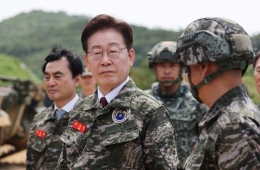
[2026 Audit] Minister Kim Junggwan: "Alaska LNG Gains Strategic Value After Middle East War"
"Supply from the Middle East is unstable... Alaska LNG would provide definite value"
"Review based on commercial rationality... Unrelated to U.S. Investment Projects No. 2 and 3"

On October 6, Minister of Trade, Industry and Energy Kim Junggwan stated regarding the Alaska liquefied natural gas (LNG) project in the United States, "It is true that the project had not moved forward until now due to clearly low business feasibility," but noted, "After the Middle East war, a new element of strategic value has certainly emerged." Although this project has faced decades of development delays due to low economic feasibility, the heightened geopolitical risks in the LNG supply chain—as a result of instability in the Middle East—have created the need to reassess the project from the perspective of energy security. Minister Kim, however, reaffirmed the existing principle that actual investments must meet 'commercial rationality.'
Minister Kim made these comments at the parliamentary audit of the Ministry of Trade, Industry and Energy by the National Assembly’s Trade, Industry, Energy, SMEs, and Startups Committee, in response to a question from Assemblywoman Choi Sujin of the People Power Party regarding the Alaska LNG project.
Explaining the changed strategic value of Alaska LNG, Minister Kim cited recent shifts in the LNG supply chain. He said, "Right now, LNG is not coming smoothly from the Middle East, and even supplies coming from the Gulf of Mexico are arriving by way of the Cape of Good Hope instead of the Panama Canal. If the Alaska project succeeds and we are able to secure that LNG, there is undoubtedly strategic value in doing so."
Given that Korea relies on overseas sources for most of its LNG, any issues in specific regions or maritime shipping routes will inevitably affect domestic supply and demand. Instability in the Middle East has further highlighted supply risks for Middle Eastern LNG passing through the Strait of Hormuz, while LNG produced in the U.S. Gulf region could see significantly longer shipping distances, depending on passage conditions through the Panama Canal. This is why the government is examining new supply routes from places like the U.S. West Coast, Canada, and Alaska as part of its energy security policy.
Minister Kim has also previously explained that, in addition to the Strait of Hormuz, it is necessary to prepare for geopolitical risks on major shipping routes such as the Strait of Malacca and the Taiwan Strait as background for reconsidering the Alaska LNG project.
The biggest barrier surrounding the project is its economic feasibility. Minister Kim again acknowledged at the parliamentary audit that the project has not proceeded thus far because of low business feasibility. However, he also pointed out that the U.S. federal government is now taking a more active role in the previously privately-led project, citing this as a shift in the business environment. "The Alaska LNG development project, which had previously been driven primarily by private companies in the United States, is now moving forward under the initiative of the federal government," he explained.
During the audit, questions were raised regarding the business feasibility and investment risks associated with the government’s current position. Assemblywoman Choi argued that the fact sheet jointly released by South Korea and the United States on September 30 included an agreement between the two governments to begin work on the Alaska LNG project, implying a commitment. She noted concerns that the U.S. side was effectively treating the project as a settled Korean investment without sufficient completion of its economic and feasibility assessment. U.S. President Donald Trump, in announcing Korea’s investment in the United States, declared that Korea had agreed to invest in the Alaska LNG project, and U.S. Secretary of Commerce Howard Lutnick claimed the investment size would exceed $50 billion.
In response, Minister Kim drew a clear line, stating, "Numbers two and three have nothing to do with the Alaska project." He also addressed concerns over differences in the official statements from South Korea and the United States, countering, "The fact sheet was a document that both countries jointly and publicly released. It was not concealed."
Hot Picks Today
 "South Koreans Are All Buying It to Take Home"... This "Drug" Costs 350,000 Won in Korea but Just 80,000 Won in Japan
- "Buy While It's Cheap"... Retail Investors Snap Up KRW 30 Billion in Bank Gold Bars as Prices Fall, Flocking In at a Frenzy
- "After Calculating Our Bonuses, It's at Least 3 Billion Won; Feels Like We've Escaped the Working Class"... Samsung Electronics DS Couple's Post
- Japan's Tokyo-Regional Fiscal Gap Widest in 18 Years... Dispute Over Tax Redistribution
- "Bride Lee Dogyeong, Groom Lee Dogyeong"... Couple Share the Same Name and Date of Birth: "This Must Be Fate"
The government maintains that the strategic value of the Alaska LNG project and the actual investment decision are two separate matters. While the necessity to diversify supply routes has grown given the uncertainties in the Middle East and major maritime passages, Minister Kim reiterated that large-scale funds cannot be committed unless economic feasibility is ensured. "As I have repeatedly stated, beginning a review signifies that it is premised on commercial rationality," he emphasized.
© The Asia Business Daily. All rights reserved. Unauthorized AI training and use prohibited.