[Exclusive] "Bought at 7,000 Won, Now at 1,600 Won"...76% Stock Plunge Shatters Big Dreams [KOSDAQ Inflated Listings]②
Of the 35 firms that overestimated earnings last year, 25 saw their share prices fall
ITChem received a disclaimer of audit opinion just 8 months after listing
After special technology listings, KOSDAQ return -37% vs. Hong Kong 35%
![[Exclusive] "Bought at 7,000 Won, Now at 1,600 Won"...76% Stock Plunge Shatters Big Dreams [KOSDAQ Inflated Listings]②](http://www.asiae.co.kr/news/img_view.htm?img=2026100613323351644_1791261152.png)
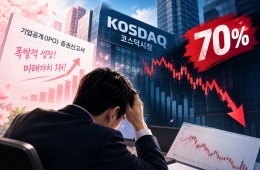
Last year, more than 70% of companies that listed on the KOSDAQ market based on overly optimistic projections of future earnings have seen their stock prices decline. Many of these companies even saw their share prices drop by more than half compared to their initial public offering (IPO) price, and a few faced trading suspensions just eight months after listing due to auditors issuing disclaimers of opinion, putting them at risk of delisting.
Of 35 KOSDAQ-listed companies that overestimated earnings last year, 71% saw stock prices fall
According to the financial investment industry on October 7, out of 35 KOSDAQ-listed companies whose IPO prices were set based on projected earnings but whose actual performance last year fell short, 25 companies, or 71.4%, recorded a drop in share price compared to their IPO price. All 25 were special listing companies whose IPOs were justified based on future value rather than past performance. A key commonality among companies whose shares declined significantly from their IPO price was the large gap between projected earnings offered at the time of listing and their actual results. Although these companies received high valuations during the IPO process due to optimistic future earnings outlooks, once actual results failed to meet expectations post-listing, this had a negative impact on their share prices.
Among the 25 companies, the one with the steepest stock price drop was IGNet, an insurance platform provider. IGNet’s IPO price was 7,000 won, but its current share price has dropped to the 1,600 won range, a decrease of 76%. Even on its first day of trading on February 4 last year, the closing price was 4,355 won, far below the IPO price. At the time of listing, IGNet projected 41.8 billion won in sales and 4.3 billion won in operating profit for last year, but actual results were only 39 billion won in sales and 3.3 billion won in operating profit.
![[Exclusive] "Bought at 7,000 Won, Now at 1,600 Won"...76% Stock Plunge Shatters Big Dreams [KOSDAQ Inflated Listings]②](http://www.asiae.co.kr/news/img_view.htm?img=2026100613292451634_1791260964.jpg)
Autocrypt, a physical artificial intelligence (AI) security specialist, also saw its shares drop 71% compared to its IPO price. At the time of listing, Autocrypt projected last year’s sales and operating loss at 33.8 billion won and 8.5 billion won respectively, but actual results were 25.5 billion won in sales and an operating loss of 16.5 billion won. Autocrypt’s IPO price was 20,000 won, and its share price soared to 30,850 won on the first day of trading, but has now plummeted to the 6,000 won range.
The company explained, “The reduction in sales was due to the postponement of some solution deliveries caused by delays in investment and development schedules at major client companies. In addition to the short-term sales slowdown due to delayed revenue recognition, profits also came in below plan as a result of proactive hiring for research and development and sales staff to prepare for technology advancement and new pipelines.” Besides this, many listed companies such as SimPlatform (69.1%), Quadmedicine (68.5%), and WiseNut (67.4%) are also experiencing severe declines in share price.
The most severe case was ITChem, a precision chemical materials company that listed on the KOSDAQ on August 7 last year. ITChem was listed under the Tesla (unprofitable company) special listing exception, but trading was suspended on April 3 this year, just eight months later. Woori Accounting Corporation, responsible for ITChem’s audit, issued a disclaimer of opinion, citing a lack of audit evidence and weaknesses in internal controls. Woori Accounting Corporation pointed out that due to insufficient operation of ITChem’s internal controls related to fund transactions and asset acquisition, it was unable to express an audit opinion.
![[Exclusive] "Bought at 7,000 Won, Now at 1,600 Won"...76% Stock Plunge Shatters Big Dreams [KOSDAQ Inflated Listings]②](http://www.asiae.co.kr/news/img_view.htm?img=2026100613354351648_1791261343.png)
In response, the KOSDAQ Market Division of the Korea Exchange suspended trading of ITChem shares, citing the occurrence of delisting grounds. After ITChem filed an objection, a grace period for improvement was granted until early April next year. At the time trading was suspended, ITChem's market capitalization was 268.4 billion won, and as of the end of last year, there were 16,032 minority shareholders—a situation in which many investors suddenly found their assets frozen overnight. At the time of listing, ITChem projected sales of 76.9 billion won and operating profit of 8.4 billion won for last year, but actual results were 62 billion won in sales and an operating loss of 1.9 billion won. This year, operating losses have increased further, with a deficit of about 4.49 billion won just in the first half.
The ITChem case demonstrates that the risk of investing in companies whose IPOs are based on future earnings projections does not end with a simple share price decline. When a company that had received a high valuation at listing later suffers poor results and even receives a disclaimer of audit opinion, the risk of extended trading suspension arises. If the trading suspension drags on, investors are effectively left without a means to dispose of their shares, leaving their capital tied up.
Hong Kong tech-special listing shows an average return of 34.5%
The weak share price performance of KOSDAQ special listing companies became even more pronounced in comparison with certain overseas markets. According to materials presented by Lee Hanbin, CEO of Seoul Robotics, at the “Why Can’t Domestic Venture Capital Be Patient?” seminar at the National Assembly on September 10, from 2024 to August this year, there were 91 KOSDAQ technology special listings, with an average post-listing return of -36.8%. In other words, a majority of early investors in these newly listed companies lost money. Conversely, during the same period, the Hong Kong tech-special listing (HKEX 18C) included 24 listings with an average post-listing return of +34.5%.
![[Exclusive] "Bought at 7,000 Won, Now at 1,600 Won"...76% Stock Plunge Shatters Big Dreams [KOSDAQ Inflated Listings]②](http://www.asiae.co.kr/news/img_view.htm?img=2026100613364051651_1791261399.jpg)
CEO Lee analyzed, “In our market, those who bear no risk are the ones evaluating future value, whereas in Hong Kong, it is the investors who have put up capital that validate value, and this is the key difference affecting post-listing returns.” He added, “In Hong Kong, those who set the price bear the risk, and review is left to the market and the passage of time. Also, in Hong Kong, the lock-up (mandatory holding) period for investors is 12 months, requiring them to hold onto shares, whereas KOSDAQ has no such requirement, causing stocks to fall on the first day of trading. If institutional investors were subject to about a 12-month lock-up period, share prices would not drop as much.”
With KOSDAQ’s structural problems persisting, financial regulators have also attempted system improvements, but with little visible effect so far. Following performance inflation controversies in 2023 involving Padu, the Korea Exchange adopted a measure to impose a put-back option (right to sell back shares) on underwriters when a technology special listing company becomes financially distressed within two years of listing and those underwriters subsequently sponsor further tech-special listings, but critics argue this measure lacks effectiveness. The Financial Services Commission is also pushing for a cornerstone investor system, in which some IPO shares are allocated in advance to institutional investors who promise to hold them for at least six months and for a pre-demand forecasting system to gauge institutional demand before the securities registration statement is filed, but there are disagreements regarding the detailed procedures.
Hot Picks Today
![[Exclusive] "Bought at 7,000 Won, Now at 1,600 Won"...76% Stock Plunge Shatters Big Dreams [KOSDAQ Inflated Listings]②](https://cwcontent.asiae.co.kr/asiaresize/93/2026100613292451634_1791260964.jpg) [Exclusive] "Bought at 7,000 Won, Now at 1,600 Won"...76% Stock Plunge Shatters Big Dreams [KOSDAQ Inflated Listings]②
[Exclusive] "Bought at 7,000 Won, Now at 1,600 Won"...76% Stock Plunge Shatters Big Dreams [KOSDAQ Inflated Listings]②
- "I Decided to Stop Ordering Delivery and Cook at Home, But Was Shocked by Grocery Prices"
- Is 'KOGUMA' Coming Too?... "Japan in Serious Trouble" - Archipelago on High Alert Ahead of Holidays
- "Buy Now and Get 17X Returns?"... Cathie Wood Makes Bold 1,665% Bitcoin Forecast by 2030
- "This Isn't Right, Someone Could Throw Out Their Back"... Triple-Layered Garbage Bags Tightly Bound with Tape
Efforts by the Exchange to accelerate the removal of poorly performing companies have also hit a snag. The 51st Civil Division of the Seoul Southern District Court on October 2 granted an injunction suspending delisting decisions against Jooyon Tech and KM Pharm, companies that had been notified of delisting from the Korea Exchange due to falling below minimum market capitalization requirements. The court held that the regulatory authorities’ decision to move forward the implementation of increased market capitalization standards—from 30 billion won for KOSPI and 20 billion won for KOSDAQ, planned for January next year, to July this year—violated the principles of proportionality and predictability.
© The Asia Business Daily. All rights reserved. Unauthorized AI training and use prohibited.