[2026 Audit] Minister Yoon Hojung: "Minimizing Local Fiscal Burden for Future Response Fund Projects"
Out of 15 Trillion Won in Local Account, 3.5 Trillion to Be Provided as General Resources
Considering Local Governments Taking the Lead in Policy Design
The Ministry of the Interior and Safety has announced a plan to reduce the financial burden on local governments stemming from the Future Response Fund. The Ministry intends to ease the requirement for local governments to match the fund’s support with their own budgets for related projects.
Yoon Hojung, Minister of the Interior and Safety, stated at the National Assembly’s Public Administration and Security Committee audit held on October 6, 2026, “We are also considering measures to allow local governments to take the lead in project decision-making and policy design.”

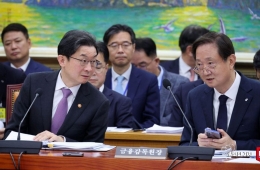
Yoon Hojung, Minister of the Interior and Safety, is taking the witness oath at the Public Administration and Security Committee's national audit held at the National Assembly on the 6th. Photo by Yonhap News
View original imageOn this day, Assemblywoman Park Jeong-hyun of the Democratic Party of Korea raised concerns that although local governments expected an increase in local allocation tax revenue due to higher tax collections, they may not receive as much as anticipated. Unlike allocation taxes, which are not earmarked for specific uses, Future Response Fund projects require matching funds from local governments, potentially reducing flexibility in local finances.
In response, Minister Yoon explained that of the 15 trillion won allocated to the Future Response Fund’s local account, 3.5 trillion won will be distributed as general resources, while the remainder will be spent as project funds from the fund itself. This approach is intended to minimize matching burdens on local governments.
Some have expressed concern that, amid strained local finances, resources meant to be distributed through the local allocation tax might be moved to the Future Response Fund, thereby increasing central government control. However, Minister Yoon responded, “The local allocation tax rate of 19.24% remains unchanged. We are aiming to secure a portion dedicated to strategic investments for future readiness. It is meaningful that local governments are participating alongside the central government’s efforts.”
Hot Picks Today
![[Exclusive] "Forecasts of Over 10 Billion, but Only 100 Million Earned"... 95% Followed This Pattern: Why Are KOSDAQ Special Exception IPOs Inflated? [KOSDAQ Inflated IPOs]①](https://cwcontent.asiae.co.kr/asiaresize/93/2026100609060151026_1791245160.jpg) [Exclusive] "Forecasts of Over 10 Billion, but Only 100 Million Earned"... 95% Followed This Pattern: Why Are KOSDAQ Special Exception IPOs Inflated? [KOSDAQ Inflated IPOs]①
[Exclusive] "Forecasts of Over 10 Billion, but Only 100 Million Earned"... 95% Followed This Pattern: Why Are KOSDAQ Special Exception IPOs Inflated? [KOSDAQ Inflated IPOs]①
- "Breakfast Now" Hits 1.41 Million Views... Burger King Expands Morning Menu Nationwide After 8x Sales Surge
- "My Debt Is 73 Million Won"... Sharing Every Repayment Led to an Unexpected Turn
- "Drinking This in the Morning Is Like Drinking Alcohol"..."Doctors Warn: Never Consume It"
- Is 'KOGUMA' Coming Too?... "Japan in Serious Trouble" - Archipelago on High Alert Ahead of Holidays
There was debate over the reasons why local governments are running budgets by issuing debt. Minister Yoon argued, “For the past three years under the Yoon Suk-yeol administration, the central government has shifted local fiscal shortfalls onto local governments.” Assemblyman Kwon Young-jin of the People Power Party countered, “Are you blaming the Yoon Suk-yeol administration again?”
© The Asia Business Daily. All rights reserved. Unauthorized AI training and use prohibited.