Government Injects Additional 6.8 Billion Won into Serious Crime Investigation Agency to Support Organizational Settlement
Contingency Reserve Plan Approved at Cabinet Meeting
Fourth Round of Support Since October 2 Launch
430 Million Won Allocated for Drone and Counter-Drone Strategy Task Force
Enforcement Decree on "Minimum Guarantee Scheme" for Rental Fraud
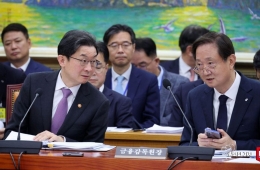
The government will inject an additional 683,683,000 won to support the operation of the Serious Crimes Investigation Agency, which was launched on October 2. This funding from the General Reserve Fund will cover operating expenses needed to help stabilize the agency’s organization and support its investigative work, following the abolition of the Prosecutors’ Office and the establishment of a new criminal justice system with the agency as a key pillar.

President Lee Jae-myung is entering the Cabinet meeting held at the Blue House on October 6, 2026. Photo by Yonhap News Agency
View original imageOn October 6, during the 43rd Cabinet meeting chaired by President Lee Jaemyung at the Blue House, the government deliberated and approved the “2026 General Account Reserve Fund Expenditure Plan,” which includes these measures.
This additional funding aims to support the operating expenses of the Serious Crimes Investigation Agency, which opened its doors on October 2 in line with the revised Government Organization Act and the enactment of the Act on the Organization and Operation of the Serious Crimes Investigation Agency. The agency’s budget of 683,683,000 won will be drawn from the General Reserve Fund for this year. This is the fourth round of reserve fund support related to the agency’s launch.
The Serious Crimes Investigation Agency was established under the Ministry of the Interior and Safety, taking over major serious crime investigation functions previously handled by the Prosecutors’ Office. In August, the government adopted the enforcement decree and organizational structure for the agency, as well as regulations for the appointment of investigators, thereby laying the foundation for its organization and personnel system.
The government will also use the reserve fund to support the establishment and operation costs of the National Drone and Counter-Drone Strategy Task Force. Following the enactment of relevant regulations in August, the government will allocate 425 million won from the General Reserve Fund for the newly established task force. This measure aims to systematically bolster the country’s drone capabilities and enhance counter-drone measures against hostile threats at the government-wide level.
An enforcement decree to strengthen the support system for victims of jeonse rental fraud has also been established. Under the revised Jeonse Fraud Victims Support Act, if the amount a victim recovers through rights of opposition or priority repayment is less than a third (“minimum guarantee amount”) of the original rental security deposit, the government will cover the shortfall. The decree sets out detailed standards for calculation and payment under this minimum guarantee system.
The decree also specifies the calculation of minimum support payments and advance disbursement amounts for victims, as well as post-payment settlement methods. In addition, it clarifies the criteria under which local authorities can provide administrative and financial support if a cooperative founded by fraud victims or certain qualifying real estate investment companies purchase and lease affected properties. The enforcement decree will take effect from November 13.
The government will also significantly increase reward payments to encourage whistleblowing on fraudulent claims for wage claims advances. The amendment to the Enforcement Decree of the Wage Claims Guarantee Act, which raises the reward ceiling for those who report or accuse false or fraudulent claims from 100 million won to 200 million won, has been approved.
A “separate transfer” system will also be introduced to reduce inconvenience in the use of seizure-protected living expense accounts. If deposit amounts exceed the legally protected limit of such accounts, funds up to the limit will remain in the protected account while any excess is automatically transferred to the account holder’s designated account. This measure is intended to minimize the need for account holders to manually check their balances for each deposit.
The Cabinet has passed an amendment to the Act on the Fairness of Trading in Large-Scale Distribution Business, which reduces by half the payment deadlines for large retailers to pay suppliers. For special purchase and consignment transactions, the maximum payment period will be cut from 40 days to 20 days after the end of the monthly sales period. For direct purchase transactions, the deadline will be shortened from 60 days to 35 days after receipt of goods.
Hot Picks Today
![[Exclusive] "Forecasts of Over 10 Billion, but Only 100 Million Earned"... 95% Followed This Pattern: Why Are KOSDAQ Special Exception IPOs Inflated? [KOSDAQ Inflated IPOs]①](https://cwcontent.asiae.co.kr/asiaresize/93/2026100609060151026_1791245160.jpg) [Exclusive] "Forecasts of Over 10 Billion, but Only 100 Million Earned"... 95% Followed This Pattern: Why Are KOSDAQ Special Exception IPOs Inflated? [KOSDAQ Inflated IPOs]①
[Exclusive] "Forecasts of Over 10 Billion, but Only 100 Million Earned"... 95% Followed This Pattern: Why Are KOSDAQ Special Exception IPOs Inflated? [KOSDAQ Inflated IPOs]①
- "If Only I Could Escape With a $40,000 Loss"... Japanese Retail Investors Cry Out, What's Happening?
- "My Debt Is 73 Million Won"... Sharing Every Repayment Led to an Unexpected Turn
- "Drinking This in the Morning Is Like Drinking Alcohol"..."Doctors Warn: Never Consume It"
- Is 'KOGUMA' Coming Too?... "Japan in Serious Trouble" - Archipelago on High Alert Ahead of Holidays
Additionally, to broaden cultural access for youth, the government removed the regulation that prohibited karaoke room operators from allowing youth to enter rooms other than those designated for them. The government also processed an enforcement decree amendment that enables the selection of additional successful candidates to fill vacancies resulting from deferred appointments after the final selection in open competitive government recruitment exams.
© The Asia Business Daily. All rights reserved. Unauthorized AI training and use prohibited.