Construction Guarantee Federation's Non-Performing Loans Double... Allowance Ratio Hits 10-Year Low
151.1 Billion Won Recovered in Three Years,
Yet 345.2 Billion Won Written Off
Heo Young: "Worsening Financial Health in Construction Sector Requires Preemptive Action"
The financial solidity indicators of the Construction Guarantee Federation, which is supposed to serve as a ‘safety net’ for the construction industry, have been deteriorating. While the total amount of loans extended into the market has been reduced, the volume of non-performing or high-risk loans at risk of default has actually increased. The allowance coverage ratio—the proportion of reserves set aside to prepare for bad debts—has fallen to its lowest level in 10 years.

Construction Hall in Gangnam-gu, Seoul, where the Korea Construction Guarantee Insurance Corporation is located. Korea Construction Guarantee Insurance Corporation
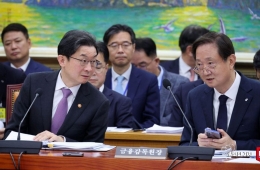
View original imageAccording to data obtained from the Ministry of Land, Infrastructure and Transport by Assemblyman Heo Young of the National Assembly's Land, Infrastructure and Transport Committee on October 6, the outstanding loan balance of the Construction Guarantee Federation as of the end of June this year stood at 2.4084 trillion won. This represents a 14.9% decrease from 2.8301 trillion won at the end of 2022.
During the same period, loans classified as ‘substandard or below’—for which recovery is uncertain—nearly doubled, going from 138.1 billion won to 263 billion won. The proportion of substandard or below assets relative to total loans more than doubled, rising from 4.88% at the end of 2022 to 10.92% by the end of June this year.
The organization’s ability to absorb losses has also weakened. Among assets subject to soundness classification, those rated substandard or below increased by 87.8%, from 421.3 billion won in 2022 to 791.2 billion won in the first half of 2026. Meanwhile, loan loss coverage—the ratio of allowances to non-performing assets—declined from 76.56% to 67.42% over the same period, marking the lowest level in the past decade. Although the absolute amount of provisions increased from 322.5 billion won to 533.4 billion won, it is failing to keep pace with the growth of problematic loan assets.

Status of Allowance for Doubtful Accounts of Construction Guarantee Association at the End of Each Year. Ministry of Land, Infrastructure and Transport·Office of Representative Hur Young
View original imageThere has also been a rise in guarantee accidents, where the federation has to pay off debts in place of construction companies that have abandoned their projects. The amount of such guarantee accidents was 136 billion won in 2021, but soared to 926.7 billion won last year and even reached as high as 969.9 billion won in 2024. Subrogation payments—the sums the federation actually paid out on behalf of its members—likewise surged from 84.4 billion won to 250.4 billion won over the same period.
Significant funds have been paid out, but recoveries remain sluggish. Over the past three years, the amount written off by the federation as accounting losses reached 345.2 billion won. In contrast, only 151.1 billion won was actually recovered. This means less than half of the bad debts were recouped, with the remainder wiped off the books.
The original purpose of establishing the Construction Guarantee Federation was to support members’ business activities through financing and guarantees, thereby preventing a chain of bankruptcies. Amid a downturn marked by a series of construction company failures, the federation’s role as a safeguard has grown, yet its financial soundness indicators are the first to show signs of strain.
Hot Picks Today
![[Exclusive] "Forecasts of Over 10 Billion, but Only 100 Million Earned"... 95% Followed This Pattern: Why Are KOSDAQ Special Exception IPOs Inflated? [KOSDAQ Inflated IPOs]①](https://cwcontent.asiae.co.kr/asiaresize/93/2026100609060151026_1791245160.jpg) [Exclusive] "Forecasts of Over 10 Billion, but Only 100 Million Earned"... 95% Followed This Pattern: Why Are KOSDAQ Special Exception IPOs Inflated? [KOSDAQ Inflated IPOs]①
[Exclusive] "Forecasts of Over 10 Billion, but Only 100 Million Earned"... 95% Followed This Pattern: Why Are KOSDAQ Special Exception IPOs Inflated? [KOSDAQ Inflated IPOs]①
- "Pension Day Equals Gambling Day"... Urban Game Centers Filled with Elderly Patrons
- "My Debt Is 73 Million Won"... Sharing Every Repayment Led to an Unexpected Turn
- "Drinking This in the Morning Is Like Drinking Alcohol"..."Doctors Warn: Never Consume It"
- "This Is How You Give a Winner’s Interview": Choi Siwon Recalls Son Heungmin... Lee Kangin’s Remarks Spotlighted Again
Assemblyman Heo Young stated, “The deterioration in the financial status of our member construction companies is now leading to increased loan defaults and guarantee accidents. Both the government and the federation must proactively detect on-site risk signals early and act in advance to ensure the situation does not worsen.”
© The Asia Business Daily. All rights reserved. Unauthorized AI training and use prohibited.