"Your Job Could Disappear Too"... A Chilling Shift as Robot Motion-Training Gigs Surge [Tech Talk]
Workers perform movements in motion-capture gear... and robots learn
Large numbers of gig workers recruited for India's "hands farms" and similar facilities
Demand similar to that for the data labeling that trained chatbots
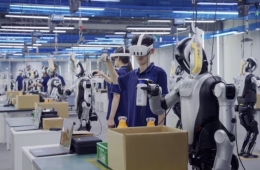
Humanoid robots stand in long rows inside a vast factory. Beside them, a person wearing specialized equipment performs all kinds of movements. The facility is a robot training center in Beijing, China. When a person wearing motion-capture equipment performs tasks such as picking up objects, packing boxes and folding fabric, the robots learn from those movements.

Humanoid training facility in Beijing, China. Beijing Municipal Government website.
View original imageAs humanoids move beyond the research stage and approach mass production and commercialization, demand for robot motion-training data is surging. In China, India and elsewhere, large numbers of people are being recruited for motion-capture jobs and sometimes train together inside factories. This is similar to how artificial intelligence (AI) chatbots such as ChatGPT once learned from text and images.
How Neural Network AI Has Changed Robot Posture Control
Robot control used to require a great deal of hands-on work. To create a humanoid that resembles a person, engineers must precisely adjust the actuators attached to its many joints. In the past, engineers wrote code themselves to reproduce every movement. But as AI-based robot control technology has advanced, a new training method has gained popularity: robots learn from human movements and become better at controlling their own bodies.

A person performs various movements while wearing motion-capture equipment on their head. In India, there are "son nongjang" operations where people do this kind of work. AFP Yonhap News
View original imageTraining AI, however, requires high-quality data on human movements. That's why people wearing motion-capture equipment are needed. The equipment converts human movements into coordinate data and sends it to research labs, where the data is used to train robots and develop more sophisticated motion-control technology.
Motion-capture jobs have already become publicly funded projects backed by local governments in China. India has robot-training facilities known as "son nongjang" ("hands farms"). These workplaces provide ordinary people with motion-capture equipment and collect data on routine movements such as peeling fruit and doing housework. More recently, job postings seeking motion-capture workers have become easy to find on Korean recruitment websites as well. Most are posted by robotics research labs.
ChatGPT Also Grew on Human Data
The surge in demand for "human data" is also a sign that full-scale commercialization of humanoids may be near. Similar gig work was around the time ChatGPT, which ushered in the AI chatbot era, was first released in 2022.
At the height of the COVID-19 pandemic, data-labeling side jobs briefly became popular online. Data labeling involves adding highlights or markings to text and images to help AI recognize them. The labeled data becomes part of the "dataset" used to pretrain large language models (LLMs).

Data labeling, once a popular side gig, involves drawing boxes around specific objects to improve AI recognition. Testworks website.
View original imageAI models that led the early chatbot race, including ChatGPT and Gemini, improved their performance through data-labeling work by tens of millions of people. Data labeling itself also grew into a massive industry. Alexander Wang, who now leads AI development at U.S. tech giant Meta, once founded the data-labeling platform Scale AI and built it into a major company valued at $14 billion.
Will Humanoids Eventually Surpass Humans?
Data labeling, however, is no longer the major industry it once was. That's because most labeling work has been automated with AI. In 2022, chatbots had poor recognition abilities: they couldn't even distinguish a dog from a puppy and confused traffic lights with the sun. But advances in pretraining have given them recognition capabilities that are now even more sophisticated than humans'. Today, AI performs basic data labeling itself, faster than humans can.

Boston Dynamics' Atlas is learning automotive manufacturing tasks at the Robotics Metaplant Application Center (RMAC). Boston Dynamics.
View original imageGiven the rapid advances in LLMs, the current boom in jobs training humanoids through motion capture is likely to fade within two to three years. Most humanoids are still slow and clumsy, and even simple movements require considerable computing resources. But robots learning from human movement data will be able to perform movements more fluidly than humans within a few years. Eventually, they may not even need to observe human movements: they will generate synthetic data themselves and continue training on their own.
Hot Picks Today
 "Our Buldak Doesn't Taste Like That"... '11 Trillion Won in Counterfeits' That'll Leave Us Fuming
- Condoms Out of Stock... "Please Stop Having Kids": Country to Deliver Contraceptive Pills Door to Door
- Ceiling Collapses at Daegu Supermarket... Fire Authorities: "Rescue Operations Underway"
- "Busan Is in Big Trouble"... 'This Insect,' Capable of Producing 350 Nymphs From One Female, Confirmed to Have Established Itself
- "Should I Raid Mom's Bathroom First?"... Millennials & Gen Z Go Wild for This 10,000-Won Bath Essential
Some companies have already started deploying robots in the workplace. U.S. humanoid developer Figure began pilot deployments of its robots at a BMW logistics plant in June 2026. Meanwhile, Boston Dynamics, a Hyundai Motor Group affiliate, announced on September 22, 2026, that it had deployed Atlas at Hyundai Motor's factory in Georgia, United States. Atlas is expected to serve as an "apprentice," watching local workers assemble vehicles and training in real time.
© The Asia Business Daily. All rights reserved. Unauthorized AI training and use prohibited.