Governance Forum Criticizes Chairman Chey Tae-won’s SK Stake Sale as Move to Evade '3% Rule'
Korea Corporate Governance Forum Statement
"Suspicion of Intent to Avoid Block Deal... Doubts Raised Over Circumventing the 3% Rule"

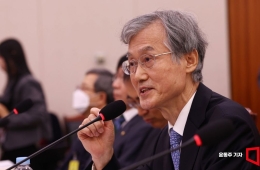
Choi Tae-won, Chairman of the Korea Chamber of Commerce and Industry, is delivering the opening address at the 15th Korea-Japan Chamber of Commerce Chairpersons' Meeting held on August 31 at the Westin Sendai Hotel in Japan. Photo by Yonhap News
View original imageThe Korea Corporate Governance Forum has raised suspicions regarding the stake sale by Chey Tae-won, Chairman of SK Group. The forum claims that the transaction was intended to circumvent the Korean Commercial Act provision that limits the voting rights of the largest shareholder and related parties to 3% when appointing audit committee members at next year’s shareholders’ meeting.
On the 6th, the Korea Corporate Governance Forum issued a statement regarding these concerns. Previously, on the 2nd, SK Inc., the holding company of SK Group, and Korea Investment Holdings announced their plan to sell a total of 1,653,924 common shares of SK Inc. owned by Chairman Chey for KRW 943,999,940,000. Of this total, KRW 544 billion is to be sold to a strategic investor (SI), with the remaining KRW 400 billion to be handled through a price return swap (PRS) transaction with Korea Investment & Securities. The entire transaction amount of KRW 944 billion is equivalent to the asset division that the court ordered to be paid to So Young Noh, Director of Art Center Nabi. The sale is scheduled to take place between November 2 and December 1, one month after the public disclosure.
The identity of the strategic investor has not yet been specified. SK Inc. explained that the investor was selected because the company considered business competitiveness and potential for mid- to long-term growth in its decision to allow Chairman Chey to sell part of his stake.
The forum first raised questions at this point, noting that, instead of pursuing a block deal (off-hours large-scale transaction), the deal was structured so that only a strategic investor and a particular securities firm would be counterparties. Lee Namwoo, President of the Governance Forum, argued, "Given the undervaluation of SK Inc.’s stock price, demand prediction among institutions and foreign investors would have been very positive. This stands in contrast to the way POSCO Group’s stake in Woori Financial Holdings and the founding family’s affiliate stake sales at the Samsung Group were both handled via block deals."
The forum also pointed out that the acquirer of the SK Inc. stake in this transaction could, in effect, be a related party. It argued that both the strategic investor and Korea Investment & Securities are considered friendly investors to Chairman Chey, and that if there is even an implicit agreement to exercise voting rights in the same manner, the parties should have been disclosed as joint holders.
Under a PRS, all legal rights to the shares—voting, dividends, and disposal—are transferred to the buyer, and only the profit or loss from stock price changes is settled later. A strategic investor, by definition, is a party whose interests are aligned with the seller, implying an agreement to exercise voting rights jointly.
President Lee said, "According to the Financial Services Commission’s legal interpretation, even a verbal agreement without a written contract qualifies as joint holding, and failure to disclose such joint holders would be a violation of the Capital Markets Act. The hidden intention of this transaction is to ensure stability of control," he criticized.
The stake being sold amounts to 2.3% of the total outstanding shares, but excluding treasury shares without voting rights, the effective voting-rights stake rises to 3.0%. Thanks to the revision of the Korean Commercial Act, all large listed companies with assets of over KRW 2 trillion, as well as listed companies with audit committees, will be subject to the strict "3% rule" at next year’s shareholder meetings from March onward. The voting rights of the largest shareholder and related parties will be capped at 3% for the appointment of audit committee members, after summing all their shares.
The forum further criticized the issue of overlapping listings among SK Group companies. It argued that the overlapping listing structure, running through SK Inc., SK Square, and SK hynix, should be resolved, and called for a halt to the planned NASDAQ listing of Solidigm, SK hynix's grandchild company, which would constitute a fifth-level overlapping listing.
Hot Picks Today
 "Koreans Spend 1 Million Won Each and Come Back"... 'They Said They Were Going for Value for Money,' but Open Their Wallets Wide in Japan
- "You Mean Only Middle-Aged Men Got to Enjoy This?"... Where Japanese Women in Their 20s and 30s Are Flocking
- Anthropic Revenue Surges 14-Fold... "AI Demand Concerns Ease" [Click eStock]
- "Naked Again?" Controversial Actress Crosses a Line... Slammed for Sexualizing 'Child Characters'
- "They Get a Good Night's Sleep and Earn Twice My Salary... Honestly, I'm So Jealous I Could Die": Civil Servant's Post Targeting Firefighters Sparks Outrage
President Lee added, "The market sees the unprecedented and distorted dual holding company structure and Chairman Chey’s relatively low effective stake compared to overseas competitors as reasons for poor shareholder returns and repeated attempts at overlapping listings. Unnecessary subsidiary structures should be eliminated, and it must be disclosed whether there are SK Group-related parties among founding shareholders or investors of the asset management company run by No Jong-won, a former CEO of SK hynix," he said.
© The Asia Business Daily. All rights reserved. Unauthorized AI training and use prohibited.