[2026 Audit] National Assembly Audit Opens... Ruling Party to "Check Implementation of Livelihood Policies," Opposition to "Question Lee Jaemyung's Governance"
Eight Key Committees, Including Judiciary and Political Affairs, Begin Session
Main Battlegrounds: Judiciary, National Defense Committees
As the 2026 National Assembly audit officially began on October 6, the ruling party announced plans to check whether livelihood-focused policies are being implemented in practice, while the opposition party signaled it would broadly hold the government to account on issues ranging from economic policy and prosecution reform to key national defense matters.
This year’s audit will run for 25 days, from this day until the 30th. Of the 17 standing committees, 16 that have finalized their audit plans will scrutinize a total of 846 institutions.
On the first day, eight key standing committees—including the Legislation and Judiciary Committee and the Political Affairs Committee—will kick off their inspections.

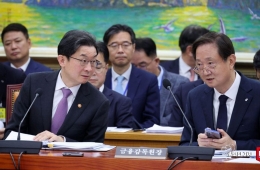
Chief Justice Cho Hee-dae sits refusing to take the witness oath at the Supreme Court audit held at the National Assembly on the 6th. 2026.10.06 Photo by Dongju Yoon
View original imageOn the morning of October 6, the Democratic Party of Korea held an inauguration ceremony for the National Assembly Audit Situation Room, signaling the full-scale launch of its audit response system. Floor leader Byungdo Han stated, "For this year’s audit, the Democratic Party's focus is, first, second, and third, all about people’s livelihoods," and added, "We will ensure that the audit focuses on policies that take a closer look at the lives of the public."
The People Power Party had already launched its own audit situation room on October 2, moving swiftly to establish its response system. On October 3, it also held a rally near Sungnyemun, Seoul, criticizing the abolition of the prosecution service as well as real estate and livelihood issues, thereby setting the stage for a pre-audit public campaign.
The Legislation and Judiciary Committee is expected to be the main battleground during this year’s audit. The ruling and opposition parties are set for a direct clash over Supreme Court Chief Justice Cho Hee-dae’s refusal to re-nominate a Supreme Court justice and over prosecution reform. Chief Justice Cho submitted a written reason for refusing to attend as a general witness, but appeared at the audit in his capacity as Supreme Court head. The committee is also expected to debate issues regarding the Public Prosecution Service and the Serious Crimes Investigation Agency—which were established after the abolition of the prosecution service—as well as concerns about the protection of crime victims following the elimination of supplementary investigation powers.

Byungdo Han, floor leader of the Democratic Party of Korea, is giving opening remarks at the National Assembly's policy meeting for the audit on the 6th. 2026.10.06 Photo by Dongju Yoon
View original imageThe National Defense Committee is also a major area of focus during this year’s audit. Since a landmine explosion in the Demilitarized Zone (DMZ), controversy has centered on the military’s response in the context of the current government’s North Korea policy. Other contentious issues are expected to include the transfer of wartime operational control, restructuring of the armed forces, and the integration of military academies. Additionally, after the close of the Asian Games, the review of the military service exemption system has surfaced as a major issue. North Korea policy is likely to become a hot topic within the Foreign Affairs and Unification Committee as well.
The issue of hacking attacks—believed to involve artificial intelligence (AI)—that resulted in leaks of personal credit information is expected to be raised during the Political Affairs Committee’s audit, among others. Initially, leverage exchange-traded funds (ETFs) had seemed poised to be the main subject of interest for the committee, but in light of the significant security incidents, this matter is now expected to take center stage.

Jeong Jeomsik, Floor Leader of the People Power Party, is delivering a speech at the National Assembly Inspection Strategy Meeting held at the National Assembly on the 6th. 2026.10.06 Photo by Yoon Dongju
View original imageFor the Public Administration and Security Committee, the stabilization of the newly established Serious Crimes Investigation Agency will be a point of contention. Issues range from organizing the government’s follow-up response after the abolition of the prosecution service to the separate personnel hearing schedule for the agency’s chief.
Handling of excess tax revenue, including proposals to establish a future response fund, is also expected to ignite debate across several standing committees this year. Topics will also include the allocation of local allocation tax and local education financial grants earmarked for local governments.
Hot Picks Today
![[Exclusive] "Forecasts of Over 10 Billion, but Only 100 Million Earned"... 95% Followed This Pattern: Why Are KOSDAQ Special Exception IPOs Inflated? [KOSDAQ Inflated IPOs]①](https://cwcontent.asiae.co.kr/asiaresize/93/2026100609060151026_1791245160.jpg) [Exclusive] "Forecasts of Over 10 Billion, but Only 100 Million Earned"... 95% Followed This Pattern: Why Are KOSDAQ Special Exception IPOs Inflated? [KOSDAQ Inflated IPOs]①
[Exclusive] "Forecasts of Over 10 Billion, but Only 100 Million Earned"... 95% Followed This Pattern: Why Are KOSDAQ Special Exception IPOs Inflated? [KOSDAQ Inflated IPOs]①
- "If Only I Could Escape With a $40,000 Loss"... Japanese Retail Investors Cry Out, What's Happening?
- Im Eunjeong: "Immediate Normal Operation of the High-Ranking Crime Investigation Division Impossible... Normalization in One or Two Months Also Unlikely"
- "Drinking This in the Morning Is Like Drinking Alcohol"..."Doctors Warn: Never Consume It"
- Is 'KOGUMA' Coming Too?... "Japan in Serious Trouble" - Archipelago on High Alert Ahead of Holidays
Negotiations related to U.S. investment are another area of attention. Amid remarks by U.S. President Donald Trump treating South Korea’s participation in the Alaska liquefied natural gas (LNG) project as a given, the content of bilateral investment agreements and the commercial viability of each specific project are expected to face close scrutiny.
© The Asia Business Daily. All rights reserved. Unauthorized AI training and use prohibited.