Oil Prices Drop as Middle Eastern Exports Recover...Trump Says "Refining Facilities Are the Problem"
Middle Eastern Shipping Recovery & G7 Stockpile Release Drive Brent Price Lower
Transport Costs and Vessel Attack Risks Remain
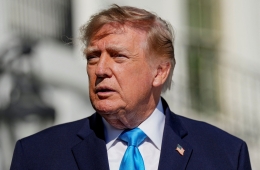
U.S. President Donald Trump argued on the 5th (local time) that the recent surge in gasoline prices is no longer due to the Strait of Hormuz, but rather a shortage of refining facilities. On the same day, international oil prices dropped due to the recovery of oil exports from the Middle East and the release of stockpiled oil by the Group of Seven (G7) nations.

President Trump stated on the social networking service Truth Social that "It is no longer the Strait of Hormuz that is pushing up gasoline prices," explaining, "That's because a record amount of oil is now coming from that region almost every day."
He continued, "The issue is refining capacity," and added, "Russian refineries are being blown up by Ukraine, and our refineries are being shut down by foolish Democrats in Democrat-dominated states like California."
President Trump, facing political pressure from rising gasoline and diesel prices ahead of the upcoming midterm elections, has continued to assign responsibility for higher energy prices to the war in Ukraine and the energy policies of Democrat-led state governments.
On the 15th of last month, he argued that the rise in global diesel prices was more due to the Russia-Ukraine war than Iran. On the 21st, he urged an end to the war, claiming Russia had lost control over the diesel industry as a result of the conflict with Ukraine. He also called on European countries such as France and Germany to release their stockpiled diesel. Subsequently, on the 2nd of this month, the Group of Seven (G7) agreed to release 100 million barrels of diesel and crude oil from their reserves.
Middle East Oil Supply Recovery & G7 Reserve Release... Oil Prices Down
International oil prices fell on this day. On the ICE Futures Exchange, December Brent crude closed at $100.32 per barrel, down 1.9% from the previous session. On the New York Mercantile Exchange, November West Texas Intermediate (WTI) crude settled at $89.43 per barrel, a decrease of 1.8% from the previous day. The recovery of Middle Eastern crude oil supply and the G7’s release of stockpiled oil have eased short-term supply uncertainties.
According to shipping data, for four out of the last seven days of September, crude oil exports from the Middle East exceeded pre-war levels.
Tim Waterer, Chief Market Analyst at KCM Trade, said, "The G7’s decision to release strategic reserves is easing short-term supply worries," adding, "There is also a growing perception that Saudi Arabia’s oil exports are returning to pre-war levels."
However, he pointed out, "Oil is still being transported via higher-cost and less efficient routes," and noted, "The risk of further damage to the Gulf region's energy infrastructure has not disappeared."
Hormuz Oil Shipments and Risks Remain
In reality, oil shipments through the Strait of Hormuz have not fully normalized.
According to the Wall Street Journal (WSJ), oil-producing countries in the Gulf such as Saudi Arabia continue to export oil using a 'shuttle operation' method, in which very large crude carriers (VLCCs) are sent inside the Strait of Hormuz to load oil at port, then transfer the oil to other vessels waiting outside the strait. This practice emerged after the Iran war, as Asian oil buyers became reluctant to send their own ships inside the Gulf.
Such transport reportedly costs $30 million to $40 million per trip, not including insurance premiums, incurring an additional cost of $15 to $20 per barrel.
The daily charter rate for VLCCs traveling from the Gulf to China shot up from $231,400 just before the war to over $1.2 million by the end of September. The risk of attacks on ships also persists. In the past two weeks, nine merchant ships near the Strait of Hormuz have been attacked, resulting in one crew member killed and two wounded.
Tensions in the Middle East also continue. On this day, Yemen's Houthi rebels claimed to have fired ballistic missiles and drones at Saudi Aramco facilities in Riyadh and the Kurais area in Saudi Arabia. The Saudi side did not confirm this.
Hot Picks Today
!["Didn't Want to Buy a Home"... Seoul Apartment Buyers Flocked to Mid- to Low-Priced Segment After Tax Reform Plan [Real Estate AtoZ]](https://cwcontent.asiae.co.kr/asiaresize/93/2026100516014950577_1791183709.jpg) "Didn't Want to Buy a Home"... Seoul Apartment Buyers Flocked to Mid- to Low-Priced Segment After Tax Reform Plan [Real Estate AtoZ]
"Didn't Want to Buy a Home"... Seoul Apartment Buyers Flocked to Mid- to Low-Priced Segment After Tax Reform Plan [Real Estate AtoZ]
- Flight Attendant Kneeled to Apologize... China Eastern Airlines Bans Passenger Who Continued to Complain
- An Apartment Once Worth 400 Million Won Nears 1 Billion... "Still Worth It" as 1990s-Born Pangyo Workers Flock to Gyeonggi Gwangju [Report]
- "Huge Sum in Pension Account He Never Knew About... What Happened to Chinese Man in His 70s Who Collected Scrap for 21 Years?"
- Musk's Partner Reveals Sudden Breakup Just a Week After Saying "I Love You"
In Europe, concerns remain over supplies of petroleum products as Ukraine has announced plans to step up attacks on Russian refining facilities.
© The Asia Business Daily. All rights reserved. Unauthorized AI training and use prohibited.