Blue House and Korea Innovation Party Spar Over 'Supplementary Investigation Rights'... Fact-Checking Cho Kuk's Actual Remarks
Lee: "Korea Innovation Party Called for Supplementary Investigation Rights"
Innovation Party Directly Rebuts: "We Asked Only for the Right to Request Supplementary Investigations"
Blue House Responds Again: "Cho Kuk Acknowledged the Need for
The Blue House and the Innovative Korea Party engaged in a dispute over the truth regarding past remarks made by former party leader Cho Kuk. When President Lee Jae-myung asserted that “the Innovative Korea Party initially called for supplementary investigative authority but then changed its stance to revocation,” the party countered, stating that “what was called for was only the right to request supplemental investigations.” In response, the Blue House issued a press release in the name of the presidential spokesperson late on October 5, further rebutting the party’s claim.
On the same day, President Lee wrote on X (formerly Twitter), “Not only the Innovative Korea Party, but most proponents of prosecutorial reform argued that the Ministry of Justice should have a Major Crimes Investigation Agency in charge of investigations, and a separate Prosecution Service responsible for indictments. Their argument included granting supplementary investigative powers to the Prosecution Service.” He went on to say, “The argument to revoke supplementary investigative authority, which signifies their changed stance, has also been implemented.”

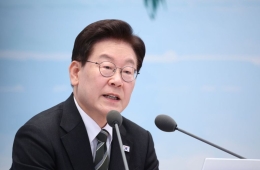
President Lee Jae-myung is speaking at the Senior Presidential Secretary Meeting held at the Blue House on October 1, 2026. Photo by Yonhap News Agency
View original imagePresident Lee’s statements are seen as targeting hardline pro-government factions who have criticized the administration’s prosecutorial reform efforts as insufficient. He claims that, historically, most prosecutorial reformists—including the Innovative Korea Party—accepted supplementary investigative powers, and the current administration has gone even further than the reforms they themselves proposed.
In turn, the Innovative Korea Party immediately responded through Chief Spokesperson Park Byung-eon, directly refuting President Lee’s comments. Park explained, “What our party advocated for was the right to request supplemental investigations, not supplemental investigative authority itself.” He added, “We only considered exceptions in judicial emergencies, such as when the statute of limitations is about to expire or when the police repeatedly reject a prosecutor’s request for a supplemental investigation, and even then, only in cases strictly enumerated by law.”
The Blue House spokesperson responded once again, releasing a statement to the media, stating, “Former party leader Cho Kuk clarified his position during an appearance on ‘Jang Yoon-sun's Reporting Convenience Store’ on August 29, 2025, saying that supplementary investigations should only be recognized under certain conditions.”
So, what did former leader Cho Kuk actually say?
(Source: YouTube 'Jang Yoon-sun's Reporting Convenience Store,' August 29, 2025)
As the Blue House pointed out, former leader Cho Kuk did say that "supplementary investigations should only be recognized under restricted conditions." The issue is that he did not clearly distinguish between 'supplementary investigative authority' and 'the right to request supplemental investigation.' The Innovative Korea Party claimed on this day that "the two powers are entirely different concepts," but former leader Cho Kuk used both terms interchangeably, referring to “the right to request supplemental investigation or supplementary investigative authority.” In fact, after expressing his support for recognizing supplementary investigations, he stated, “the scope of the right to request supplemental investigations is straightforward ...”
Ultimately, the Blue House and the Innovative Korea Party have issued different interpretations regarding whether the term used by former leader Cho Kuk signified ‘supplementary investigative authority’ or ‘the right to request supplemental investigation.’
The Blue House explained, “The Innovative Korea Party itself has stated that it has altered the substantive details of its prosecutorial reform proposals in response to actual realities and evolving circumstances. Their stance on supplementary investigative authority is now different from what it was on August 29, 2025, and while the party previously demanded that the Major Crimes Investigation Agency (Jungsucheong) be under the Ministry of Justice, it later switched its policy line to place it under the Ministry of the Interior and Safety. In this way, the detailed design of prosecutorial reform has been adjusted according to the course of debate and changes in circumstances.”
Furthermore, the Blue House added, “President Lee’s X posting made clear that the core purpose and direction of prosecutorial reform was to bring about irreversible transformation of prosecutorial organization, that this has been achieved, and that this principle has remained unchanged since his presidential campaign pledge. The Innovative Korea Party itself has repeatedly changed its position on details such as supplementary investigative authority, further demonstrating that the Lee Jae-myung administration aimed for a prosecutorial reform even more advanced than what was originally discussed.”
Hot Picks Today
 "Didn't Save This Money to Leave to Our Kids?"... Retired Couples Spend $10,000 on a Single Trip
- "I Thought It Was Middle-Aged Men's Hiking Wear"... 20- and 30-Somethings Open Their Wallets for "This Padded Jacket"
- Friend Who Went Abroad Goes "Silent"... 617 South Koreans Out of Contact, What's Going On?
- "She Turned Her Life Around by Dancing in a Parking Lot..." An Absurd Tax Dodge Brought a "1.2 Billion Won Shock"
- "Stockpile 9 Liters of Bottled Water and Three Days' Worth of Food"... UK on Edge as Nationwide Emergency Preparedness Alert Issued
The statement concluded, “Rather than clinging to minor differences in the process of prosecutorial reform, we request your cooperation in ensuring that the now irreversible prosecutorial reform process is completed at a high level of quality so it can address even the most detailed aspects of people’s lives and livelihoods.”
© The Asia Business Daily. All rights reserved. Unauthorized AI training and use prohibited.