SK hynix Icheon Effluent Raises Chloride and Sulfate Ions in River Above FAO Guidelines... Gyeonggi Province Calls for Management Standards
A recent investigation found that the concentrations of chloride ions and sulfate ions in the river receiving discharged water from SK hynix’s Icheon facility exceed the guidelines recommended by the Food and Agriculture Organization (FAO) of the United Nations. As there are currently no domestic standards for rivers or agricultural water in Korea, Gyeonggi Province has urged the government to establish management criteria and called on semiconductor companies to strengthen their discharge water management.
The Gyeonggi Provincial Institute of Health and Environment announced the results on October 5, stating that it had examined the water quality of Jukdang Stream, which receives discharged water from SK hynix Icheon employing similar processes to the upcoming Yongin semiconductor cluster, in order to predict the impact of effluent on Gosam Reservoir.
The investigation revealed that all nine water quality parameters measured in Jukdang Stream were below current domestic river water quality standards, indicating no major issues overall. However, the concentrations of chloride and sulfate ions were higher compared to nearby Bokha Stream, which is not affected by the effluent. Currently, there are no defined domestic standards for these two substances in river water.
According to three rounds of sampling conducted in Jukdang Stream on August 26 and September 2-3, the average concentration of chloride ions was 731 mg/L and sulfate ions 1,561 mg/L at a point 0.4 kilometers downstream from the SK hynix discharge outlet.
At a location 1.9 kilometers downstream, chloride ions measured 639 mg/L and sulfate ions measured 1,338 mg/L. At 7.4 kilometers downstream, levels further dropped to 513 mg/L and 1,060 mg/L, respectively. The data confirmed that the concentrations of both substances decrease with greater distance from the discharge point.
Notably, the chloride ion concentration exceeded the FAO guideline of 355 mg/L for irrigation water used in surface irrigation. The FAO has indicated that chloride ion levels above 355 mg/L may result in a "severe restriction" for sensitive crops.
Sulfate ions also remained around 1,000 mg/L at the sampling points, surpassing the FAO's typical range for irrigation water of 0–960 mg/L. The FAO advises that when sulfate ions are present at high concentrations, salt can accumulate in the soil or interfere with crops’ nutrient uptake, and recommends maintaining concentrations within the ordinary range.

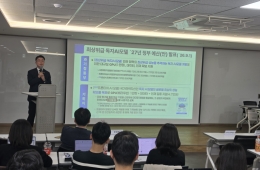
Gyeonggi-do Institute of Health and Environment is announcing the investigation results of chloride ion and sulfate ion concentrations in the stream receiving discharge from SK hynix in Icheon. Provided by Gyeonggi Province
View original imageHowever, both chloride and sulfate ions are commonly found in natural water sources, such as groundwater and river water, and this investigation did not identify them as acutely harmful substances. These ions mainly affect water taste, pipe corrosion, and can cause gastrointestinal irritation.
Domestic regulations exist for drinking water, managing chloride ions at or below 250 mg/L and sulfate ions at or below 200 mg/L. However, there are currently no separate standards for chloride and sulfate ions for river or lake water used for agriculture.
The current water quality of Han Stream and Gosam Reservoir, which will be affected by treated water from the Yongin semiconductor cluster, is found to be suitable for agricultural use. Han Stream holds a BOD (biochemical oxygen demand) grade I, and Gosam Reservoir is graded III–IV for TOC (total organic carbon).
Gyeonggi Province maintains that, given the scale of discharged water from large semiconductor operations entering rivers and lakes, management standards are necessary to safeguard agricultural water quality. Accordingly, the province is requesting the government establish permitted discharge standards for chloride and sulfate ions and is also urging related companies to devise stricter effluent management measures.
Previously, on August 13, Gyeonggi Province requested the Ministry of Climate, Energy and Environment to apply environmental impact assessment (EIA) consultation standards, which are stricter than the current permitted discharge standards for SK hynix’s integrated environmental business site in Yongin.
Environmental impact assessment consultation standards are strengthened pollutant discharge limits, set separately if it is difficult to maintain environmental quality or risk environmental deterioration due to large-scale development or factory installation, through agreement between the consultative agency and the business operator.
In addition, Gyeonggi Province requested that permitted discharge standards be set for chloride and sulfate ions, for which domestic standards currently do not exist. The province plans to continuously monitor water quality in Gosam Reservoir and nearby rivers and will coordinate with the government to expedite the development of related standards.
Moon Heecheon, Acting Director of the Provincial Institute of Health and Environment, stated, "If chloride and sulfate ions at the same levels as SK hynix Icheon are introduced into Gosam Reservoir from February next year, research and effective effluent management measures need to be in place," adding, "We will continue to investigate water quality in this region to faithfully provide basic data for developing optimal solutions."
Meanwhile, Governor Chu Miae of Gyeonggi Province issued administrative guidance this past July and August to minimize process water discharge and raise recycling rates at the Yongin semiconductor cluster, aiming to reduce water use and wastewater discharge in order to prevent damage to local residents in areas such as Anseong.
Hot Picks Today
![An Apartment Once Worth 400 Million Won Nears 1 Billion... "Still Worth It" as 1990s-Born Pangyo Workers Flock to Gyeonggi Gwangju [Report]](https://cwcontent.asiae.co.kr/asiaresize/93/2026100211322949134_1790908349.jpg) An Apartment Once Worth 400 Million Won Nears 1 Billion... "Still Worth It" as 1990s-Born Pangyo Workers Flock to Gyeonggi Gwangju [Report]
An Apartment Once Worth 400 Million Won Nears 1 Billion... "Still Worth It" as 1990s-Born Pangyo Workers Flock to Gyeonggi Gwangju [Report]
- [Breaking] Military: "Final assessment confirms our soldiers were injured by North Korean landmines south of the MDL"
- Suddenly Called Out During Class, Awarded $100,000 as Students Cheer in the Gym
- "After a Dream About Feces, Bought a Lottery Ticket and Won 20,000 Won... Scratched Again and Hit a 2 Billion Won Jackpot"
- 'Limp-and-Gold Medal' Controversy Grows... Woojin Choi Apologizes, Says "Absolutely Not Intended to Demean Armed Forces"
Governor Chu emphasized, "Like global semiconductor companies such as TSMC in Taiwan, we need to dramatically increase the reuse rate of process water," and said, "Since water is supplied publicly, companies must also proactively invest in developing and adopting technologies to reduce and reuse wastewater."
© The Asia Business Daily. All rights reserved. Unauthorized AI training and use prohibited.