Chief AI Officer (CAIO) Council Convened... First Chaired by Lee Hae-min, Chief Secretary for AI
Pan-Government Discussion on "AI Legislative Framework"

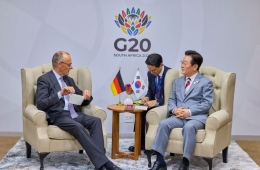
Heamin Lee, Chief Secretary for AI Future Planning, presiding over the 5th Chief AI Officer (CAIO) Council meeting on the 2nd. Provided by the National AI Strategy Committee.
View original imageThe National AI Strategy Committee announced on the afternoon of October 2 that it held the 5th Chief AI Officer (CAIO) Council meeting at Seoul Square and discussed matters including an "AI Legislative Framework (Draft)" at the pan-government level.
This meeting was the first chaired by Lee Hae-min, Chief Secretary for AI Future Planning, in the role of council chair. The session was attended by Chief AI Officers from 42 central government agencies, as well as 13 heads from subcommittees, special committees, and task forces.
Notably, starting from this meeting, the range of attending institutions expanded from the previous 28 ministerial-level agencies to include 14 vice-ministerial-level agencies, such as the Ministry of Personnel Management, the Ministry of Government Legislation, and the Ministry of Data and Statistics, resulting in a total of 42 central government agencies.
During the meeting, four agenda items were presented and discussed: the "Korea AI Legislative Framework," preparations for the launch of the "AI for All" service, the current status and requests for cooperation in building a pan-government data pipeline, and ways to strengthen personal data protection management systems in the public sector.
The Committee reported on a legislative framework outlining the government’s legislative direction, in response to the significant increase in legislative demand in the AI sector following the implementation of the Basic AI Act. The framework set out four fundamental directions—centered on Basic AI Act-driven legislation; closing legislative gaps in national defense and security sectors; enhancing predictability for businesses; and enabling immediate response to negative side effects—and established sector-specific legislative principles in areas such as AI development, AI convergence promotion, AI safety, trust-building, and prevention of AI misuse.
The Ministry of Science and ICT shared the preparation progress for the "AI for All" service, which is set for an official nationwide launch in December. The ministry called for cooperation among relevant agencies in connecting existing open public application programming interfaces (APIs) and opening up additional APIs and data for embedding public AI agents, as well as in formulating standards for privacy processing and utilization by AI agents, and verifying the security and safety of the service.
The Ministry of the Interior and Safety requested that, following the launch of the pan-government data pipeline, each ministry register and share high-value data and identify demand for composite data. Meanwhile, the Personal Information Protection Commission discussed establishing a comprehensive personal data protection and security management system for each ministry in response to the recent series of large-scale hacking and data leaks in both the public and private sectors. The commission also proposed ways to strengthen the role of Chief Privacy Officers (CPOs), and called for a comprehensive action plan to be established, stressing the need to reinforce risk-based identification of information assets and stricter management of handlers.
Hot Picks Today
 "The Transfer Failed, but 'Ding-Dong,' Money Came In"... KRW 32.5 Billion Financial Incident at Toss Bank
- Shark 'Bukkangi' Missing... Oil Spill off Busan North Port Raises Concerns
- "Made 12 Billion Won Cleaning Up Other People's Dog Poop With Just a Rake"... 'Poop Scoop Millionaire' Is All the Rage in the U.S.
- Self-Employed Delinquencies Hit 13-Year High... High Interest Rates and Oil Prices Fuel Fears of Domino Defaults
- Woman Who Bought Economy Ticket Causes Uproar, Demands "Put Me in Business Class," Delays Flight
Lee Hae-min, Chief Secretary for AI Future Planning, said, "The CAIO Council serves as a bridge connecting different ministries," adding, "As chair, I will ensure that the council does more than just hear reports, and that it becomes a body that coordinates and makes decisions on inter-ministerial issues." He further added, "Including the vice-ministerial-level agencies joining us for the first time today, I will operate the council regularly so that all ministries can work as one team for the grand AI transformation, and I will actively address collaboration projects proposed by ministries."
© The Asia Business Daily. All rights reserved. Unauthorized AI training and use prohibited.