U.S. 'Polysilicon Minimum Import Price' Expected to Boost Competitiveness of Korean Firms
$21 Per Kilogram Minimum, Tariffs for Shortfall
Faced Off Against Chinese Polysilicon at $5.4 Per Kilogram
Price Gap Narrows for OCI and Hanwha, Raising Hopes
As the United States sets a 'price floor' of $21 per kilogram for imported polysilicon beginning in December, OCI Holdings is expected to see improved competitive conditions in the U.S. market. The price advantage of Chinese polysilicon, which is priced in the $5 per kg range, will be significantly reduced, giving OCI Holdings, a non-Chinese producer, greater potential to secure additional customers.

According to industry sources on October 2, the United States will apply a Minimum Import Price (MIP) of $21 per kilogram on imported polysilicon starting December 4 under Section 232 of the Trade Expansion Act. Importers will be required to prove that the first arm’s-length transaction in the U.S. meets or exceeds the MIP; if it does not, a specific duty corresponding to the price difference will be imposed.
The core purpose of this measure is to reduce the price advantage of Chinese polysilicon. According to market research firm Shanghai Metals Market (SMM), as of September 30, the average price of Chinese-made N-type high-purity polysilicon was $5.4 per kilogram. In comparison, the price of non-Chinese polysilicon for solar use is around $18.5 per kilogram.
Currently, the price difference between Chinese and non-Chinese polysilicon is about $13 per kilogram. With the implementation of Section 232, the low-price competitiveness of Chinese imports in the U.S. market will be significantly weakened. While OCI Holdings’ products will also be subject to the minimum import price, the reduction in the price gap with Chinese products will place OCI Holdings at a relative advantage.
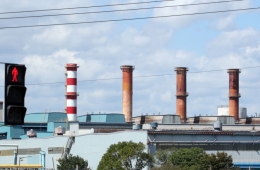
OCI Holdings, through its Malaysian subsidiary OCI TerraSus, produces about 35,000 tons of solar-grade polysilicon annually. By manufacturing non-Chinese polysilicon using hydropower, it is targeting the U.S.-bound solar supply chain. OCI Holdings is one of the major suppliers with large-scale production capacity in non-Chinese regions.
The company has already secured buyers for its current production volume. OCI Holdings has signed long-term supply agreements with new U.S. clients in addition to Hanwha Solutions, fully contracting its existing annual capacity of 35,000 tons. In 2022, it also signed a long-term supply memorandum of understanding with Hanwha Solutions, covering a total of $1.2 billion in polysilicon supplied over 10 years from 2024. According to the company, the amount supplied to Hanwha Q Cells is about 10,000 tons per year.
Therefore, the main effects of Section 232 measures are likely to appear in additional contracts and in the expansion of capacity going forward. In response to the expected increase in solar demand due to the expansion of AI infrastructure in the United States, OCI Holdings plans to double OCI TerraSus’s annual polysilicon production capacity from 35,000 tons to 70,000 tons by 2029.
While OCI Holdings is discussing potential supply with additional customers, the company believes that more clarity on the Section 232 implementation guidelines is required before finalizing specific prices and contract terms. The company is currently preparing scenarios according to the implementation criteria while continuing discussions with clients, and expects negotiations for additional contracts to accelerate once uncertainties are resolved.
In the market, SpaceX has been cited as a potential additional customer. In April, it was reported in the media that OCI TerraSus was in multi-year polysilicon supply contract discussions with SpaceX. At that time, OCI Holdings neither confirmed nor denied the existence of a contract, and the company has not disclosed whether it is supplying any specific customer at present.
However, the implementation of Section 232 will not immediately translate into improved profitability. Long-term supply agreements already have fixed price terms, so how suppliers and customers share changes in market prices remains a variable. In fact, the U.S. government has separate criteria for contracts concluded under fixed terms before the announcement of these measures on August 6. The company believes that while business conditions for non-Chinese polysilicon may improve in the mid- to long-term due to Section 232, actual sales prices and profitability will still depend on negotiations with customers.
Hot Picks Today
 Kim Jong Un Sends World Into a Frenzy, Then Appears at Major Military Event, Making 'Death Rumors' Look Moot
- "I Only Buy Domestic Brands, and I Can't Pay Full Price": Chinese Consumers Turn Away From Nike as It Falls Out of Favor
- "Let's Give Unemployment Benefits to Those Who Find Jobs Quickly and Stay Long-Term"... Petition Takes Aim at Compensation for 'Voluntary Resignations'
- " 'We're Selling at Half Price' " SH's Ambitious Sale Draws Applications for Just 2 Lots... Risk of Falling Into the Red for the First Time in 14 Years
- "Shares Hit Daily Limit on 56 Billion Won News"... Marubeni Launches Tender Offer for K-Beauty Firm of 'Chae Sira's Husband' Kim Taewook
An OCI Holdings representative stated, "Section 232 is expected to make business conditions more favorable for non-Chinese polysilicon in the mid- to long-term," adding, "However, we can only begin full-scale discussions with new customers regarding specific prices and supply terms once the detailed implementation guidelines are finalized."
© The Asia Business Daily. All rights reserved. Unauthorized AI training and use prohibited.