③Crowded Space... Nuri Considers "Space Traffic" Before Launching [Reading Science]
Beyond Simple Distance from Crewed Spacecraft:
Approach Direction and Collision Probability Now Calculated
Fifth Launch Marks Granular Proximity Standards,
Expanding Launch Windows While Ensuring Safety
As Earth's near-space environment grows more crowded, we have entered an era when even rockets must account for "traffic conditions" prior to launch. Beginning with the fifth launch of Nuri, proximity avoidance standards will be further refined: rather than simply measuring the distance from crewed spacecraft such as the International Space Station (ISS), the standards will also consider approach direction and probability of collision. This enhanced precision aims to secure more accurate launch windows by assessing the risk of an actual collision while maintaining safety.

The Korean launch vehicle Nuriho was erected on the launch pad at Naro Space Center in Goheung, Jeollanam-do, ahead of its fourth launch on November 25 last year. Courtesy of Korea Aerospace Research Institute
View original imageAccording to the Korea Aerospace Research Institute, the Nuri launch team analyzes the possibility of close approaches with crewed spacecraft operating in orbit before launch. The planned trajectory of the launch vehicle is compared with the paths of crewed spacecraft, and if a risk of close proximity is detected, launches during those times are prohibited.
For the first four Nuri launches, the fundamental standard for proximity avoidance was maintaining a separation of at least 200 km from crewed spacecraft. However, relying on the shortest distance between two objects in space has inherent limitations when it comes to fully evaluating collision risks.
The fifth launch introduces more granular criteria. Distances are checked both along and perpendicular to the direction of flight, and the probability of collision is also calculated as a supplementary measure. For example, a threshold of no more than 0.0001% probability of collision is used to assess actual approach risks.
One reason for subdividing these standards is to maximize the launch window—i.e., the length of time available for a possible launch. If launches are restricted solely because an object might come within a certain distance, launch times may have to be adjusted even in cases where the risk of collision is minimal. The research team explains that by analyzing approach direction, relative orbital paths, and collision probabilities together, risk assessments can be made in a more precise and realistic way.

The launch time for the rocket is not determined solely by the state of launch vehicle preparations. Other factors are also reviewed, including the target orbit, the mission of the onboard satellite(s), weather conditions around the launch site, and proximity to other objects in space. The scheduled launch window for Nuri's fifth launch is set from 12:23 p.m. to 1:23 p.m. on October 7, 2026, and the final decision will be made on the day of the launch, reflecting all real-time variables.
The ability to adhere to predetermined launch windows is also linked to reliability and the ability to conduct repeated launches. Tae seog Oh, administrator of the Korea Aerospace Administration (KASA), stated at the Kwanhun forum on September 30, 2026, "We will solve issues quickly and launch on schedule to enhance trust and reliability in these missions."
Even after reaching space, collision avoidance remains critical. This Nuri mission will carry a total of 15 satellites: five miniature cluster satellites and ten CubeSats.
Even after reaching space, collision avoidance continues. In this Nuri mission, five miniature cluster satellites and ten CubeSats—a total of 15 satellites—will be onboard. After sequentially separating these satellites, the third stage of Nuri will then perform avoidance maneuvers to ensure it does not re-approach the satellites it has released.

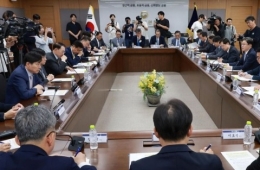
After the fourth launch of Nuriho on November 27 last year, researchers from the Korea Aerospace Research Institute checked the flight status and orbital information of Nuriho at the Launch Control Center (LCC) of Naro Space Center in Goheung, Jeonnam. Provided by KARI
View original imageThe proximity of already-orbiting objects is considered before launch, while after reaching its target orbit, the newly separated satellites must be kept safe from collisions as well. As more missions involve the transport of multiple satellites, precise orbital insertion, separation, and collision avoidance have become increasingly important in launch vehicle operations.
This operational experience is not limited to Nuri alone. The expertise gained through repeated launches—covering launch vehicle manufacturing, assembly, testing, and launch operations—can be leveraged for the development of next-generation launchers.
Jaesung Park, Director of Space Transportation at the Korea Aerospace Administration, stated, "Quality management, manufacturing and assembly, testing, and launch operations experience gained through repeated launches can be applied in establishing reusable and high-frequency launch systems for next-generation launch vehicles."
Hot Picks Today
 "I Ate at Home to Save Money, But My Account Balance Was Still a Shock"
- Suddenly Called Out During Class, Awarded $100,000 as Students Cheer in the Gym
- Seocho District to Care for Isolated Households with AI Companion Robots and Urine Analyzers
- "After a Dream About Feces, Bought a Lottery Ticket and Won 20,000 Won... Scratched Again and Hit a 2 Billion Won Jackpot"
- "Uncle Will Buy Them All for Wonie"... Men in Their 30s Sweep Up 600,000 'RESCENE Bread'
© The Asia Business Daily. All rights reserved. Unauthorized AI training and use prohibited.