TSI Considering Early RCPS Repayment to Enhance Financial Soundness and Shareholder Value
Interview with Byo Insik, CEO of TSI
"Targeting a Debt Ratio Below 100% This Year"
Strong Performance Amid the EV Market Chasm
"This year, we aim to lower our debt ratio to below 100%. A company must have strong financial health, and I believe it's better to generate income and then invest, rather than borrowing money to do so."

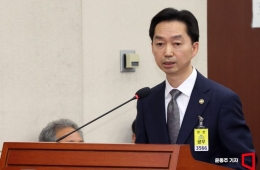
The CEO of Table Recognition TSI is posing at the TSI headquarters in Hwaseong, Gyeonggi Province, ahead of an interview with The Asia Business Daily. TSI
View original imageIn a recent interview with The Asia Business Daily, Byo Insik, CEO of TSI, emphasized the importance of financial soundness, saying, "After running a business for 30 years, I believe that a company without debt is a good company." TSI specializes in supplying mixing systems and equipment, which are key components in the manufacturing process of secondary batteries.
'Debt Diet'... Reviewing RCPS Repayment After CB Redemption
As CEO Byo highlighted, TSI’s debt ratio has been consistently decreasing. At the end of 2022, the debt ratio stood at 416.4%, but through steady efforts, it dropped to 140.5% by the end of last year. Furthermore, this June, TSI fully repaid its 3 billion won remaining balance of the 2nd series unregistered, unsecured private convertible bonds (CB), reducing the debt ratio to 124.0% as of the first half of this year.
The company’s efforts to reduce debt are ongoing. CEO Byo stated, "We are considering an early repayment plan for 40 billion won of redeemable convertible preferred shares (RCPS)." He explained, "Although RCPS is accounted for as capital, early repayment could temporarily increase the debt ratio, but in reality, it functions much like debt. If we proceed with early repayment, the return on equity (ROE) will actually rise."

The CEO of POIINS TSI is speaking in an interview with The Asia Business Daily. POIINS TSI
View original imageThis move is also aimed at enhancing shareholder returns. TSI continues to pursue debt reduction and share buybacks, but its share price closed at 3,615 won on October 1, down 28.0% from the previous year's closing price of 5,020 won. CEO Byo remarked, "We're doing everything possible, but I believe the lackluster stock price is currently due to RCPS. Even if we increase dividends, RCPS holders are entitled to dividends first, so more capital is required for distributions." He added, "In order to pay proper dividends, I believe it’s important to eliminate this risk by repaying the RCPS early. RCPS repayment would have a similar effect as cancelling treasury shares, which is why we are taking it seriously."
Profit Growth Amid EV Market Chasm Seen with Fast LFP Transition
Regarding delays in orders and changes in contract deposits with major clients such as LG Energy Solution, CEO Byo said, "These issues can be interpreted as a temporary demand slowdown (chasm) in the electric vehicle (EV) market. Our clients have launched joint ventures and built factories in the United States with large-scale investments, most of which we successfully secured. However, after the U.S. EV subsidy program ended, battery demand fell, leading to discussions about slowing factory construction." He went on, "Due to this chasm, plant completion has been delayed, resulting in contract extensions, which is an unfortunate but understandable development."
TSI has been overcoming these challenges by expanding its business in the energy storage system (ESS) and lithium iron phosphate (LFP) markets. In the first half of this year, TSI’s sales reached 167.5 billion won, jumping over 40 billion won compared to 120.2 billion won in the same period last year, with operating profit rising from 4.3 billion won to 10.9 billion won in the same timeframe.

The CEO of TSI, a table recognition company, is speaking in an interview with The Asia Business Daily. TSI
View original imageCEO Byo explained, "In the EV market, LFP batteries have taken over the market because they are 10 million won cheaper per vehicle model compared to nickel-cobalt-manganese (NCM) batteries, on which Korea had mainly focused. The lower fire risk of LFP batteries has also contributed to the growth of the ESS market, benefiting us further. While Korea mostly concentrated on NCM batteries, TSI has already been involved in the LFP business, which allowed us to transition to LFP more quickly in the domestic market."
TSI’s technological prowess has also been recognized internationally. On September 3, TSI announced that it had signed a 24.1 billion won agreement with DJK in Japan to supply secondary battery mixing equipment. CEO Byo commented, "In the past, Korea learned equipment technology from Japan, but now we're exporting our technology there; this is highly significant. Major Japanese customers have also requested quotes from TSI and are planning visits, which is a positive sign in the current challenging order environment."
Hot Picks Today
 "300,000 Won Grant" Shelved at Chuseok to Go to All Residents After All... This City Says It Will Pay Before Lunar New Year
- "Didn't Save This Money to Leave to Our Kids?"... Retired Couples Spend $10,000 on a Single Trip
- "Make $10 Million by Flipping It Right After Delivery?"... The Market Drawing the World's Ultra-Rich in ‘This Market’
- Friend Who Went Abroad Goes "Silent"... 617 South Koreans Out of Contact, What's Going On?
- "Stockpile 9 Liters of Bottled Water and Three Days' Worth of Food"... UK on Edge as Nationwide Emergency Preparedness Alert Issued
In closing, CEO Byo said, "You need to prepare while business performance is strong," underscoring his commitment to sustainable management. He concluded the interview by stating, "While running a business, you can always face temporary liquidity pressures or an increase in the debt ratio, so efforts to withstand such challenges are essential for the future."
© The Asia Business Daily. All rights reserved. Unauthorized AI training and use prohibited.