National Graduate School of Medicine to Be Established in Namwon... Opening Set for 2029 (Updated)
Campus to Be Established Near Namwon Medical Center; Academic Curriculum Begins in 2030
Enrollment Set at 100 Students, Full Support for Tuition and Dormitory Fees
15-Year Mandatory Public Healthcare Service Required After Graduation
The site for the establishment of the National Medical Graduate School has been officially confirmed as Namwon in North Jeolla Province Special Self-Governing Province. The government will begin full-fledged follow-up procedures with the goal of opening the school in 2029 and launching the curriculum in 2030.

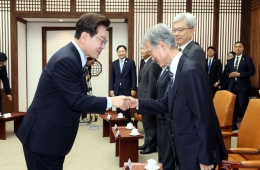
Lee Hyun-hoon, Deputy Minister of Health and Welfare, is announcing the discussion results of the Preparatory Committee for the Establishment of the National Medical Graduate School at the Seoul Government Complex in Jongno-gu, Seoul, on the 1st. The National Medical Graduate School for training 'public doctors' will be established in Namwon, Jeonbuk, opening in 2029, and the first educational program will begin in 2030. October 1, 2026 Photo by Cho Yong-jun
View original imageThe Ministry of Health and Welfare announced on the 1st that it convened the fourth meeting of the Preparatory Committee for the Establishment of the National Medical School, where it decided to locate the school in Namwon. The National Medical School will be built on a planned site near Namwon Medical Center.
With this decision, the location of the school is finalized for the first time in more than eight years since the decision to establish a national public medical school in Namwon, North Jeolla, in April 2018. Namwon City has been continuing administrative and financial preparations, such as land acquisition and designation of urban planning facilities, to support its establishment.
The Namwon site was selected after a review by the infrastructure subcommittee under the Preparatory Committee. Beginning in late August, the subcommittee held its first meeting, visited the planned site in Namwon, and conducted joint sessions with the curriculum subcommittee. Subsequently, it reviewed suitability based on four criteria: ▲project relevance, ▲implementation efficiency, ▲policy credibility, and ▲scalability and connectivity.
The subcommittee highlighted as a primary advantage the proximity to Namwon Medical Center, which favors the integration of local medical education and clinical training. The majority of the land has already been secured, allowing for the design and construction schedule necessary to open in 2029 and begin the curriculum in 2030. The site also provides the conditions for gradual campus expansion, such as strengthening research functions in the future.
The establishment of the National Medical School is a project designed to alleviate regional disparities in healthcare and enable the state to take responsibility for training essential and public healthcare professionals. The related law, the "Act on the Establishment and Operation of the National Medical Graduate School," passed the National Assembly in April of this year and was promulgated on May 26. It is scheduled to take effect on November 27.
The National Medical School will operate exclusively as a four-year graduate-level institution, admitting 100 students each year. It will produce public healthcare professionals who work not only in public hospitals but also in various fields such as fire and industrial accident response, veterans’ care, infectious disease control, national trauma centers, health and medical policy, and international health.
Students will be provided with essential educational expenses, including entrance fees, tuition, the cost of textbooks, and dormitory expenses. Training and clinical practice will take place at the National Medical Center, local public medical centers, public health institutions, and healthcare facilities with which the school has agreements. The curriculum will be centered in Namwon but will also offer clinical training at a variety of public health institutions, taking into account the characteristics of the public healthcare sector.
Graduates will be required to serve a mandatory service period of 15 years. If they undergo residency training at a designated institution, the entire period counts toward mandatory service. Mandatory service institutions include central administrative bodies, local governments, public healthcare institutions, and other related agencies designated by the Minister of Health and Welfare. Military service periods will not be counted toward the mandatory service requirement.
Together with the establishment of the National Medical School, the functions of Namwon Medical Center will also be enhanced. Namwon Medical Center will be converted into the "National Medical Center Namwon Hospital," managed as a state-run hospital, and will gradually expand its capacity to approximately 500 beds. The hospital will be specialized in treating diseases such as cardiovascular disorders and dementia and will serve as a regional hub hospital, playing a key role in clinical education for local and public healthcare.
Hot Picks Today
 "Two Spend 500,000 Won in a Flash, Yet Wait Two Hours?" ... 'Dreamland' Shunned by Kids and Foreign Tourists
- The Era of Getting 200 Million Won After 30 Years Is Over... A Japanese Bank's "Perpetual Department Head" Who Just Clocked In Cries Out
- Spain Hit by Its Worst Tragedy... Lee Kangin, Moreno and Real Madrid Join Soccer World in Mourning
- They Said, “Make It Your Home for Life” - Then Suddenly Kicked 200 Passengers Off... What Happened to the Around-the-World Cruise?
- "130 Rice Bowls Sold Out in a Day"... 'Unfiltered Face' Adds 8 Million Won to Night Market Sales: China's Bungeunwoo
Lee Hyung Hoon, Second Vice Minister of Health and Welfare, said, "This decision not only upholds the credibility of our longstanding policies, but also reflects the thorough review by the subcommittee, which confirmed the educational environment and the feasibility of the project," adding, "We will work closely with related organizations to ensure the school opens in 2029 as planned and becomes a cradle for nurturing public healthcare talent under state responsibility."
© The Asia Business Daily. All rights reserved. Unauthorized AI training and use prohibited.