Acting Police Chief: "Emergency Response System Until Criminal Justice Reform Is Fully Established"
National Police Investigation Commanders Gather at Central Headquarters
"Successful Implementation of the New System Depends on the Field"
On the eve of a transition in the criminal justice system, police investigation leaders from across the nation gathered together. The purpose was to renew the police's commitment to putting the protection of citizens' human rights and victims at the forefront as the new system takes hold.

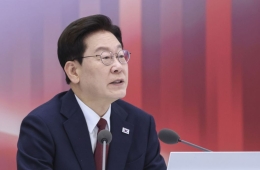
Kim Jongcheol, Acting Commissioner of the National Police Agency, is delivering a keynote speech at the National Police Investigation Commanders Meeting held on the 1st at the Chamsuri Hall of the National Police Agency in Seodaemun-gu, Seoul. Photo by Yonhap News
View original imageKim Jongcheol, Acting Commissioner of the National Police Agency, stated at the National Police Investigation Commanders Meeting held at Chamsuri Hall, the headquarters in Seodaemun-gu, Seoul, around 2 p.m. on October 1, "With our criminal justice system undergoing its first major change in 78 years, the separation of investigation and prosecution tasks adds a significant responsibility for the police to more firmly protect the rights and interests of the people." He further declared, "The police will switch to an emergency response system until the new structure is fully established in the field."
Kim Jongcheol emphasized, "Commanders in charge of investigations will approach every case and accident with the mindset that, for those involved, it may be the crisis of a lifetime, and will exercise utmost care accordingly." He reiterated, "We will thoroughly double-check the handling of every case, from local police stations to regional agencies and headquarters, to ensure not a single wrongful victim or even a minor oversight occurs, and if a problem is found, we will correct it immediately." He particularly stressed that "the success or failure of the new criminal justice framework depends on its implementation on the ground" and instructed that "any confusion or difficulties in the early stages of the system must be directly addressed and promptly corrected by the chiefs of local police stations."
At the meeting, Hong Seokki, Chief of the National Investigation Headquarters, along with 650 investigative executives from provincial and regional agencies—including deputy directors, investigation division chiefs, superintendents, and police station chiefs—gathered. It was the first time in 25 months that all commanders at the rank of police station chief or higher assembled together.
Chief Hong delivered a lecture on the roles and responsibilities of investigative commanders in light of the changing criminal justice system, urging them to: ① base investigations solely on objective evidence and facts, ② act in accordance with the law and conscience, and ③ conduct investigations with responsibility. Afterwards, each principal officer at headquarters shared policy changes in succession, calling for active participation as follows: ▲ responding to investigative corruption and bolstering human rights protection (Inspector General for Human Rights), ▲ strengthening protection for the socially vulnerable and crime victims (Director of the Public Safety and Traffic Bureau), ▲ improving the missing persons investigation system (Director of the Criminal Affairs Bureau), and ▲ advancing police reform measures (Head of the Police Reform Group).

Kim Jongcheol, Acting Commissioner of the National Police Agency, is delivering opening remarks at the National Police Investigation Commanders Meeting held on the 1st at Chamsuri Hall, National Police Agency, Seodaemun-gu, Seoul. Photo by Yonhap News
View original imageUnder the emergency response system declared by Acting Commissioner Kim, the police will implement a range of measures to enhance the completeness of investigations and strengthen protection for victims. Going forward, police station chiefs will check the status of major cases and those requiring further investigation or re-investigation at the request of prosecutors each day and conduct layered reviews at regional and headquarters levels.
Furthermore, in line with making the protection of crime victims the primary principle in police investigations, in addition to establishing the substantive truth, the procedures for safeguarding victims' rights will be reinforced throughout all stages—from the initial report to victim interviews and follow-up actions. Notifications about the progress and closure of cases will be improved and expanded to include online notifications so that victims can directly check the status of their cases and exercise their rights in practice.
Serious misconduct affecting the essence of a case, such as case manipulation, concealment, or bribery, will not only be subject to investigation but also to principle-based disciplinary action including dismissal or removal. The intention is to strengthen both internal and external oversight.
Hot Picks Today
 "Two Spend 500,000 Won in a Flash, Yet Wait Two Hours?" ... 'Dreamland' Shunned by Kids and Foreign Tourists
- The Era of Getting 200 Million Won After 30 Years Is Over... A Japanese Bank's "Perpetual Department Head" Who Just Clocked In Cries Out
- Spain Hit by Its Worst Tragedy... Lee Kangin, Moreno and Real Madrid Join Soccer World in Mourning
- They Said, “Make It Your Home for Life” - Then Suddenly Kicked 200 Passengers Off... What Happened to the Around-the-World Cruise?
- "130 Rice Bowls Sold Out in a Day"... 'Unfiltered Face' Adds 8 Million Won to Night Market Sales: China's Bungeunwoo
Meanwhile, to promote a shared sense of responsibility and mission among South Korea’s 140,000 police officers, a meeting of investigative division chiefs from police agencies and stations, presided over by the heads of the 18 regional police agencies, is scheduled for the morning of October 2 as the new criminal justice system goes into effect.
© The Asia Business Daily. All rights reserved. Unauthorized AI training and use prohibited.