[Why&Next] Monthly Average Exchange Rate Hits Two-Year Low...Where Will the Q4 Roller Coaster End?
September’s Average Exchange Rate at 1,358.8 Won, Down Nearly 170 Won in Three Months
Drop Driven by Foreign Investor Rebalancing and Dollar Selling by Exporters
Four Major Banks Project Q4 Exchange Rate Range of 1,310 to 1,410 Won
Key Q4 Variables: Foreign Investors in Stocks, Corporate Dollar Conversion, U.S. Rates, and Midterm Elections
Last month, the average KRW-USD exchange rate hovered around the 1,350 won mark, recording its lowest point in two years. Several factors contributed to the rapidly rising value of the Korean won, including a decline in portfolio rebalancing by foreign investors in the domestic stock market. As a result, the monthly average exchange rate plunged by nearly 170 won in just three months. Experts pointed to the following as key variables for exchange rate movements in the fourth quarter: changes in foreign stock holdings, the scale of corporate dollar conversions amid strong exports, the trajectory of U.S. policy rates (base rate), and the outcome of the U.S. midterm elections.
![[Why&Next] Monthly Average Exchange Rate Hits Two-Year Low...Where Will the Q4 Roller Coaster End?](http://www.asiae.co.kr/news/img_view.htm?img=2026100111032347322_1790820203.jpg)
September’s average exchange rate recorded at 1,358.8 won...down 169.2 won in three months
According to the Economic Statistics System (ECOS) of the Bank of Korea on October 1, the average KRW-USD exchange rate last month stood at 1,358.8 won, marking the lowest level since September 2024 (1,332.8 won), a two-year low.
In 2024, the monthly average KRW-USD exchange rate fluctuated between the low and high 1,300 won range but surged to the mid-1,400s at year-end due to the election of U.S. President Donald Trump and the 12·3 Emergency Martial Law incident. Last May, concerns about a repeat of the Plaza Accord, which artificially devalued the dollar, and Korea-U.S. exchange rate consultations contributed to the rate dropping back to the 1,300 won range. However, it spiked to the high 1,400s again by year-end. Capital outflows by investor groups like 'Seohak Ants' (Korean retail investors targeting overseas markets) led to upward supply-demand pressure on the exchange rate.
At the start of this year, the exchange rate stabilized in the early 1,400 won range, but in late February, the outbreak of war in the Middle East, along with a surge in the domestic stock market in May and June prompting foreign investors to rebalance their portfolios, pushed the June monthly average up to 1,528 won. Ha Geonhyeong, economist at Shinhan Investment & Securities, noted, “The real effective exchange rate—reflecting Korea’s currency value against its trading partners and inflation—was 18% lower than the post-2000 average in June, comparable to the levels seen during the 1998 currency crisis and the 2008 financial crisis.” However, the exchange rate sharply declined afterward. As foreign rebalancing subsided and semiconductor exporters began selling dollars, the September monthly average marked a steep fall of 169.2 won in just three months.
Projections indicate that the exchange rate is likely to follow a similar trend this month. With the Korean won on a strengthening trajectory and the U.S. Federal Reserve increasingly hawkish, the directional bias in exchange rates has become less clear. Baek Seokhyun, economist at Shinhan Bank, said, “The key question is whether soaring U.S. Treasury yields will impact the broader risk asset market. Although the Korean won could eventually come under pressure, for now it is expected that the exchange rate’s upper and lower bounds will remain within the September range for October.”

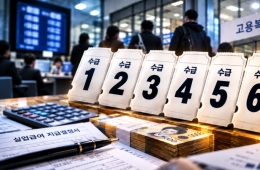
On the 29th of last month, employees are monitoring the stock market and exchange rates in the dealing room at the headquarters of Hana Bank in Jung-gu, Seoul.
View original imageKey Q4 variables: Foreign investors in the stock market, corporate dollar conversion, U.S. rates, and the midterm elections
The four major commercial banks (KB Kookmin, Shinhan, Hana, and Woori Bank) projected the exchange rate to range between 1,310 and 1,410 won in the final quarter of the year. The lower bound is set at 1,310 to 1,340 won, and the upper bound at 1,390 to 1,410 won, with KB Kookmin Bank providing the widest outlook. Moon Junghui, chief economist at KB Kookmin Bank, stated, “We expect the Q4 average exchange rate to be 1,360 won, with a broad range of 1,310 to 1,410 won.” She explained that after a sharp drop in the third quarter, volatility may also be high in the fourth quarter. The main Q4 variables she cited included the status of semiconductor exports, the scale of foreign investors’ net buying (or selling) of Korean stocks, the path and market expectations for U.S. policy rates, the Middle East war, and the U.S. midterm elections.
Shinhan Bank and Woori Bank forecast the lower end at 1,330 won, citing robust export conditions in Korea and an outlook that the more hawkish Fed is unlikely to raise rates as rapidly as in 2022. Baek, the economist, expects the fourth-quarter exchange rate to remain within 1,330 to 1,390 won, saying, “There are currently both upside and downside pressures, so a strong direction in the exchange rate is unlikely this quarter. Recent rises in U.S. Treasury yields have also had a relatively muted effect in translating into a stronger dollar.”
Im Hwanyeol, economist at Woori Bank, emphasized, “The continuation of dollar selling by exporters is the most important factor. Externally, the movement of the Japanese yen, with market expectations for monetary tightening by the Bank of Japan, is likely to be the key determinant affecting the Korean won’s trajectory.” Woori Bank set the Q4 exchange rate band at 1,330 to 1,400 won.
Hot Picks Today
 "From 20s to 60s, Everyone Rushed In"...The 'Top License' Also Obtained by Actors Yoo Yeon-seok and Sung Hoon Revealed
- "Unbelievable Event" in Tokyo Leaves Japan Stunned...Even 'Weather-Related Illnesses' Emerge
- [Exclusive] "Extra Pension Without Ever Setting Foot in Korea"... Baffling Loophole in Foreigners' Childbirth Credit
- Smoking Cigarettes and Taking Photos at Gyeongbokgung Palace..."I Don't Know How to Smoke," Foreign Tourists Deny Accusations
- "Nothing Left to Buy, Feeling Indifferent"... 'Rich Daughter' Vibe in Department Stores with 'Hyunbaek Core'
Yu Jeong, researcher at Hana Bank, set the fourth-quarter exchange rate band at 1,340 to 1,390 won, stating, “Exports remain exceptionally strong, especially for semiconductors, so supply-demand conditions will likely remain favorable.” However, she also pointed out that the lower end could be slightly more open, taking into account the potential for additional Fed tightening by year-end, U.S. economic conditions, and U.S. Treasury yields, which all continue to support a strong dollar. The scale of foreign capital outflows from the Korean stock market is also highlighted as a Q4 variable.
© The Asia Business Daily. All rights reserved. Unauthorized AI training and use prohibited.