$120 Billion U.S. Nuclear Project Revealed: Eight Plants to Be Built in Four States, Including Ohio
Lutnick: "Ohio, Tennessee, South Carolina, Kentucky"
No disclosure on unit allocation by state or construction sites for Korean reactors

Howard Lutnick, U.S. Secretary of Commerce, is attending the Korea-U.S. Business Roundtable held at Gyeongju Arts Center in Gyeongju, Gyeongsangbuk-do on the 29th. 2025.10.29 Photo by Kang Jinhyung
View original imageThe locations for the construction of eight large nuclear power plants in the United States, to be developed through strategic Korea-U.S. investment, have been revealed for the first time. The four selected states are Ohio, Tennessee, South Carolina, and Kentucky. However, details on how the eight nuclear power plants—including two units of the Korean APR1400 model—will be distributed across these areas have not been disclosed.
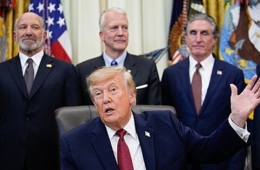
Howard Lutnick, U.S. Secretary of Commerce, explained the $120 billion nuclear power plant construction plan during the announcement event for the Korea-U.S. strategic investment project, which was attended by U.S. President Donald Trump on the 30th (local time).
Secretary Lutnick stated, "The largest project involves an amount of $120 billion, which is comprised of $100 billion plus a contingency of $20 billion, to build eight large nuclear power plants."
He specifically mentioned the construction sites for the nuclear power plants. He said, "These nuclear power plants will be built throughout the United States," adding, "They will be constructed in Ohio, Tennessee, South Carolina, and Kentucky." He further noted, "We aim to build a nuclear supply chain to establish the United States as a global nuclear exporter."
The previously released Korea-U.S. nuclear framework by the Korean government outlined the nuclear reactor types and total investment size for the eight plants to be built in the U.S., but did not specify exact construction locations. The current plan seeks to comprise the eight reactors of six Westinghouse AP1000 units and two Korean APR1400 units. The total project cost will reach up to $120 billion, consisting of approximately $100 billion for construction costs and a $20 billion contingency fund to cover cost overruns.
However, Secretary Lutnick did not specify how many reactors will be built in each of the four states. In particular, the planned locations for the two Korean APR1400 units have also not been disclosed. Similarly, the Korean government maintains that the nuclear framework does not immediately signify the implementation of individual nuclear projects.
Kim Jungkwan, Minister of Trade, Industry, and Energy, stated during a briefing related to U.S. investment on the 22nd of last month that "this announcement does not immediately mean the implementation of nuclear projects," and explained that "when details such as sites, business structure, and construction schedules are finalized, commercial viability reviews and parliamentary procedures will be conducted, after which a final decision will be made on whether to proceed with each individual project."
Hot Picks Today
 "From 20s to 60s, Everyone Rushed In"...The 'Top License' Also Obtained by Actors Yoo Yeon-seok and Sung Hoon Revealed
- "Unbelievable Event" in Tokyo Leaves Japan Stunned...Even 'Weather-Related Illnesses' Emerge
- Smoking Cigarettes and Taking Photos at Gyeongbokgung Palace..."I Don't Know How to Smoke," Foreign Tourists Deny Accusations
- “3.5-Meter Shark Becomes a Celebrity”… Busan’s PR Ambassador ‘Bukangyi’ Draws International Attention
- The Effortlessly Chic "Rich Daughter" Mood... Have You Heard of the Latest Trend, "Hyunbaekcore"?
If two units of the APR1400 are actually constructed among the eight nuclear reactors, it will mark the first case of the Korean nuclear reactor entering the U.S. market. The government is also pursuing a plan for Korean construction and equipment companies to participate in the construction of the six AP1000 units, in addition to the APR1400 units within the United States.
© The Asia Business Daily. All rights reserved. Unauthorized AI training and use prohibited.