Minister Kim Jonggwan: "US Investments Will Not Shift to 9-to-1 Profit-Split Until Full Recovery of Principal and Interest"
"Risk Pooling" for Entire Portfolio of US Investments
50-50 Profit Sharing Between Korea and US Maintained Until Full Recovery of Principal and Interest
Business Plan and Profit Distribution Ratio Can Be Adjusted if Profitability Deteriorates

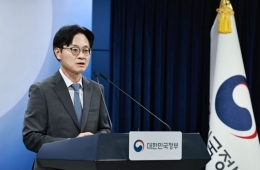
Kim Jungkwan, Minister of Trade, Industry and Energy, is giving a briefing on investment in the United States at the Government Complex Seoul on the 22nd of last month. Ministry of Trade, Industry and Energy.
View original imageThe government has established a safeguard to ensure that, during the $200 billion strategic investment in the United States, Korea will receive 50% of the profits generated by the projects until the principal and interest of its investment is fully recovered. Additionally, there is a mechanism that allows for the profit-sharing ratio between Korea and the US to be renegotiated if the profitability of individual projects deteriorates.
During a briefing on investment in the United States held at the Government Complex Seoul on the 22nd of last month, Kim Jonggwan, Minister of Trade, Industry and Energy, stated, "What our government considered most important was how to secure the principal and interest," adding, "If you look at risk pooling, what was vaguely mentioned in the MOU has now been clarified in this agreement."
The strategic investment in the United States will be carried out by establishing multiple project-specific SPVs (P-SPVs) under an umbrella investment-purpose vehicle (I-SPV). The investment funds and profits from individual projects will be managed collectively by the I-SPV, so if one project's profitability declines, profits from another project can make up for the loss.
Accordingly, until Korea has recovered both its principal and interest for the entire portfolio of projects, all profits generated from each individual project will be split 50-50 between Korea and the US. The original 1-to-9 profit-sharing ratio stipulated in the MOU will not be implemented until Korea has recovered its principal and interest. Minister Kim explained the intent behind risk pooling by saying, "Selecting each individual project is important, but if one project does not work out, the overall project, including other projects, must be considered."
If the business prospects are worse than initially expected, the profit-sharing arrangement itself can be renegotiated. Minister Kim stated, "If the project is compromised and its profitability becomes an issue, what we have secured this time is the ability to adjust the profit distribution," adding, "If a 5-to-5 split does not work, then we must ask for a 9 (presumably meaning 9-to-1 in Korea’s favor)." He emphasized, "Even if we cannot withdraw completely, until the principal and interest are fully recovered—including profits from other projects—the ratio cannot be changed to 9-to-1."
If it is determined that the business prospects of an actual project are seriously undermined, the governments of Korea and the US can negotiate adjustments to the business plan, business budget, and the profit-sharing ratio between the two countries.
There is also a mechanism to prevent the investment size from exceeding the originally agreed limits. Korea and the US have specified, in a legally binding contract, annual and total investment ceilings of $20 billion per year and $200 billion in total, as set in the MOU. This is intended to prevent the overall cap for Korea's strategic investments in the US from being increased even if the costs of individual projects, such as nuclear power plants or the Alaska LNG project, fluctuate.
Minister Kim also noted that, if project profitability is significantly undermined, it is possible to halt further investment. However, since the implementation of the US investment is linked to tariffs, actually suspending investment requires careful consideration. He said, "Halting investment can be done independently of the MOU," but added, "The issue is that, should this happen, there is a provision for a tariff increase, so caution is needed." He further explained that, rather than exiting the project immediately, the primary strategy is to adjust the profit distribution and use profits from other projects to increase the likelihood of recovering the principal and interest.
Hot Picks Today
 "From 20s to 60s, Everyone Rushed In"...The 'Top License' Also Obtained by Actors Yoo Yeon-seok and Sung Hoon Revealed
- "Unbelievable Event" in Tokyo Leaves Japan Stunned...Even 'Weather-Related Illnesses' Emerge
- Smoking Cigarettes and Taking Photos at Gyeongbokgung Palace..."I Don't Know How to Smoke," Foreign Tourists Deny Accusations
- "The Real Winner Controls the Heat"...LG Electronics Bets 150 Billion Won on New Chiller Plant in Virginia, US
- The Effortlessly Chic "Rich Daughter" Mood... Have You Heard of the Latest Trend, "Hyunbaekcore"?
The government has also secured rights to access key information—such as financial statements, business reports, and details of fund usage—to monitor project progress. Major matters related to Korea's investment interests, such as significant changes in the scope of business or the issuance and transfer of shares, are also subject to Korea's consent rights.
© The Asia Business Daily. All rights reserved. Unauthorized AI training and use prohibited.