US-Proposed Projects Rejected... 'Commercial Viability' Key in Strategic Investments in the US
Louisiana Project Excluded Due to Concerns Over Recovery of Principal and Interest
CCUS Also Rejected for Lack of Commercial Viability; Additional Data Requested and On-Site Inspections Conducted
If Investment Quota Remains, Smaller Strategic Projects Such as Critical Minerals to Be Considered

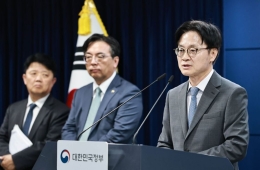
Kim Jungkwan, Minister of Trade, Industry and Energy, held a briefing on investment in the United States at the Government Complex Seoul on the 22nd of last month. Ministry of Trade, Industry and Energy.
View original imageIt has been revealed that, during the selection process for the government’s 200 billion dollar strategic investment projects in the United States, several projects proposed by the US side were excluded one after another. The Louisiana project was eliminated because it was deemed difficult to recover the principal and interest on the investment. The carbon capture, utilization, and storage (CCUS) project was also rejected due to a perceived lack of commercial viability. According to reports, the US side has even expressed concerns that Korea is excessively strict in its project selection process.
Kim Jonggwan, Minister of Trade, Industry and Energy, explained the coordination process with the US side during a briefing on investment projects in the United States held at the Government Seoul Office Building on the 22nd of last month. He said, "From the US perspective, there were moments when they thought Korea was being too demanding."
The representative example is the Louisiana project. The US side previously proposed a project similar to the Texas Encinal combined cycle gas power plant, which is being promoted as the first investment project in the United States. However, after the government reviewed the project's commercial feasibility, it determined that it would be difficult to recoup the investment, so it declined the project.
Minister Kim said, "We were presented with something similar to Texas, which was the Louisiana project," and added, "Even if the projects appear the same, the Louisiana one did not allow for the recovery of principal and interest from a commercial standpoint." He continued, "During the discussions, we said we could not accept it, and the project was subsequently dropped."
The CCUS project was also included among the investment candidates but did not proceed to actual investment. The government viewed the project as strategically significant in responding to climate change and from an industrial perspective, but concluded that it lacked commercial viability. During the project evaluation, the government requested additional information from the US side and conducted on-site inspections to further assess its economic feasibility.
Minister Kim remarked regarding the CCUS project, "It does have significance," but also stated, "Although it is a main challenge in tackling climate change, we found it inadequate from a commercial viability perspective." He further explained that, during the process of requesting information and conducting site inspections, the US side also came to believe that it would not be easy to meet the investment requirements set by Korea.
On the other hand, the government is considering a different approach for projects with significant strategic value, even if they lack immediate economic feasibility. A prominent example is a reprocessing-related project proposed by the US side. The government noted that, while this project is unlikely to achieve commercial viability, it involves technology that does not currently exist in Korea.
Minister Kim stated, "There was also a project for nuclear fuel reprocessing," and admitted, "Commercial viability appears limited for this project as well, but Korea does not possess this technology." He continued, "Although the project is not commercially viable, parliamentary approval would be required. We are considering whether we could attempt this project at least once."
He also clarified that the full quota for US strategic investments will not necessarily be filled with only large-scale projects. After allocating funds to projects currently being pursued or reviewed, such as the Texas combined cycle gas plant, eight nuclear power plants in the US, and the Alaska LNG project, the government is also considering the possibility of adding relatively smaller strategic projects—such as those involving critical minerals—if there is any remaining quota.
Hot Picks Today
![SK hynix Maintains 3.4 Million Won Target Price: "Strong Memory Demand" [Click eJongmok]](https://cwcontent.asiae.co.kr/asiaresize/93/2026093008003444894_1790722835.jpg) SK hynix Maintains 3.4 Million Won Target Price: "Strong Memory Demand" [Click eJongmok]
SK hynix Maintains 3.4 Million Won Target Price: "Strong Memory Demand" [Click eJongmok]
- Trump Announces “Korea to Invest in Texas Power Plant, Eight Nuclear Plants, and Alaska LNG” (Update)
- "You Have to Try Buldak Panini and Black Sesame Latte"... Cafes Hit Jackpot as Foreign Tourists Spend 14 Trillion Won
- Micron Reports Record Q4 Revenue of $54.2 Billion on Surging AI Demand
- "I’m Now Afraid of Chinese People"... Chinese Restaurant Owner Appeals After Being Threatened Over Sign
Minister Kim said, "If we have any quota left, there are meaningful projects we have developed, such as those related to minerals," adding, "Even if a small amount remains, rather than looking only from a commercial perspective, if there is something we can do in strategic areas for both countries, I would like to take on such a project—even if it is small in scale."
© The Asia Business Daily. All rights reserved. Unauthorized AI training and use prohibited.