"The Board Must Answer... Next After the Commercial Act Amendment: 'Disclosure and Discovery'"
Democratic Party AI Finance and Economy Task Force Forum
"With the third amendment to the Commercial Act, we have created the first round of capital market reform—a system where shareholders ask questions and boards of directors provide answers. The next focus for round two is strengthening disclosure and introducing discovery (the evidence submission process)."
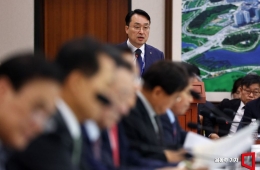
Yongwoo Lee, head of the AI Finance and Economy Task Force of the Democratic Party of Korea and director of the Gyeongje Plus Research Institute, made this statement at the "Capital Market System Improvements: Disclosure and Discovery" forum held at the Korea Exchange in Yeouido on the afternoon of September 30. The forum’s themes—enhanced disclosure and the introduction of discovery—are also included in the "Financial Reform for People’s Sovereignty," one of the Democratic Party’s 4+1 reform initiatives made public in July.
First, Task Force Leader Lee assessed that after the implementation of the revised Commercial Act last year—which mandated board members’ duty of loyalty and other provisions—the transformation from rubber-stamp boards to checks and balances has already begun. The most notable example is SK Networks. He remarked, "The board independently blocked a proposal that would have appointed a former chairman convicted of a crime as honorary chairman and advisor in order to award him substantial compensation, judging the measure as a violation of board members’ fiduciary duty to shareholders and potentially constituting breach of trust."
Lee also referenced the so-called Starbucks controversy. "When Yongjin Chung, chairman of E-Mart, dismissed the CEO of a subsidiary (Starbucks Korea) following a major marketing mishap, it raised concerns about how a non-registered owner with no executive title could lead personnel changes and receive high compensation," he explained. "As a result, Chairman Chung returned as a registered director of E-Mart after 13 years, coming back within the legal framework of accountability."
In particular, Task Force Leader Lee stressed that the next step after the Commercial Act amendment must be to strengthen disclosure. He stated, "Disclosure is making capital costs and projected returns public through precise figures so that market participants can specifically assess the value of the business. Boards of directors must respond to shareholders with numbers."
He continued, "Discovery means going beyond a results-oriented ex-post disclosure system and instituting a civil judicial right that allows shareholders to verify concealed documents on equal footing. Rather than criminal penalties, it is a structure where shareholders themselves secure documents and address issues." Lee argued for the need to introduce the discovery system, adding, "Rather than making more and more laws, it is more important to establish soft norms. In the concrete process of dispute resolution, case law and practices based on the spirit of the law should be established, naturally leading to the formation of soft norms in the marketplace."
As the second presenter, Professor Jongseop Lee of Seoul National University’s Business School discussed the ideal direction for "disclosure in the AI era." Professor Lee first pointed out that more than 70% of turnover in the Korean stock market comes from individual investors, stressing that "a high proportion of individual investors makes minority shareholder protection a matter that affects trust in the entire capital market."
However, Professor Lee also observed that even as barriers to entry have lowered and individual investor participation has increased thanks to AI and mobile technology, information asymmetry has only grown more pronounced. "Management knows, but shareholders do not. Such information asymmetry reduces the duty of loyalty to just a piece of paper," he said, emphasizing, "Disclosure is the infrastructure of corporate governance."
Accordingly, Professor Lee argued that disclosure in the AI era must provide equal access to information, verify the authenticity of information, and incorporate AI-based disclosure supervision. "We must discuss ways to redesign the disclosure system so that it fits the AI distribution environment," he suggested. "To ensure the authenticity of information, a certification mechanism should be established to check whether information was generated or altered by AI and to verify the original source, as well as to quickly facilitate corrections and set up warning systems." He went on to propose the introduction of an individual investor governance index, which would show the concentration of vulnerable investors by stock, to reduce corporations' disclosure burdens while strengthening market surveillance capacity by leveraging AI.
Additionally, Jooyoung Kim, managing attorney at Hannuri Law, highlighted that since the main means of evidence in civil proceedings are documents and certifications, the supplementation of the order for document production system, and the recording of witness testimony are crucial components for implementing discovery. Attorney Kim stated, "Discovery significantly affects key parts of the civil litigation process, such as pleadings, evidence collection, and examination, and such procedures should be integrated effectively into current civil litigation practices and harmonized with existing systems by including broader and more comprehensive amendments."
Hot Picks Today
![[Exclusive] "Do I really need to hear an explanation?" Pick what you want and head straight to checkout... Misuse concerns mount, but the government is "in the dark"](https://cwcontent.asiae.co.kr/asiaresize/93/2026072313313455983_1784781094.jpg) [Exclusive] "Do I really need to hear an explanation?" Pick what you want and head straight to checkout... Misuse concerns mount, but the government is "in the dark"
[Exclusive] "Do I really need to hear an explanation?" Pick what you want and head straight to checkout... Misuse concerns mount, but the government is "in the dark"
- President Lee’s Approval Rating Rebounds to Upper 30s... Internal Strife Rocks Democratic Party and People Power Party [Asia Business Daily-Realmeter Poll]
- "I thought getting into a big company was the goal"... The 'position' only 1 in 121 employees reaches
- "'No! Dad, Run!'... Father Moved by 5-Year-Old Son Who Shielded Him from Ghost at Korean Folk Village"
- "Jealous of Koreans" - Now a Must-Do on Every Trip... The Place Where Foreigners Spent KRW 229.8 Billion
The forum was co-hosted by the Democratic Party of Korea’s AI Finance and Economy Task Force and the K-Capital Market Special Committee, with support from the Korea Exchange, Korea Financial Investment Association, and Korea Corporate Governance Forum. Democratic Party leader Minseok Kim, in his celebratory remarks, said, "Although the amendment to the Commercial Act has greatly strengthened the institutional foundation for advanced corporate governance, unless shareholders are properly informed about their company’s situation, the effect will inevitably be limited. Presenting all critical management information in detail to all shareholders, thus eliminating information asymmetry, is the hallmark of advanced-country governance."
© The Asia Business Daily. All rights reserved. Unauthorized AI training and use prohibited.



!["Please, Just Take Them Off" - They Made It All the Way to Bed... Then Fecal Bacteria Struck [Deep Scroll]](https://cwcontent.asiae.co.kr/asiaresize/307/2026101610053063338_1792112730.png)