"From Artificial Sun to Next-Generation Power Grids"... Naju Discusses the Future of Energy
Naju Global Energy Forum 2026 Opens on September 30
Focused Discussions on the 'F3' Agenda: Fusion, Youth Innovation, and Next-Generation Power Grids
Keynote Lecture by Nobel Laureate in Chemistry, Omar Yaghi
Renowned scholars and energy experts from around the world have gathered in Naju, which aspires to become a global hub for future energy, leveraging its bid to attract an artificial sun research facility. The event covers discussions on future energy industry technologies and industrial strategies, spanning topics from nuclear fusion to youth-led innovation and next-generation power grids.
On September 30, the Naju city government announced it had hosted the opening ceremony of the 'Naju Global Energy Forum 2026 (NGEF 2026)' at the main auditorium of Korea Energy Engineering University, marking the beginning of a two-day program.

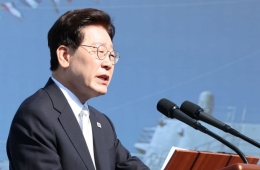
Yoon Byungtae, Mayor of Naju, delivers the opening address at the opening ceremony of the 'Naju Global Energy Forum 2026 (NGEF 2026)' held at the main auditorium of Korea Energy Engineering University on the 30th. Photo by Shim Jinseok
View original imageThe forum, held until October 1, is co-hosted by the Greater Jeonnam-Gwangju Metropolitan City, Naju City, and Korea Energy Engineering University, with the Green Energy Institute serving as the organizer.
Now in its third year, the forum brings together prominent scholars, energy experts, industry and research institute representatives, and innovative entrepreneurs, creating a platform for global exchange that connects the flow of future energy industries with technology, industry, and policy.
The theme for this year's event is "Artificial Sun and Energy Transition." The forum has adopted the 'F3' agenda, focusing on three core pillars: 'Fusion' (unlimited clean energy through nuclear fusion), 'Future' (future talent and innovation entrepreneurship), and 'Flexibility' (adaptable power grids meeting an evolving energy landscape).
The opening ceremony was attended by Yoon Byungtae, Mayor of Naju; National Assemblyman Shin Jeonghoon; Park Jin Ho, Acting President of Korea Energy Engineering University; Jeon Ho-gwang, Vice President of Korea Plant Service & Engineering (KPS); Choi Jinsoo, Vice President of Korea Electric Power Data Network (KDN); Kwak Geunryeol, Deputy President of Korea Power Exchange; Kim Kiman, Chair of the Forum Steering Committee; Ko Hyung Kwon, former Ambassador to the OECD; Kim Gwanyong, Chair of Naju City Council; and Lee Geunbae, President of Chonnam National University, among others.
Mayor Yoon stated, "At this pivotal moment of attracting the artificial sun research facility and driving a global energy transition, discussing solutions for the future of energy alongside world-class scholars is significant not only for Naju but for the entire energy industry of South Korea." He added, "We will channel all our capabilities to ensure the research facility does not remain solely focused on research, but evolves into a business ecosystem that attracts enterprises, technology, and talent, establishing Naju as the center of global fusion and emerging energy industries."
The first morning of the forum featured an opening lecture by Jang Daeik, a philosopher of science and evolutionary biologist, who serves as a distinguished professor at Gachon University, speaking on the topic of "The Evolution of Humanity and Civilization, and a New Future."
The afternoon commenced with the first session, "Artificial Sun." Howard Wilson, Chief Scientific and Technical Officer of the UK’s STEP Fusion Project for next-generation commercial fusion demonstration, delivered the keynote address.
This was followed by a panel discussion involving Hwang Yongseok, Professor at Seoul National University; Oh Youngguk, President of Korea Institute of Fusion Energy; Yang Hyungnyul, Program Director for Fusion at the K-Moonshot Project; and Mayor Yoon Byungtae, who examined the prospects for commercializing fusion technology and strategies for building a research and industrial ecosystem.
Mayor Yoon also presented a strategy session on "Naju’s Future Transformed by the Artificial Sun," outlining plans to cluster research institutes, businesses, and talent around the artificial sun research facility, aiming to develop Naju into a global hub for fusion research and industry.
At 6:30 p.m., Lee Jungmo, a prominent science communicator and former Director of the National Gwacheon Science Museum, gave a special lecture for citizens, addressing the climate crisis and energy transition from the perspective of citizens and youth.
On October 1, the "Energy Young Leader" session puts the spotlight on researchers and innovative companies poised to lead the future energy industry.
The keynote was delivered by Professor Carrie Forrest of the University of Wisconsin, co-founder of the U.S. fusion startup Realta Fusion. Participants including Sung Chunggi (Professor at KAIST), Kim Taekyung (CEO of EternaFusion), Kim Jaemin (CEO of Standard Magnet), Jung Bongki (CEO of Qbeam Solution), and Kim Yoonsoo (Professor at GIST) engaged in discussions on commercialization of research technology, entrepreneurship, and the roles of future talent.
The "Next-Generation Power Grid" session continues, beginning with a keynote by Professor Thomas Gries of Aachen University of Technology in Germany. The session, chaired by Moon Seungil, Director of Research at Korea Energy Engineering University, will explore power grid flexibility, new grid technologies, and strategies for building industrial ecosystems that respond to the energy transition.
The final stage of the forum will feature a keynote by Omar Yaghi, a distinguished professor at Tsinghua University and recipient of the 2023 Nobel Prize in Chemistry. His lecture, titled "Precision Materials and AI for a Sustainable Planet," will address the future of precision materials and artificial intelligence in sustainability.
Professor Yaghi, a pioneer in the field of metal-organic frameworks (MOF) and reticular chemistry, will join Park Jin Ho, Acting President of Korea Energy Engineering University, for a dialogue following the lecture, discussing how advanced materials and AI could transform future energy technology and sustainable societies.
During the forum period, the first-floor lobby of Korea Energy Engineering University will host an exhibition featuring a model of the Korea Superconducting Tokamak Advanced Research (KSTAR) device from the Korea Institute of Fusion Energy, as well as displays of advanced technologies from companies and organizations in the fusion and power sectors.
Hot Picks Today
 Some Earn Over $200,000 a Year... US Women Choosing Trades Over Office Jobs
- "Falling Asleep Instantly in Bed"...Is a Nightly Pattern a Warning Sign for Your Health?
- [Exclusive] Over KRW 400 Billion in Loans Recalled in Four Months After Ban on Multi-Homeowners' Loan Extensions... Minimal Impact on Property Listings
- [Exclusive] Concerns Over Public Agency’s Monopoly of PPA Brokerage Market... Private Platform Companies Push Back
- "Thought She Was AI, So Pretty"... Viral Female Spectator Turns Out to Be First-Year Med Student
Technologies from participating companies, including KAT, VitroNextTech, Standard Magnet, Eugine MS, Qbeam Solution, and Cytronic, will be showcased, offering a look at research achievements and commercialization prospects in the future energy industry.
© The Asia Business Daily. All rights reserved. Unauthorized AI training and use prohibited.