Real Wages Fall for Fourth Straight Month...Longest Decline Since 2023
Real wages, adjusted for inflation, declined for the fourth consecutive month. While nominal wage growth lagged behind inflation, nominal wages for temporary and daily workers also decreased. The number of workers in the construction sector, which had shown two months of growth, reverted to a decline.
According to the “August 2026 Workplace Labor Force Survey” released by the Ministry of Employment and Labor on September 30, real wages per worker at businesses with at least one regular employee in July stood at 3,604,000 won, down 12,000 won (0.3%) from the same month last year. Real wages declined by 1.0% in April, 1.4% in May, 0.1% in June, and continued to decrease in July, marking a four-month streak. In July, nominal wages rose by 104,000 won (2.5%) to 4,316,000 won, but this increase was less than the 2.8% rise in consumer prices.
By employment status, total earnings for regular employees increased by 151,000 won (3.4%) to 4,633,000 won. Fixed salaries rose 2.5% to 3,744,000 won, while special payments were up 6.7% to 620,000 won. In contrast, total earnings for temporary and daily workers fell by 46,000 won (2.6%) to 1,736,000 won. Although temporary and daily worker wages increased by 3.1% in April, 3.2% in May, and 3.8% in June, this trend reversed to a decline in July.

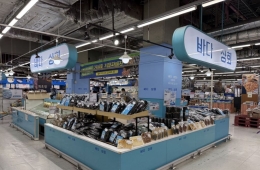
On the 10th, office workers and citizens visiting the '2026 Gwanghwamun Autumn Market with Small Business Owners' held at Gwanghwamun Square in Jongno-gu, Seoul, are browsing small business products at food trucks and flea markets. This autumn market will be held at Gwanghwamun Square until November 5th. 2026.9.10 Photo by Yongjun Cho
View original imageThe wage gap by company size persisted. For companies with 300 or more employees, total earnings rose by 209,000 won (3.3%) to 6,490,000 won, while companies with fewer than 300 employees saw a smaller increase of 64,000 won (1.7%) to 3,846,000 won. For four straight months, the nominal wage growth rate at companies with fewer than 300 employees—1.8% in April, 1.6% in May, 2.3% in June, and 1.7% in July—was below the corresponding consumer price inflation rates of 2.6%, 3.1%, 3.2%, and 2.8%.
The construction sector continued to underperform despite overall job gains. As of the end of August, the total number of employees at all businesses was 20,690,000, up 233,000 (1.1%) from a year earlier. The number of regular employees rose by 92,000 (0.5%) and temporary and daily workers rose by 141,000 (7.4%). About 60% of the overall increase was accounted for by temporary and daily workers. However, the number of construction workers fell by 1,000 (0.1%) to 1,379,000. After 23 consecutive months of decline, the number of workers in the construction sector increased by 7,000 in June and by 3,000 in July, but reverted to a decline after just two months. Considering the base effect of a steep drop in construction employment by 77,000 (5.3%) in August last year, this recent uptick was not enough to signal a full recovery.
By industrial classification, comprehensive construction employment decreased by 18,000. The Ministry of Employment and Labor also remarked at last month’s briefing that the increase in construction employment “may not necessarily indicate a recovery,” suggesting a temporary rise. By company size, businesses with fewer than 300 employees added 160,000 workers (1.0%) to reach 16,996,000, while those with 300 or more grew by 73,000 (2.0%) to 3,694,000.
Labor market mobility increased sharply. In August, the number of new hires stood at 1,008,000, up 154,000 (18.1%) compared to the same period last year, and the number of separations was 1,036,000, an increase of 147,000 (16.5%). There were 28,000 more separations than new hires. Jeong yangsuk, head of the Labor Market Survey Division at the Ministry of Employment and Labor, stated during a briefing, “August marks the first time that both new hires and separations have exceeded one million.” The hiring rate stood at 5.2% and the separation rate at 5.4%, both up by 0.7 percentage points. Of those who left their jobs, involuntary separations increased by 114,000 (20.9%) to 657,000, accounting for a large part of the overall growth in separations (147,000). Of these involuntary leavers, 589,000 were temporary or daily workers.
Total recruitment rose by 144,000 (17.9%) to 948,000. Recruitment of temporary and daily workers increased by 21.6% to 622,000, while recruitment of regular employees grew by 11.5% to 325,000. In construction, both hiring and involuntary separations increased by similar amounts: hiring by 63,000 and involuntary leavers by 65,000. In August, involuntary separations in the construction sector totaled 309,000, surpassing new hires at 302,000. By industry, employees in health and social welfare services reached 2,732,000, an increase of 122,000 (4.7%), driving total job gains. Professional, scientific and technical services, as well as financial and insurance services, each saw an increase of 28,000 workers.
Hot Picks Today
 "Falling Asleep Instantly in Bed"...Is a Nightly Pattern a Warning Sign for Your Health?
- Caterpillar Catching Contest Held in China to Combat Deadly Pest That Survives from -16°C to 40°C
- Where Have All the 'Finished Today's Workout' MZs Gone?... 6 Out of 10 Men in Their 30s Are Obese
- KOSPI Plunges in July, National Pension Fund Shrinks by KRW 182 Trillion in Just One Month
- "Thought She Was AI, Too Beautiful"... Viral Beauty Caught on Broadcast Turns Out to Be Med School Freshman
The number of employees in manufacturing rose by 17,000 (0.5%) to 3,770,000, posting growth for the eighth consecutive month. Employment increased by 8,000 in the electronics, computers, imaging, audio, and telecommunications equipment manufacturing sector (which includes semiconductors), and by 6,000 in the other transportation equipment manufacturing sector (which includes shipbuilding). Conversely, wholesale and retail employment fell by 30,000 (1.4%) to 2,211,000, marking a 29-month consecutive decline. In July, the average monthly working hours per employee was 161.9 hours, down 7.0 hours (4.1%) from a year earlier. With the number of working days decreasing by one, from 23 to 22, working hours fell across all industries except for accommodation and food services.
© The Asia Business Daily. All rights reserved. Unauthorized AI training and use prohibited.

!["Failed Even With Net Assets of 400 Million Won?"... Six Criteria That Define 'The Real Middle Class' [Data Pick]](https://cwcontent.asiae.co.kr/asiaresize/307/2026092809144741876_1790554486.jpg)