President Lee Orders Earlier Relocation of Gwangju Military Airport... Accelerates Semiconductor Cluster Project
"Mid-2028 Relocation Plan Is 'Too Late'"
Calls for Legal and Regulatory Revisions... Residential Environment to Be Addressed Together
President Lee Jae-myung has instructed officials to accelerate the temporary relocation of Gwangju Military Airport to help establish a semiconductor cluster in the Honam region. He ordered that the transfer of military airport operations take place earlier than the Ministry of National Defense's proposed mid-2028 timeline, urging a faster pace for setting up the semiconductor industrial complex.
During the '3rd Public-Private Joint Inspection Meeting on the Mega Project' held at the Blue House the previous day, President Lee was briefed on the Ministry of National Defense's temporary deployment plan for the military airport. He stated, "Completing the temporary relocation around mid-2028 is too late," and instructed officials to "reexamine the plan to expedite the schedule as much as possible." He added, "Extraordinary times require extraordinary measures," and suggested that if necessary, they should consider amending laws or changing regulations and guidelines.

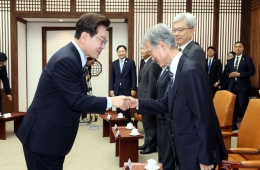
President Lee Jae-myung is speaking at the 3rd Public-Private Joint Inspection Meeting on Mega Projects held at the Blue House on the 29th. Photo by Yonhap News
View original imageRegarding this, Kang Yoo-jung, Chief Presidential Spokesperson, explained, "The relocation of the military airport can serve as the starting point for many projects or as an opportunity to increase the pace of progress," and emphasized that President Lee had issued instructions to explore ways to bring the timeline forward as much as possible.
In the 2nd inspection meeting held last month, President Lee had already ordered the Ministry of National Defense to temporarily relocate Gwangju base functions to another military airport by mid-2028. This was part of efforts to utilize the Gwangju Military Airport site early for the semiconductor industrial complex. Now, just a month later, he has called for the schedule to be advanced even further.
He also addressed the need for improved residential conditions around the semiconductor industrial complex. President Lee said, "The ultimate goal of this mega project is for young people and talented individuals to flock to the region for jobs, so that all areas and citizens can fairly enjoy the benefits of growth," stressing that "creating favorable living conditions is central to the project's success."
President Lee made it clear that merely building an industrial complex would not be sufficient. He stated, "We must create a new regional development model that integrates high-tech industries with housing, education, healthcare, and culture," and instructed that "from the outset, plans for the industrial complex and the surrounding living environment must be developed together as part of a single initiative."
Hot Picks Today
 "Two Spend 500,000 Won in a Flash, Yet Wait Two Hours?" ... 'Dreamland' Shunned by Kids and Foreign Tourists
- The Era of Getting 200 Million Won After 30 Years Is Over... A Japanese Bank's "Perpetual Department Head" Who Just Clocked In Cries Out
- Spain Hit by Its Worst Tragedy... Lee Kangin, Moreno and Real Madrid Join Soccer World in Mourning
- They Said, “Make It Your Home for Life” - Then Suddenly Kicked 200 Passengers Off... What Happened to the Around-the-World Cruise?
- "130 Rice Bowls Sold Out in a Day"... 'Unfiltered Face' Adds 8 Million Won to Night Market Sales: China's Bungeunwoo
He also instructed that the newly appointed National Strategic Investment Adviser at the Blue House oversee the overall project schedule. President Lee said, "We need to manage the entire schedule collectively and clarify each person's responsibilities," and asked officials to "identify potential causes of delay in advance and seek solutions."
© The Asia Business Daily. All rights reserved. Unauthorized AI training and use prohibited.