Economic Chiefs: "Reducing Government Bond Issuance by Utilizing Surplus Tax Revenue"
First Expanded Macrofiscal and Financial Meeting Presided by Deputy Prime Minister Lee Hyung-il
Emergency Buyback Measures Also Under Review

Lee Hyung-il, Deputy Prime Minister and Minister of Finance and Economy, is taking a commemorative photo with attendees before the start of the 'Expanded Macroeconomic Fiscal and Financial Meeting' held at the Government Seoul Office in Jongno-gu, Seoul on the 30th. From left, Paik Hong-geun, Minister of Planning and Budget; Deputy Prime Minister Lee; Shin Hyun-song, Governor of the Bank of Korea; and Lee Eok-won, Chairman of the Financial Services Commission. Ministry of Finance and Economy
View original imageThe government has decided to consider using a portion of this year’s surplus tax revenue, which is expected to amount to an additional 6.32 trillion won, to reduce the volume of government bonds issued.
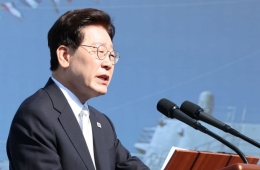
On the morning of September 30, Deputy Prime Minister and Minister of Finance and Economy Lee Hyung-il presided over his first Expanded Macroeconomic Fiscal and Financial Meeting since taking office at the Government Seoul Office. Attendees included Paik Hong-geun, Minister of Planning and Budget; Lee Eok-won, Chairman of the Financial Services Commission; and Shin Hyun-song, Governor of the Bank of Korea. Deputy Prime Minister Lee stated, “Domestic bond yields continue to rise as upward pressure from global interest rates—caused by rising oil prices, the shift to tighter monetary policy in major countries, and other domestic factors—persist.”
He added, “We will closely monitor developments in the government bond market, and if the rise in interest rates becomes excessive, we will implement necessary stabilization measures, such as emergency buybacks or reducing the volume of government bonds issued by using part of the surplus tax revenue.”
The government had already announced during next year’s budget formulation process that it would reduce new government bond issuance by 1.25 trillion won. However, criticism emerged that this reduction was small compared to the additional tax revenue amounting to 16.23 trillion won due to the semiconductor boom.
Regarding the updated tax revenue estimate released today, participants agreed that, since an additional tax revenue of 6.32 trillion won is expected thanks to robust performance in the semiconductor sector and an accelerating economic recovery, the surplus should be used strategically, taking the economic environment into consideration.
In particular, it was decided that to ensure the rapid economic recovery directly benefits people's lives, the surplus tax revenue will serve as a priming pump to ease polarization by being allocated to the three key social policy areas most intimately connected to citizens’ daily lives: housing, employment, and microfinance for low- and middle-income households.
Hot Picks Today
 "Falling Asleep Instantly in Bed"...Is a Nightly Pattern a Warning Sign for Your Health?
- Some Earn Over $200,000 a Year... US Women Choosing Trades Over Office Jobs
- [Exclusive] Over KRW 400 Billion in Loans Recalled in Four Months After Ban on Multi-Homeowners' Loan Extensions... Minimal Impact on Property Listings
- Caterpillar Catching Contest Held in China to Combat Deadly Pest That Survives from -16°C to 40°C
- "Thought She Was AI, So Pretty"... Viral Female Spectator Turns Out to Be First-Year Med Student
The Ministry of Finance and Economy explained that this was the first Expanded Macroeconomic Fiscal and Financial Meeting since Deputy Prime Minister Lee took office, held against the backdrop of the Bank of Korea’s recent base rate hike and the upcoming National Assembly review of next year’s budget bill. The ministry emphasized that the significance of the meeting lies in officials responsible for fiscal, monetary, and financial policy convening to assess current macroeconomic and financial market conditions and discuss strategies moving forward.
© The Asia Business Daily. All rights reserved. Unauthorized AI training and use prohibited.