Confirmed North Korean Landmines Spark Inter-Korean Tensions
Kim Yojong Denounces Incident as a "Staged Farce"
Military and UN Command: "Additional Mines Discovered... Violation of the Armistice Agreement"

The military and the United Nations Command announced that during the third joint field investigation at the DMZ landmine explosion site, they discovered one additional North Korean Sujipan anti-personnel mine that had been buried close to the accident location. Photo by Joint Chiefs of Staff
View original imageTensions have begun to rise between North and South Korea following an explosion in the western section of the Demilitarized Zone (DMZ). On September 29, Defense Minister Kang Shinchul asserted that "North Korea buried the mines to fortify the border," prompting North Korea to respond the following day, condemning the incident as a "staged farce."
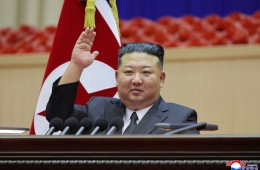
On September 30, the state-run Korean Central News Agency (KCNA) reported that Kim Yo-jong, Deputy Director of the Workers’ Party of Korea, released a statement claiming, "This incident is clearly a fabrication, reminiscent in both timing and method of the 'box mine incident' that shocked the world more than a decade ago." This marks North Korea’s first official position since the accident took place nine days ago on September 21. The statement was not published in domestic media accessible to the North Korean public, such as Rodong Sinmun or the Korean Central Broadcasting Station.
The "box mine incident" referenced by Ms. Kim occurred in 2015, when a landmine explosion—believed to have been caused by North Korean forces infiltrating south of the Military Demarcation Line (MDL) and planting mines—left a South Korean non-commissioned officer severely injured. At the time, the South Korean military responded by broadcasting loudspeaker propaganda towards the North.
Regarding calls within the political sphere to resume loudspeaker broadcasts towards the North, Kim Yo-jong objected, saying, "The South Korean authorities’ attempts to shift blame and manufacture 'material evidence' to prove their claims represent an extreme absurdity and a peak of linguistic nonsense."
On September 28, the military released interim investigation findings publicly, indicating that it is highly likely a North Korean landmine caused the DMZ explosion, and stated that "corresponding measures" would be taken if the final assessment identifies the mine as one planted by North Korea.
Appearing before the National Assembly on September 29, Defense Minister Kang Shinchul reiterated, "It appears [North Korea] buried the mines to fortify the border," adding, "This is clearly a violation of the Armistice Agreement." He emphasized that the incident was not caused by a lost mine, but rather by North Korea actively planting mines south of the MDL, making it an unmistakable "mine provocation" by North Korea.
The military and the United Nations Command announced that during the third joint field investigation at the DMZ landmine explosion site, they discovered an additional North Korean Sujipan anti-personnel mine buried close to the accident location. The military considers this mine to be different from the one witnessed by soldiers during the explosion on September 21. In total, at least four North Korean mines, including the two that exploded, have been confirmed at the scene. The military and the United Nations Command suspect that more mines could be buried in the area, raising the possibility that the site is a "minefield" with many North Korean mines. The United Nations Command also released a statement: "We discovered a North Korean anti-personnel mine south of the MDL in our area," and added, "We have determined that an Armistice Agreement violation has occurred and are taking measures according to the established armistice system."
Hot Picks Today
 A 12-Year-Old Girl Went to the Hospital After Her Blood Pressure Hit 225 and Was Stunned: "What Is This Coral Reef-Like Thing in Her Aorta?"
- "Samsung Electronics Employees Commute by Shuttle Bus"... More Than 5,000 Homes to Be Supplied in Seoul and Busan [Real Estate A to Z]
- “3.3 Million Won, Yet It Cracked with a ‘Snap’ When Unfolded”... Humiliation for iPhone Duo Amid Launch-Day Rush, Outclassed by Galaxy Fold?
- “I Thought Surely They Wouldn’t, but Grown Adults Did This”... Wedding Shoot Atop Tomb Sparks Controversy
- "If This Airs, I'm Dead"... Why a Restaurant Refused to Let Jeon Hyunmoo's Show Film
Within the military, there are discussions about responding by deploying more reconnaissance assets and increasing surveillance forces near the MDL. However, such measures could significantly increase the burden on South Korean forces. Consequently, the South Korean side is expected to prioritize measures such as referring the case to the UN Security Council for international condemnation and pressing North Korea for an apology and assurances against recurrence.
© The Asia Business Daily. All rights reserved. Unauthorized AI training and use prohibited.