Hallyu Expands with 'Made with Korea' [K-Content Japan]
KOCCA Unveils 'Next K' Initiative
Strengthening IP-Centered Collaboration
The K-Content industry is seeking to expand into the global market through Korea-Japan co-productions. Efforts are focused on going beyond the export of completed works by leveraging intellectual property (IP) to collaborate with overseas production infrastructure and talent.

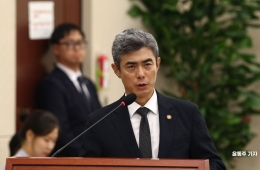
Song Jin, Head of Policy Research Division at the Korea Creative Content Agency, is discussing the 'Next K' initiative at the 'Korea-Japan Content Co-production Week' held in Tokyo, Japan on the 29th. /Korea Creative Content Agency Tokyo Business Center.
View original imageSong Jin, Head of the Policy Research Division at the Korea Creative Content Agency, unveiled the 'Next K' initiative at the 'Korea-Japan Content Co-production Week' held in Tokyo, Japan, on September 29. This initiative builds on past achievements. Over the past 20 years, K-Content exports have grown 10.4 times, making Korea the world's fourth-largest exporter in the audiovisual media sector. A $100 million increase in exports has led to a $570 million total production inducement effect.
However, as global platforms increase their market dominance, production costs are rising, and investments based on profitability are shrinking. Signs of slowing growth have also appeared recently. With rapid technological innovation, including artificial intelligence (AI), the industry itself is at a turning point.
Song proposed 'Made with Korea' as the core direction for 'Hallyu 5.0', moving beyond the previous export-led Hallyu 1.0~4.0 era. He said, "It is now time to look beyond 'Made in Korea' to 'Made with Korea'," and explained, "Next K refers to K-Content that is not confined by Korea's cultural or geographical boundaries, but meets broader markets and more users."

'Korea-Japan Content Co-Production Week' Site / Korea Creative Content Agency Tokyo Business Center.
View original image'K-Pop Demon Hunters' by Sony Pictures is an example of this direction. Korean creators and global talent collaborated, utilizing North American production infrastructure to produce the work together.
Other Korea-Japan collaboration cases include 'Tower of God Season 2', where Korea's planning skills and webtoon IP were combined with Japan's animation production system, and the Netflix drama 'Romantic Anonymous', which merged Korean planning with Japanese direction.
Song noted, "These collaborative experiences demonstrate not only the cultural significance of international exchanges, but also the need for cooperation to expand industrial outcomes."
The business value of Korea-Japan co-productions stretches from production to IP expansion. The synergy between Korea's speed in production and digital dissemination and Japan's sophisticated character franchise management skills highlights the strengths of both countries. Sharing talent, technology, and locations reduces production costs and improves quality. Leveraging local partners' distribution networks and fan bases can lower entry barriers and disperse box office risks. Asian co-created IP, extended through online video services (OTT), games, and licensing, improves global competitiveness and lengthens content lifespans.

Song Jin, Head of the Policy Research Headquarters at the Korea Creative Content Agency, is discussing the 'Next K' concept at the 'Korea-Japan Content Co-Production Week' held on the 29th in Tokyo, Japan. / Korea Creative Content Agency Tokyo Business Center.
View original imageTo facilitate such expansion, a virtuous cycle ecosystem integrating planning, production, and investment needs to be established. Song drew attention to the Japanese production committee model, stating, "Although the structure and applicable content types differ, we can gain insights, especially in extending IP lifespans and strengthening competitiveness."
Hot Picks Today
 Japanese Women Smitten by the Irresistible Charm of Korean Men: "Great Looks, Age, Income... and Thoughtfulness"
- "Unprecedented": Atmosphere Shifts Live On-Air Amid Sighs Over Japan's 34 Consecutive Rainy Days
- Former Manager of Narae Park, Who Demanded 10% of Revenue, Claims "Exercising Legitimate Rights" at First Trial
- "One in Three Unsuitable for Marriage": 72-Year-Old Professor's Diagnosis Sparks Fierce Debate Among Chinese Netizens
At the national level, supporting infrastructure upgrades include supplying 10 trillion won in policy finance and securing investment capacity for blockbuster IP and AI-powered content. This plan is aligned with the government's national agenda, 'Promoting the Content Industry as a Strategic National Industry for the K-Culture Era.' The agenda targets a K-Culture industry market size of 400 trillion won and $110 billion in exports by 2030. Song emphasized, "A robust and healthy content ecosystem is the foundation for making everything possible."
© The Asia Business Daily. All rights reserved. Unauthorized AI training and use prohibited.

!["Failed Even With Net Assets of 400 Million Won?"... Six Criteria That Define 'The Real Middle Class' [Data Pick]](https://cwcontent.asiae.co.kr/asiaresize/307/2026092809144741876_1790554486.jpg)