President Lee: "Nuclear Submarines and Hypersonic Missiles Are the Key to Autonomous Defense"
President Lee Presides Over Cabinet Meeting
Stresses Autonomous National Defense as KF-21 Delivered to Air Force
"Defend Air, Land, Sea, and Space With Indigenous Technologies"
"We Must Create a Peace Where War Is Unnecessary"
On the 29th, President Lee Jae-myung stated, "We need to make greater efforts to advance the construction of nuclear-powered submarines and further develop hypersonic missile technology, both of which are key to autonomous national defense." With the recent delivery of the domestically produced KF-21 fighter jet to the Air Force, President Lee outlined a vision for establishing an independent and advanced weapons system that expands from the sky, land, and sea to outer space. As he once again emphasized the acquisition of advanced strategic weapons as a core task for self-reliant defense—following his recent call for the repatriation of wartime operational control during his term and the advancement of the nuclear submarine project—it is expected that related projects will gain momentum.

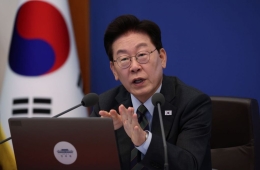
President Lee Jae-myung is speaking at the Cabinet meeting held at the Blue House on the 29th. 2026.9.29 Yonhap News Agency
View original imagePresiding over the Cabinet meeting at the Blue House that day, President Lee said, "A strong national defense is both the foundation and the central pillar for safeguarding the lives of our citizens and Korea’s national interests."
President Lee particularly highlighted the formal delivery of the KF-21 to the Air Force on the 22nd as a noteworthy achievement in autonomous national defense. He stated, "KF-21, the first fighter jet built by our own hands, has been officially delivered to the Air Force," and added, "There are only eight countries in the world, including ours, that have independently developed a 4.5-generation fighter jet that represents the pinnacle of Korean advanced technology." He further emphasized, "For this reason, the official induction of the KF-21 holds special significance in terms of self-reliant defense."
President Lee also called for securing independent capabilities across a wide range of advanced strategic weaponry, extending beyond the KF-21. He said, "We must take one step further and continue to develop and deploy cutting-edge weapons systems in order to protect our skies, land, seas, and even outer space with our home-grown technology and capabilities."
He specifically identified nuclear submarines and hypersonic missiles as core military assets. President Lee remarked, "Above all, we must put even more energy into building nuclear-powered submarines and advancing hypersonic missile technologies, which are the key to autonomous national defense." This signals his intention to bolster the military's deterrence capabilities by securing independent long-range, high-speed strike power and covert naval operational abilities.
Nuclear-powered submarines have been a priority national security agenda item that President Lee has consistently pursued since taking office. In last month’s Ulchi Cabinet meeting, he instructed preparations for the seamless repatriation of wartime operational control within his administration, adding, "Please accelerate progress on the nuclear submarine project, which will symbolize the future of the Korea-U.S. alliance."
Hot Picks Today
 "Once Worth 4 Million Won a Day, Now Going for Chicken Money"... Chinese Robots' Humiliating Fall to 'Bargain-Bin' Prices in Just One Year
- "Who Says It's a Meal for Ordinary People? It Deserves 'Special Dish' Status Now"... The Era of 12,000-Won Bibimbap
- "I will open fire at a childcare center"... Australian man in his 20s arrested over AI chatbot conversation
- Daughter in Her 30s Ate Tteokbokki Alone... 34-kg Father Dies of Malnutrition
- "I Won't Take It Even If You Leave It to Me"... 9 Million Parents' Homes Sit Empty as 320,000 Japanese Renounce Inheritances
Nuclear-powered submarines were also addressed as a major security issue during the summit between President Lee and U.S. President Donald Trump, which was held in New York on the 22nd. Referencing the discussions during the Cabinet meeting that day, President Lee explained, "We conducted in-depth conversations on major topics such as shipbuilding, nuclear energy, nuclear-powered submarines, and wartime naval operations." He continued, "Our efforts must not only focus on winning in conflict, but also on persistently building a true peace where conflict becomes unnecessary."
© The Asia Business Daily. All rights reserved. Unauthorized AI training and use prohibited.