North Korea: "Nuclear-Armed Status Is Irreversible"... Criticizes South Korea's Nuclear Submarine Push
Criticizes South Korea’s Pursuit of Nuclear-Powered Submarines
"Aggravating Regional Security Instability"
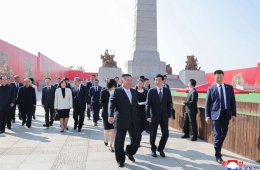
Sun-Kyung Kim, Deputy Minister of Foreign Affairs of North Korea, reiterated at the United Nations (UN) General Assembly that North Korea’s status as a nuclear-armed state is irreversible. While criticizing South Korea’s efforts to acquire a nuclear-powered submarine, he also called for reform, arguing that the UN is being used as a tool for the hegemonic strategies of certain countries.

Sun-Kyung Kim, Deputy Minister of Foreign Affairs of North Korea. Screenshot from UN Web TV
View original imageDeputy Minister Kim, in his address at the 81st UN General Assembly General Debate, held at UN Headquarters in New York on the 28th (local time), stated, "Our nuclear deterrent is purely an irresistible force to thoroughly safeguard national sovereignty, security, and peace from external aggression and threats." He emphasized, "No matter how fervently hostile forces deny this by mobilizing all manner of rhetoric, both physically and legally, North Korea’s status as a nuclear-armed state remains irreversible under any circumstances."
He characterized North Korea’s nuclear deterrent as "an absolute strength to protect sovereignty, security, and peace from external aggression and threats." He went on to claim that armed conflict has not occurred on the Korean Peninsula or in surrounding areas because North Korea maintains a powerful war deterrent, "which enables the control and management of hostile forces’ intentions to use military force." This reiterated North Korea's longstanding justification that its nuclear armament prevents regional conflict.
Deputy Minister Kim also targeted trilateral security cooperation among South Korea, the United States, and Japan. He asserted that the United States is developing South Korea-U.S.-Japan military cooperation into "a more offensive and aggressive military bloc armed with nuclear elements."
He argued, "The Korean Peninsula and surrounding areas are facing unprecedented instability and heightened tensions—different even from last year—due to the U.S. and its allies’ unwavering hostile policy toward North Korea and their escalating military confrontations." He continued, "This year, the United States has continued to conduct various multi-purpose military exercises, such as Freedom Shield and Freedom Edge, that simulate actual combat, making no effort to hide its dangerous intentions to provoke military confrontation with us."
Particularly, he criticized, "The United States has approved and instigated Seoul’s ambition to possess nuclear-powered submarines and is deploying various advanced military assets—such as state-of-the-art missiles and drones—to the Korean Peninsula and surrounding regions." He added, "These military moves are already further deteriorating the region’s already fragile security situation."
He also criticized Japan for pushing ahead with rearmament and the development of long-range strike weapons. Deputy Minister Kim declared, "Japan, a top war criminal state, is accelerating its rearmament drive to an unprecedented degree amidst today’s chaotic international environment—revising its pacifist constitution, reorganizing its military apparatus, and boosting its armed forces—dragging the entire region closer to the brink of war."
Deputy Minister Kim also took aim at the United States regarding the war in Iran. He pointed out, "Security instability has been exacerbated by incidents such as major acts of state terrorism and tremendous shocking events unimaginable by ordinary conceptions and common sense, as well as war and bloody conflict."
In the latter part of his speech, he demanded UN reform. Deputy Minister Kim claimed that the UN is being used as a tool for the hegemonic strategy of certain powers and declared, "Now is the time to reform the UN."
He emphasized that what is needed is not a reform centered on specific nations, but "genuine democratization of the United Nations," in which the perspectives and interests of all member states are equally reflected. He further stressed that the era in which a single member state could unilaterally impose its will on others is over, emphasizing the importance of multilateralism and a multipolar world order.
Hot Picks Today
 "Please Pay Me at Least 3 Million Won a Month": More Than Half of Young People Today Prioritize "Working Conditions" Over Company Size
- Selling Like Crazy Every Year... 30-Year-Old Hetbahn Takes on a New Challenge: Tastes Better Than "Mom's Home Cooking" [On-Site Report]
- Sleep Is Koreans' 'No. 1' Health Interest, but the 'Twist' Is They Averaged Less Than 7 Hours a Night This Year
- Ran 18 km With 9-Year-Old Tied to Him at the Waist... "Man Banned From Competing for 3 Years"
- Beachgoer Finds 'Plastic' That Turns Out to Be Perfume Ingredient Worth More Than Twice as Much as Gold
Meanwhile, Deputy Minister Kim’s speech at the UN General Assembly marks the second consecutive year of such an address. After refraining from sending high-level delegations to the UN General Assembly from 2019, following the breakdown of the Hanoi North Korea–U.S. summit, North Korea resumed dispatching high-level officials last year.
© The Asia Business Daily. All rights reserved. Unauthorized AI training and use prohibited.






![[Market ING] KOSPI Seeks Rebound in Superweek Packed with Corporate Earnings and FOMC](https://cwcontent.asiae.co.kr/asiaresize/307/2026102514484873155_1792907327.jpg)