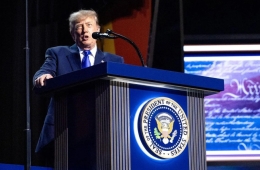
[New York Stock Exchange] Trump Rejects Conditional Ceasefire Proposal... Major Indexes Fall Together
Brent Oil Up Over 2%
AI Stocks Weaken... Nvidia Gains
After U.S. President Donald Trump rejected Iran's conditional ceasefire proposal, international oil prices surged more than 2%, and the yield on the 10-year U.S. Treasury note also rose, causing all three major New York stock indexes to fall on September 28 (local time).
As of 10:10 a.m. at the New York Stock Exchange (NYSE), the Dow Jones Industrial Average was trading at 51,586.56, down 242.06 points (0.47%) from the previous session. The S&P 500 index, which tracks large-cap stocks, fell by 32.02 points (0.41%) to 7,711.39, while the technology-heavy Nasdaq index dropped by 167.97 points (0.64%) to 26,900.74.
![[New York Stock Exchange] Trump Rejects Conditional Ceasefire Proposal... Major Indexes Fall Together](http://www.asiae.co.kr/news/img_view.htm?img=2026092822562443034_1790603785.jpg)
On this day, investor sentiment weakened as optimism faded regarding the reopening of the Strait of Hormuz. Previously, Iran demanded the following from the United States—as conditions for reopening the Strait of Hormuz within seven days: the release of at least $12 billion of Iran’s frozen overseas assets; the lifting of sanctions on Iranian oil; and an end to the U.S. maritime blockade against Iran. However, after President Trump announced on September 26 that he had rejected the agreement, international oil prices surged again.
On the New York Mercantile Exchange, West Texas Intermediate (WTI) crude for November delivery was up 1.82% from the previous session, trading at $94.09 per barrel. On the ICE futures exchange, Brent crude for November delivery was up 2.07%, trading at $106.47 per barrel.
As oil prices climbed, concerns over inflation resurfaced, leading U.S. Treasury yields higher. The yield on the 10-year note surpassed 5.2%, and the yield on the 30-year note exceeded 5.5%.
In contrast to last week, when artificial intelligence (AI)-related stocks drove the market’s gains, some investors took profits. Shares of AMD fell by 3.54%; Micron Technology dropped 3.07%; Microsoft was down 1.65%, close to 2%; and Meta’s loss was especially notable at 4.10%.
Hot Picks Today
 "Please Pay Me at Least 3 Million Won a Month": More Than Half of Young People Today Prioritize "Working Conditions" Over Company Size
- Selling Like Crazy Every Year... 30-Year-Old Hetbahn Takes on a New Challenge: Tastes Better Than "Mom's Home Cooking" [On-Site Report]
- I Thought Only 'Old Guys' Ate It... Young People Are Hooked on This 'Unusual Food' at Risk of Disappearing? [Delicious Stories]
- "Hey, Lady, Teach Your Kids to Behave!" ... 300,000 Won in Cash and a Bodily Injury Claim Demanded Over Child's Door Ding
- Beachgoer Finds 'Plastic' That Turns Out to Be Perfume Ingredient Worth More Than Twice as Much as Gold
On the other hand, Nvidia was up 2.70% from the previous session. The company announced on this day that it would expand its stock buyback program by an additional $150 billion, bringing the total program to $235 billion, which contributed to the rise.
© The Asia Business Daily. All rights reserved. Unauthorized AI training and use prohibited.