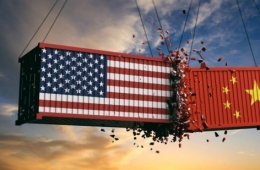
U.S. and China Each Make $30 Billion in Tariff Concessions, Focusing on Agricultural and Consumer Goods
Both Countries Agree to $60 Billion in Tariff Reductions
10% Tariff Remains on U.S. Soybeans
Sensitive Issues Like Tech Export Controls and Taiwan Still Unresolved
Last week, as part of the recent U.S.-China summit agreement, both countries detailed measures to lower tariffs on a total of $60 billion (approximately 81 trillion won) worth of imports. Sensitive issues such as advanced technology export controls and the Taiwan matter have been set aside, with the two sides first reaching an agreement focused on non-sensitive items, including agricultural products, consumer goods, and medical devices.

U.S. President Donald Trump (right) is speaking with Chinese President Xi Jinping on the steps of the National Archives Museum in Washington D.C. on the 25th (local time). Photo by AP Yonhap News
View original imageAccording to Bloomberg and Caixin on September 28, the United States will reduce tariffs on 77 categories of Chinese products, including fireworks, household goods, sports equipment, and toys. China will offer tariff reduction benefits on 1,619 items from the United States, such as meat, seafood, dairy products, grains, coal, timber, and medical devices. The specific items were released simultaneously on this day by the governments of both countries following their agreement.
Both the United States and China have committed to $30 billion each, with the total trade volume affected amounting to $60 billion. While this represents only a portion of last year's total U.S.-China trade volume of $415 billion, Bloomberg reported that it is regarded as one of the most concrete economic achievements resulting from the meeting between U.S. President Donald Trump and Chinese President Xi Jinping.
However, U.S. soybeans, which the market had closely watched, were excluded from China's tariff reduction list. The 10% additional tariff on U.S. soybeans will remain in place. Market participants had previously pointed out that while China's state-owned purchasing enterprises have been increasing their orders of U.S. soybeans, the tariff rate of around 10% remains too high for private companies to absorb.
Furthermore, China has pledged to purchase at least $1.7 billion worth of U.S. agricultural products annually through 2028, and separately to import 25 million tons of soybeans per year. Plans have also been made to import at least 10 million tons of U.S. coal each in both 2027 and 2028. The two countries have agreed to extend the trade truce until January of next year. Bloomberg noted that agricultural trade is a relatively easier field for agreement compared to more sensitive issues such as semiconductors and artificial intelligence (AI).
The two countries announced that they would implement the tariff reductions simultaneously after completing the necessary domestic legal procedures. About 90% of the targeted items will see their tariffs reduced to the Most-Favored Nation (MFN) level. Additionally, all additional tariffs imposed during the course of their trade conflict will be eliminated.

Wang Yi, Chinese Foreign Minister who accompanied Chinese President Xi Jinping on his visit to the United States, stands on the runway at Andrews Joint Base on the 25th (local time). Photo by Reuters Yonhap News
View original imageJamieson Greer, a representative of the Office of the United States Trade Representative (USTR), stated that the new measures will improve access for U.S. agricultural products and medical devices to the Chinese market. The USTR explained that the items involved account for about 30% of all U.S. exports to China. Tariff burdens on Chinese household goods and toys imported into the United States are also expected to fall.
Hot Picks Today
 "The Transfer Failed, but 'Ding-Dong,' Money Came In"... KRW 32.5 Billion Financial Incident at Toss Bank
- "People with money have already moved," they say... 1,700-ton underground vault full as the wealthy flock to this country
- Legend Who Turned 40-Store Olive Young into a "KRW 1 Trillion Giant"... Returns to Shinsegae After 25 Years as a Rescuer
- Saemaul Geumgo Posts 3.6 Trillion Won in Net Losses Over 3.5 Years... "Comprehensive Measures Needed"
- 'Hangover Legend' Returns After 11 Years... Lee Sunmin Hyung's 'Captain Q' Sells Out
According to China's Ministry of Commerce, this step will help stabilize U.S.-China trade, improve conditions for exports of Chinese products to the United States, and meet domestic market demand in China. In addition, it is expected to serve as an opportunity to expand bilateral trade cooperation in agriculture, energy, manufacturing, and consumer goods.
© The Asia Business Daily. All rights reserved. Unauthorized AI training and use prohibited.