[Q&A] Kim Sung-hwan: "No Power or Water Issues for Honam Semiconductors... Dongbok Dam Heightening to Begin Next Year"
"Compensation and Relocation Plans Underway for Residents in Submerged Areas"
"Gas-Free Apartment Projects Set for Second Half of Next Year"
Kim Sung-hwan, Minister of Climate, Energy and Environment, stated, "We need to begin the Gwangju Dongbok Dam elevation project next year," adding, "We are also working on compensation and relocation measures for the residents in the area slated for submersion." The plan is to secure an additional 250,000 tons of water daily to ensure an uninterrupted supply for the Honam Semiconductor Cluster.
During an interview with The Asia Business Daily at his office in the Hangang Flood Control Center in Seocho-gu, Seoul, on September 21, Minister Kim emphasized, regarding the power and water supply issue for the Honam Semiconductor Cluster, "There will never be a situation where semiconductor factories in Honam are unable to operate due to electricity or water shortages."
The Dongbok Dam elevation project has been exempted from the preliminary feasibility study, and follow-up procedures are underway. Minister Kim explained, "Raising the height of an existing dam is relatively less environmentally destructive and more effective than constructing a new dam," adding, "We have made a policy decision to proceed with the elevation and are following the related processes while Korea Water Resources Corporation is handling the practical preparations." The Dongbok Dam elevation project involves increasing the height of the existing dam to expand its storage capacity, as opposed to building a new one.
In the building sector, he presented air-source heat pumps as a key measure to reduce carbon emissions. Minister Kim said, "Carbon neutrality policies for buildings have been relatively lacking until now," and explained, "It's necessary to move away from the previous approach of substituting gas demand based on the premise of falling green hydrogen prices." He continued, "This year, we will provide subsidies covering 70% of installation costs based on 14 million won, and next year, 70% based on 13 million won." The long-term goal is to lower the installation cost of heating and cooling heat pumps with air conditioning functions for new homes to below the 10 million won range. Minister Kim noted, "Depending on technological innovation and price reductions, the total amount of subsidies may decrease while the scope of support could expand."
Minister Kim also outlined plans to secure both an energy transition and industrial competitiveness with the launch of the Ministry of Climate, Energy and Environment. "We will turn the climate crisis into an opportunity for growth by completing the energy transition, striving to transform Korea from a country dependent on oil into an energy powerhouse taking a leading role in the AI era," he said.

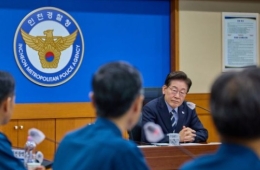
Kim Sung-hwan, Minister of Climate, Energy and Environment, is being interviewed by The Asia Business Daily at the Hangang Flood Control Office in Dongjak-gu, Seoul. 2026.9.21 Photo by Kim Hyun-min
View original imageBelow is a Q&A with Minister Kim Sung-hwan, Minister of Climate, Energy and Environment
- What is your perspective on the current situation where industrial electricity rates are now higher than household rates?
▲Until now, Korea has kept industrial electricity rates lower than those for residential and general users, since our industries must remain internationally competitive. Recently, however, industrial electricity rates have surged so that the average industrial rate is now 181 won, while the residential rate is around 150 won. In China, industrial electricity rates are about 120 to 140 won. For industries with high electricity consumption, such as steel or petrochemicals, this is inevitably a burden in terms of cost competitiveness. In particular, I believe it was the wrong decision for the previous administration to raise only the industrial electricity rate by more than 10% at the end of their term. If an increase was necessary, the burden should have been shared between industry and households.
- Do you believe there is a need to lower industrial electricity rates again?
▲We are considering a system that differentiates power rates by region. For regions far from the metropolitan area, industrial electricity rates could be lowered to reflect transmission costs, as well as the local structure of electricity production and consumption. We have announced a plan for region-based electricity rates considering transmission charges, local power self-sufficiency, and the National Balanced Development Index, and we are in the final stages of confirming it.
- What is the significance of integrating the five state-run power generation companies?
▲It's not simply about merging them again or relocating their headquarters. In the past, neoliberal trends led to splitting and privatizing the power generation sector; integration is about normalizing that direction. The integration of power generation companies counters those previous trends. However, the process must ensure that workers do not lose jobs and regions with coal power plants are not negatively impacted. That is the core of a "just transition." (Minister Kim clarified that the idea of transforming KEPCO into a holding company, which some have raised, is only one of many opinions.)
- The closure of coal power plants could significantly shock local economies. What is your view?
▲We need to end coal power by 2040. That said, coal power cannot be continued simply due to difficulties in local regions. The basic direction is to transition these locations to centers for renewables. Still, that alone may not be enough; we can also consider attracting new industries, such as SMRs or large-scale battery facilities, depending on the region. Even after closure, we must create new industries and jobs so that former workers can continue to live in those areas.
- What are the core challenges regarding future power demand and energy policy?
▲The AI revolution and climate crisis are occurring concurrently. We have to address both challenges simultaneously. During the daytime in summer, solar power currently supports the bulk of the peak load, with solar output during peak hours reaching 25–28 GW and nuclear averaging about 20–21 GW. The challenge is the early morning before sunrise and after sunset, when there is no solar. How we meet power demand in those periods is a key task going forward. By 2035, the share of renewables will be a little over 30%. The question is whether combining this with nuclear can raise the carbon-free energy share to 70%. How quickly we reduce coal and gas will also matter.

Kim Sung-hwan, Minister of Climate, Energy and Environment, is being interviewed by The Asia Business Daily at the Hangang Flood Control Office in Dongjak-gu, Seoul. 2026.9.21 Photo by Kim Hyun-min
View original image- Some point out that freezing electricity rates while expanding grid investments could increase KEPCO’s financial risk.
▲During the Russia–Ukraine war, KEPCO absorbed the electricity price burden, causing its debt to rise sharply. While KEPCO's debt is said to be 200 trillion won, about 40 trillion won of this increase is attributable to electricity rate deficits during the war. We managed to repay part of it with a surplus of about 13 trillion won last year, and this year is also not in deficit. There are currently no factors necessitating a rate hike or financial risk for KEPCO. However, it’s true that the scale of profit has decreased compared to last year.
- How will you manage the growing burden of grid investments in the future?
▲KEPCO has invested about 5 to 10 trillion won annually in building the power grid. KEPCO still has that much financial capacity. Still, continued investment in the grid is essential, and the state must manage this civil risk in conjunction with KEPCO. Ensuring KEPCO’s sound management without increasing the public’s electricity burden is a measure of the government’s operational ability.
- There continue to be concerns about power and water supply for the Honam Semiconductor Cluster.
▲There is no shortage. We can provide adequate water for semiconductor operations through various channels. While droughts are difficult to predict, as long as we build sufficient water capacity and prepare diverse measures for droughts, it will be manageable. I am confident that there will never be a case where semiconductor plants in Honam cannot operate due to power or water shortages. Such claims, I believe, are made with particular intentions.
- What is the current status of the Dongbok Dam elevation to supply an additional 250,000 tons of water per day?
▲We have decided to proceed with elevation as a policy and are following the related procedures. The project was exempted from a preliminary feasibility study, and Korea Water Resources Corporation is handling the practical preparations. Compensation and relocation packages for residents in submerged areas are also underway. We need to start next year. While I cannot specify an exact date in the first half, we must proceed as quickly as possible. I believe that raising existing dams is relatively less environmentally damaging and more effective than constructing new dams.
- Why focus on expanding heat pump adoption?
▲The building sector has long been a gap in carbon neutrality policy. In the past, we believed that as green hydrogen prices fell, gas could be replaced and thus did not fully deploy available policy tools. But as hydrogen prices did not fall, it became necessary to shift to using air-source heat pumps. Europe, the US, and Japan moved quickly in this area, but Korea has lagged behind.

Kim Sung-hwan, Minister of Climate, Energy and Environment, is being interviewed by The Asia Business Daily at the Hangang Flood Control Office in Dongjak-gu, Seoul. 2026.9.21 Photo by Kim Hyun-min
View original image- Will the heat pump subsidy continue to be set at 70% going forward?
▲The President has instructed that subsidies should be maintained until deployment becomes widespread. This year, we're covering 70% of costs based on an installation price of 14 million won, and next year, 70% based on 13 million won. For new builds installed together with air conditioning, prices could go below the 10 million won range. With technological innovation and declining prices, total subsidy outlays may shrink while coverage could expand.
- Is it possible to introduce electric heat pump systems without gas pipes in new apartment complexes?
▲That will be up to construction companies and housing associations. For public rental or public apartments, Korea Land and Housing Corporation (LH) can make that decision. For general reconstruction projects, it’s decided by the association and contractor. Samsung Electronics and LG Electronics each are conducting R&D with Samsung C&T, GS Engineering & Construction, and others to develop apartments without gas pipes. From the second half of next year, we will promote the construction of such gas-pipe-free apartments. While heat pumps are initially more expensive, they are environmentally friendly and highly efficient. For apartments, we are conducting tests regarding equipment load and electrical capacity. Ultimately, this will improve comfort, reduce operating costs, help save the planet, and lessen household burdens.
Hot Picks Today
 "Expensive, Smelly and Scary"... What's Happened to the "Honeymooners' Paradise" Tourists Have Abandoned?
- Women Who Say "A Husband's Annual Salary of 100 Million Won Is a Given"... Matchmaking CEO: "They Talk About It Like It's Nothing"
- "I Want to Eat Like Koreans..." Foreigners Who Once Opened Ramen Packs Now Keep Gochujang in Their Pantries
- [2026 Parliamentary Audit] SMR Development Speeds Up, but What About Safety Review Personnel? NSSC: "Organization Needs to Expand"
- "I'll Give You 53.4 Billion Won to Keep Quiet"... Influencer Reveals Secret Deal; Musk Denies It
- What organizational integration effects have you observed since launching the Ministry of Climate, Energy and Environment?
▲There were initial concerns about whether combining an environmental regulatory department and an energy promotion department would work. However, staff from both the former Ministry of Environment and the energy division are generating synergy. Over the past year, I’ve been deeply impressed by the dedication of our civil servants—especially those at the climate ministry—who are passionately devoted to the country’s future and people’s lives. Going forward, we will strive to turn the climate crisis into an opportunity for growth, complete the energy transition, and establish Korea as a leading energy powerhouse in the AI era, moving beyond oil dependency.
© The Asia Business Daily. All rights reserved. Unauthorized AI training and use prohibited.