Korea and Mexico Accelerate Trade Agreement Talks...Expanding Cooperation on Minerals and Supply Chains
Agreement Reached on Joint Benefit Study to Analyze Trade Agreement Effects
Joint Committee and Working Groups Launched
Cooperation to Expand from Minerals and Resources to High-Tech Industries

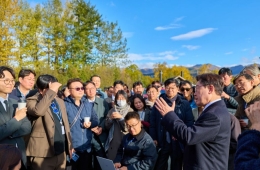
Kim Jungkwan, Minister of Trade, Industry and Energy (right), is seen taking a commemorative photo on the 25th (local time) in Mexico before a meeting with Lee Jae-myung and Marcelo Ebrard, Mexico's Secretary of Economy. Ministry of Trade, Industry and Energy
View original imageSouth Korea and Mexico have begun preliminary steps toward establishing a trade agreement. Both countries are launching a joint study to assess the economic effects of such a trade agreement, while also expanding the scope of economic cooperation to include minerals and resources, supply chains, and investment. As Mexico recently raised tariffs on countries without a free trade agreement (FTA), increasing the burden on Korean companies operating locally, attention is focused on whether discussions on a trade agreement between the two countries will now accelerate.
According to the Ministry of Trade, Industry and Energy on September 27, President Lee Jaemyung's state visit to Mexico served as an opportunity for South Korea and Mexico to sign the "Economic and Industrial·Resource Cooperation Initiative," and to launch a Joint Benefit Study as a preliminary step toward pursuing a trade agreement.
Minister Kim Jungkwan of the Ministry of Trade, Industry and Energy and Marcelo Ebrard, Mexico’s Minister of Economy, signed the Initiative under the witness of both heads of state, right after the Korea-Mexico summit on September 24 (local time).
The two countries will establish a joint committee to implement the initiative, where they will discuss cooperation in minerals and resources, as well as improvement of the business environment for Korean companies operating locally. Cooperation between Korea Trade-Investment Promotion Agency (KOTRA) and corresponding Mexican institutions will also be enhanced to facilitate trade and investment expansion.
In particular, the two countries agreed to launch a Joint Benefit Study in preparation for future trade agreement negotiations. This process involves analyzing the potential benefits and economic impact a trade agreement may bring to both parties. Specific plans for further cooperation will continue to be discussed through the joint committee and working groups.
During a separate meeting with Minister Ebrard in Mexico City on September 25, Minister Kim underscored the need for a bilateral trade agreement. He conveyed that Mexico’s recent increase in tariffs for non-FTA countries has raised operating costs for Korean companies in Mexico and weakened incentives for additional investment.
Minister Kim also shared specific difficulties faced by Korean enterprises operating in Mexico, such as customs clearance delays, port congestion, inadequate power infrastructure, and challenges arising from the Mexico-Brazil automotive agreement (ACE55). He asked for support from the Mexican government regarding these issues.
In addition to intergovernmental cooperation, private sector economic cooperation will also be expanded. The Ministry of Trade, Industry and Energy and the Korea Chamber of Commerce and Industry (KCCI) hosted the "Korea-Mexico Business Forum" on September 25 at the World Trade Center in Mexico City, attended by President Lee, Minister Ebrard, and approximately 300 Korean and Mexican business figures.
From the Korean side, more than 150 participants attended, including Chey Tae-won, Chairman of KCCI, Koo Kwangmo, Chairman of LG, Koo Ja-eun, Chairman of LS, Roh Taemoon, President of Samsung Electronics, Song Hosung, President of Kia, and Lee Kye-in, President of Posco International.
The forum highlighted cases of business and cooperation between the two countries in areas such as investment, high-tech industries, supply chains, future industries, energy, and the creative culture industry. Discussions were also held on broadening cooperation, currently focused on manufacturing and supply chains, to new fields such as energy, digital, biotechnology, and the cultural industry.
Four private-sector Memorandums of Understanding (MOUs) were signed to put these discussions into practice. POSCO International and Korea Aerospace Industries (KAI) signed a comprehensive cooperation MOU with the Mexican Federation of Aerospace Industries (FEMIA) for the development of the aerospace sector. HS Hyosung Advanced Materials signed an MOU with the state government of San Luis Potosi for investment in a local production base for industrial products.
The KCCI and Mexico’s Business Council for Foreign Trade, Investment and Technology (COMCE) signed an MOU to expand economic and trade cooperation, and KOTRA and COMCE also agreed to strengthen collaboration in trade and investment.
Minister Kim said, “South Korea and Mexico have nurtured a close economic relationship centered on manufacturing and supply chains. The Korean government will proactively support efforts to expand the horizon of cooperation to promising future sectors, including high-tech industries, energy and strategic sectors, digital and bio, thus creating new opportunities for the joint growth of the Korean and Mexican economies.”
Efforts are also being made to expand entry into the Latin American consumer market. The Ministry of Trade, Industry and Energy and KOTRA held the "Korea Excellent Product Fair" in Mexico City from September 24 to 25 for domestic consumer goods companies.
The event saw the participation of 82 Korean companies, including those joining online, as well as 123 local buyers, resulting in a total of 730 consultations. Major local online distribution network sellers, including Amazon Mexico, Mercado Libre—the largest e-commerce platform in Latin America—and TikTok Shop, also took part.
The Korean government plans to broaden the scope of bilateral economic cooperation—historically focused on supply chains and investment—to the consumer goods sector as well, leveraging Mexico’s role as a strategic hub bridging the North American and Latin American markets.
Hot Picks Today
 "Auntie, When Will Dried Shredded Squid Return as a Side Dish?"...Once Vanished from Restaurants, Now Making a Comeback
- Monthly Salary Soars 3.7 Times from 8.25 Million Won to 30.59 Million Won... 86 Fair Trade Commission Retirees Join Law Firms Over 10 Years
- Spate of Shootings at South African Tavern and Store Leaves at Least 27 Dead, 26 Injured
- "You've Earned Your Wealth—Now It's Time to Use It Well"...Seniors Turning to Financial Centers Before Illness Hits [Finance Embracing Seniors] ①
- "V and Go Yoonjung Wear Them Too"... The Transformation of the ‘Grandma Ring’ Captivates Foreigners [K-Holic]
Minister Kim stated, “Based on the local demand confirmed at this event, we plan to comprehensively support the expansion of cooperation with Mexico—gateway to the Latin American market—from a primary focus on investment and supply chains to now include the consumer goods sector, backing our companies’ entry into Latin America in a substantial way.”
© The Asia Business Daily. All rights reserved. Unauthorized AI training and use prohibited.