Will Iran Ease Its Control of the Strait of Hormuz After U.S.-China Declaration Against International Strait Transit Fees?
Iran Faces Increased Pressure from U.S.-China Agreement
But Remains Unchanged as the Accord Is Seen as Principled Declaration
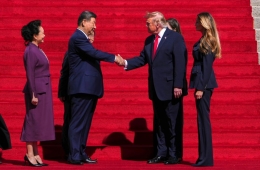
U.S. President Donald Trump and Chinese President Xi Jinping have agreed at their summit to oppose an "international strait transit fee," a move that is expected to place additional pressure on Iran as it seeks to control the Strait of Hormuz. However, some analysts point out that this agreement remains largely principled, so it is unlikely to immediately weaken Iran’s capacity to control the Strait of Hormuz.

U.S. President Donald Trump and Chinese President Xi Jinping are shaking hands during a meeting in Washington, D.C., USA. Photo by AP Yonhap News
View original imageAccording to the U.S. White House fact sheet released on September 25 (local time), "The two leaders agreed that no nation or entity should be allowed to impose a fee on transit through international straits." While neither Iran nor the Strait of Hormuz was directly mentioned in the fact sheet, the language follows a statement declaring "the two leaders agree that Iran must never possess a nuclear weapon," suggesting the possibility that Iran could face increasing pressure.
From Iran’s perspective, it is an unwelcome development that the Chinese leader—one of its major allies—reached such an agreement with a counterpart actively engaged in conflict. The timing is particularly sensitive, as just a week before President Xi’s U.S. visit, Iran’s foreign minister visited China to discuss wartime issues and navigation through the Strait of Hormuz. China’s acceptance of this phrasing at the summit appears to reflect its judgment that ensuring free passage through the Strait of Hormuz is in its own best interests.
China is both a strategic and security partner to Iran and is heavily reliant on energy imports and maritime trade. Therefore, if tensions rise in the Strait of Hormuz and passage is restricted or costs surge, China would inevitably be affected. In this context, it is rational for China to maintain relations with Iran but distance itself from actions that could destabilize international markets—such as a blockade of the Strait or imposing a transit tariff. The agreement can thus be interpreted to mean that China is not siding with the U.S. in pressuring Iran, but also cannot endorse measures that would undermine its core economic interests.
Nevertheless, this agreement can be viewed as a general declaration whereby China expresses support for openness and predictability in international maritime routes. Since the agreement does not explicitly mention Iran or the Strait of Hormuz, China has managed to maintain at least a minimal show of friendship toward Iran.
Hot Picks Today
!["Now Is the Cheapest"... Stocks Forecast for a 'Sharp Rise' After December 4 [Weekend Money]](https://cwcontent.asiae.co.kr/asiaresize/93/2025081909273687512_1755563255.jpg) "Now Is the Cheapest"... Stocks Forecast for a 'Sharp Rise' After December 4 [Weekend Money]
"Now Is the Cheapest"... Stocks Forecast for a 'Sharp Rise' After December 4 [Weekend Money]
- 'Just Watching?'... "Real Profits Are Elsewhere" Expert Picks True Robot Beneficiaries [Weekend Money]
- 'Is This the Same Chuseok?'... SMEs Pay 660,000 Won vs Lawmakers Receive 4.4 Million Won
- "Believing the 'Registered Mail Notice,' Victims Call First... Letter Phishing on the Rise"
- Miss Jamaica Who Loved Hyundai Suffers Brain Injury After Stage Fall
Given these circumstances, there is a view that this U.S.-China agreement will not immediately weaken Iran’s ability or willingness to control the Strait of Hormuz. In fact, it is not new for China to express its support for free navigation in the Strait. On September 16, during a meeting between the Chinese and Iranian foreign ministers, Chinese Foreign Minister Wang Yi urged for the early opening of the Strait of Hormuz and the safeguarding of international routes, energy transport, and supply chain stability.
© The Asia Business Daily. All rights reserved. Unauthorized AI training and use prohibited.