[Office of the President] "U.S.-China Summit Discussed Korean Peninsula Issue... 'Busan Consensus' Trend Continues"
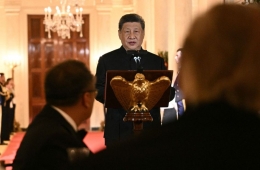
U.S.-China Summit Held in Washington, D.C.
Office of the President: "Ukraine and Middle East Issues Discussed... Still Assessing Details"
Office of the President: "Trade Conflict Suspension Period Short... Premature to Judge Long-Term Stabil
The Blue House assessed the U.S.-China summit held in Washington, D.C. on the 24th (local time) as a continuation of the approach toward managing bilateral relations that began with the APEC summit in Busan last year. However, the Blue House also noted that since the deferment period for trade tensions was described as relatively short, it is still too early to conclude that the two countries have entered a phase of long-term stability. At this summit between U.S. President Donald Trump and Chinese President Xi Jinping, issues including the Korean Peninsula, Ukraine, and the Middle East were also discussed.
![[Office of the President] "U.S.-China Summit Discussed Korean Peninsula Issue... 'Busan Consensus' Trend Continues"](http://www.asiae.co.kr/news/img_view.htm?img=2026092500073840720_1790262459.png)
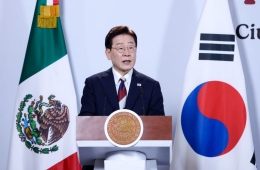
A senior official from the Blue House, speaking with reporters at a press center set up in Mexico City on the occasion of President Lee Jaemyung’s state visit to Mexico, said, "Although we have not yet confirmed the details, we understand that the Korean Peninsula issue was discussed at this meeting," adding, "Our understanding is that issues such as the Korean Peninsula, Ukraine, and the Middle East were on the agenda." Earlier, China's Ministry of Foreign Affairs also announced that the two leaders exchanged views on key international and regional issues—including the situation in the Middle East, the Ukraine crisis, and issues on the Korean Peninsula—at the White House meeting.
However, the Blue House official noted that it is not particularly unusual for the Korean Peninsula to be a topic at U.S.-China summits. He stated, "It is generally common for the issue of the Korean Peninsula to be discussed at U.S.-China summits," and added that regarding North Korea, "We will need to confirm the specific details of the exchanges between the two leaders."
The Blue House analyzed this summit as an extension of the framework first established at the leaders’ meeting in Busan last year, commonly referred to as the "Busan Consensus." The senior Blue House official explained, "The U.S.-China relationship had been headed toward intensified confrontation for some time, but in Busan last year the two sides broadly agreed to set a framework and manage the relationship," noting, "Experts call this the 'Busan Consensus.'"
He continued that, after the summit in Beijing this May, this framework developed into a more concrete form of "constructive and strategically stable relations." The Blue House official stated, "The relationship between the two countries has somewhat stabilized, and it was explained that certain frameworks for managing issues—such as supply chain and trade disputes, which were sources of confrontation—are now in place," adding, "It appears that the consensus reached in Busan was specified in Beijing and that this approach is continuing now."
Nevertheless, the Blue House expressed caution against concluding that U.S.-China relations have reached a path of long-term stability. In particular, it drew attention to the duration of mutual deferment measures regarding U.S. tariffs and Chinese export controls. The official commented, "Both the implementation of U.S. tariffs and China’s export controls have been deferred, and this deferral appears to still be in place," adding, "One of the main issues was whether this period would be set long or short, but from the announcement, it does not appear to be lengthy."
He added, "It does not seem that a very stable, long-term relationship has been established; rather, it seems that while relations are being managed, the deferment period is actually short. We need to analyze the details further as we obtain more information."
Hot Picks Today
!["Even with 410 Million Won in Assets, You May Not Be Middle Class"... The Six True Conditions of the Middle Class [Weekend Money]](https://cwcontent.asiae.co.kr/asiaresize/93/2026092213413938253_1790052098.jpg) "Even with 410 Million Won in Assets, You May Not Be Middle Class"... The Six True Conditions of the Middle Class [Weekend Money]
"Even with 410 Million Won in Assets, You May Not Be Middle Class"... The Six True Conditions of the Middle Class [Weekend Money]
- "Father, Please Help Me Buy a House" - Half of Home Purchases by Buyers in Their 20s Used Parental Support
- "Unable to Stream Due to Gluteal Amnesia"... 2.2 Million-Subscriber YouTuber Reveals the Condition
- "So Many People Flying to China?" Air Routes Drastically Increased... Beneficiaries Revealed [Weekend Money]
- Who Is the Woman Next to Ivanka? Trump’s Granddaughter Who Sang in Chinese for Xi Jinping 9 Years Ago
Meanwhile, the Blue House analyzed that the very trend of managing the risk of conflict between the U.S. and China creates a positive environment for South Korea as well. The senior official from the Blue House commented, "The continued management and stabilization of U.S.-China relations is basically positive for us as a country in the region," but also said, "Just how positive this is will require further analysis with additional information."
© The Asia Business Daily. All rights reserved. Unauthorized AI training and use prohibited.