Lee Directly Raises Korean Companies' Tariff Issues in Mexico Summit: "FTA Not Ready on Mexico's Side"
President Lee's Korea-Mexico Summit
Establishment of Joint Director General Committee... FA-50 Included as Summit Agenda
Wi Seongrak: "Institutional Cooperation to Be Strengthened for Korea-Mexico Economic Cooperation"
Seven-Year Investment
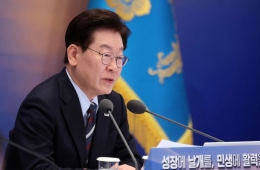
It was confirmed on the 24th (local time) that President Lee Jae-myung personally raised each of the difficulties faced by Korean companies in Mexico—such as tariff burdens and delays in the procedures for tariff exemptions and refunds—during his summit meeting with Mexican President Claudia Sheinbaum. The Mexican side is reportedly said to have responded to some issues by stating, "We will look into it," and "We will view it positively."

President Lee Jae-myung and Mexican President Claudia Sheinbaum co-chaired the Korea-Mexico Business Meeting at the Presidential Palace in Mexico City on the 24th (local time). The meeting was attended by more than 30 high-ranking officials from both countries, including nine Korean business leaders such as Choi Tae-won, chairman of the Korea Chamber of Commerce and Industry and chairman of SK Group, and Koo Kwang-mo, chairman of LG Group. September 25, 2026, Yonhap News Agency
View original imageIn addition, as for the Korea-Mexico Free Trade Agreement (FTA), which Korea favors, both sides agreed to explore the possibility of pursuing it only after the review of the United States-Mexico-Canada Agreement (USMCA) currently underway between Mexico and the U.S. is wrapped up. Until then, they will operate separate trade, investment, and industrial cooperation channels.
A senior official from the presidential office told reporters at the press center in Mexico City, set up for President Lee Jae-myung's state visit, "Although our preference is for an FTA, Mexico says it is not in a position to respond affirmatively at this time." According to the senior official, Mexico's ongoing review negotiations with the U.S. on the USMCA have brought rules of origin to the forefront as a key issue.
A significant number of Korean companies operating in Mexico import materials and parts from Korea, process and assemble them locally, and then export the finished products to the U.S. The senior official explained, "Because the U.S. is communicating tough requirements on rules of origin to Mexico, until these matters are resolved within the USMCA, discussions about trade agreements with Korea or other countries cannot take place."
Accordingly, both countries have decided to keep open various options, including not only an FTA but also a Comprehensive Economic Partnership Agreement (CEPA), which is a notch below. First, they plan to launch a 'Trade, Investment, and Industrial Cooperation Initiative,' and, under this umbrella, establish a director-level joint committee to conduct joint studies on mutual benefits and specific cooperation plans, which will then inform future steps forward.
The senior official said, "For now, we will wait for the results of the USMCA negotiations, but in the meantime, the joint committee will conduct research to identify mutual benefits, and based on those findings, we will proceed to the next stage. This in itself is a meaningful achievement."
The challenges faced by Korean businesses were also discussed in detail during the summit talks. The senior official stated, "President Lee does not stop at generalities during summit meetings, but instead pursues detailed and specific outcomes. On this occasion as well, he raised each and every difficulty, based on a summary document prepared in advance."
Particular emphasis was placed not only on tariff burdens but also on the problems caused by delayed procedures for tariff exemptions and refunds. The senior official stated, "While the Mexican side did not accept all requests, for some items they promised to 'look into it' or showed 'a positive outlook.' In short, the concerns of Korean businesses were adequately raised and discussed." Working-level officials from both sides are expected to carry forward follow-up discussions.
Wi Seongrak: "Results of the Korea-Mexico Summit—Systematic Cooperation to Implement Economic Collaboration"

Sung-Rak Wi, Director of the National Security Office, is giving a briefing on current issues at a hotel in Mexico, where President Lee Jae-myung is on a state visit, on the 24th (local time). 2026.9.25 Yonhap News Agency
View original imageWi Seongrak, Director of the National Security Office, announced during a briefing on the state visit that the two leaders had agreed to strengthen the necessary institutional cooperation in order to actively respond to the changing global trade environment and fully realize the economic cooperation potential shared by both countries. The two sides also agreed to conduct a joint study on mutual benefits and derive the best possible policies to expand mutually beneficial trade and investment.
A major outstanding issue in the renegotiation of the Bilateral Investment Treaty—which had dragged on for seven years—was resolved in one go during this summit. Director Wi explained, "While clarifying the legitimate regulatory authority of the host country, we have strengthened the protection of Korean businesses’ rights regarding investment recovery and compensation for losses." He also noted that provisions were newly introduced to prevent indiscriminate lawsuits from paper companies and to guarantee the transfer of investor funds even during foreign exchange crises, as well as to improve the dispute resolution process and scope of investor protection.
The two countries’ export-import banks also agreed to establish a new USD 100 million interbank credit line. They will further reinforce cooperation regarding intellectual property protection and information sharing on illicit customs clearance, and—building on the achievement of Korean companies securing an additional 13 million barrels of Mexican crude oil since the summit call in May—remain committed to securing a stable crude oil supply chain.
In the defense sector, the South Korean-made FA-50 light combat aircraft, which President Lee mentioned in an interview with local media, became an official agenda item in the summit. The senior official stated, "Defense cooperation between Korea and Mexico was one of the major themes, with the FA-50 specifically discussed among other items. We provided an explanation, and the Mexican side listened attentively and agreed to hold follow-up talks at the working level." He added, "Other military vehicles and equipment were discussed as well, and there is room to expand cooperation through further consultations."
During the business meeting, domestic companies presented plans to expand business in conjunction with the Mexican government’s industrial competitiveness strategy, 'Plan Mexico.' SK Bioscience proposed participation in Mexico’s national immunization program and cooperating on technology transfer for vaccine quality management. LG announced plans to increase investment in electric vehicle and autonomous driving sectors, as well as to expand its five current production bases across additional states.
Hot Picks Today
 "Please Pay Me at Least 3 Million Won a Month": More Than Half of Young People Today Prioritize "Working Conditions" Over Company Size
- Selling Like Crazy Every Year... 30-Year-Old Hetbahn Takes on a New Challenge: Tastes Better Than "Mom's Home Cooking" [On-Site Report]
- I Thought Only 'Old Guys' Ate It... Young People Are Hooked on This 'Unusual Food' at Risk of Disappearing? [Delicious Stories]
- [Exclusive] Prosecution Service Overhauls Cartel "Leniency" Rules, Guarantees Reporting Firms' Legal Status from the Outset
- Beachgoer Finds 'Plastic' That Turns Out to Be Perfume Ingredient Worth More Than Twice as Much as Gold
Director Wi noted that a total of 16 memorandums of understanding (MOUs) were signed during the state visit, spanning seven areas including the economy, finance, education, culture, tourism, development, and customs, with a separate declaration for cooperation in artificial intelligence. The two countries also agreed to build a comprehensive framework for collaboration in the aerospace sector, which will cover not only aircraft exports but also local production and maintenance, supply chain participation, financial support, and workforce development.
© The Asia Business Daily. All rights reserved. Unauthorized AI training and use prohibited.