From Mexico, President Lee Cites 22-Year-Old National Security Act Debate, Directly Challenges Yoo Si-min
Attending Meeting with Korean Residents in Mexico
Recalling the Conflict over National Security Act Revision and Abolition
"Radical Clarity May Look Impressive, But Achieving Tangible Results Is Difficult"
Presidential Office to Yoo Simin: "Regret Over Distortion of Will for Prosecution Reform"
Once Again Draws the Line on Constitutional Amendment for Consecutive Terms
"There Will Be No Case of Going Beyond June 2, 2030"
President Lee Jaemyung emphasized the need to produce tangible results in the reform process by being cautious about excessive speed and competing for "radical clarity," while also minimizing resistance from vested interests. He particularly cited the debate over the revision and abolition of the National Security Act during the Roh Moo-hyun administration as an example, conveying that excessive demands from reformers can actually result in missing opportunities for institutional change. This remark notably came just after he openly expressed regret towards author Yoo Si-min, who, the previous day, criticized the president's plans for prosecution reform by stating that "the public has been deceived." Regarding the recent debate over constitutional amendment and possible extension of presidential terms, President Lee once again drew a clear line, stating, "There will never be a case of going beyond June 2, 2030."

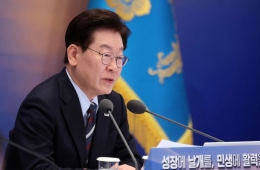
During his state visit to Mexico, President Lee shared relatively detailed thoughts on pursuing reform in a meeting with Korean residents in Mexico City on the afternoon of the 24th (local time), saying, "Within the limited timeframe, I am trying to accomplish as many of the tasks and promises that I can and have wanted to do, making the most of every single moment and sparing not a second."
President Lee defined reform as "changing what is abnormal into normal" and "adjusting the system and reconciling interests." According to his analysis, groups that benefit from the current system may be small in number, but they resist changes strongly because the losses are direct to them. Meanwhile, the majority, who stand to gain from reform, often take the changes for granted and are less likely to actively speak up.
He stressed that "how we achieve results" is just as important as the cause of reform itself. Referring once again to the French Revolution, as he did during his recent state visit to France, he warned, "When revolutionary circumstances arise, there is a tendency to go overboard; moving too fast, too far, and too rashly can trigger backlash."
This time, President Lee also pointed to the debate surrounding the National Security Act during the Roh Moo-hyun administration. He explained that at the time, there was potential bipartisan agreement to revise some controversial clauses instead of abolishing the entire Act. However, calls within the ruling party for a complete repeal grew louder, which ultimately led to a failure to make any revisions at all.
"Suddenly, someone began to object, saying, 'Abolition means abolition, how can you abolish only half of it?'" President Lee said. "With the opposition adamant about not abolishing the whole Act, nothing was accomplished in the end. Some people make extreme demands just to showcase their own clarity. That may look impressive, but it is rarely effective in creating the desirable changes we seek."
In 2004, there was an intense debate within the ruling Uri Party over whether to revise or entirely abolish the National Security Act. At the time, author Yoo was also a lawmaker and among those who called for full abolition. Nevertheless, the failure to revise or abolish the Act resulted from a complex mix of factors: not only internal disagreements within the ruling party, but also resistance from the opposition Grand National Party, parliamentary occupations, and deadlocked negotiations between party leaders. There are still differing assessments in political circles regarding the events of that period.
These circumstances have led to interpretations that President Lee's recent remarks may have been intended for author Yoo, who is currently in conflict with the president over the issue of prosecution reform. On a YouTube broadcast on the 22nd, author Yoo criticized President Lee's plan for prosecution reform, which was announced in a press conference on the 18th, stating, "What the president proposed was fundamentally different from what we understood prosecution reform to be—different from the Democratic Party position and the president's campaign promises. The public has been misled until now."
The controversy began with President Lee's press conference. He described the "maximum" extent of prosecution reform as splitting the roles of prosecutors in charge of investigation and those in charge of indictment, assigning these two functions to different agencies within the Ministry of Justice. Author Yoo argued that this was very different from the "complete organizational separation of investigation and indictment" that the ruling party and its supporters had understood. He also criticized the president for not disclosing his plan earlier, stating, "I've never heard such a thing before."
This is not the first direct clash between author Yoo and the presidential office. In July, author Yoo had argued that the delay in prosecution reform was because President Lee did not actually want a complete separation between investigation and indictment. At that time, the presidential office responded, "We do not respond to remarks by specific individuals," but also stated, "The president and the presidential office have never wavered in their commitment to the core value of separating investigation and indictment as part of prosecution reform."
However, as author Yoo's criticism escalated to the accusation that "the public has been deceived," the presidential office responded even more strongly. In a special media release on the 24th, the presidential office said, "We regret the distortion of the president's will for prosecution reform," and that "we are verifying the facts regarding the continued baseless accusations." However, regarding reports that legal action might be considered against author Yoo, the office stated, "No decision has been made on whether to pursue legal action."
President Lee did not mention specific individuals during his speech on this day. However, by criticizing the insistence on "complete repeal" within the reformist camp during the National Security Act debate, and in light of the presidential office's rare official response to author Yoo's criticism just the day before, some believe President Lee's statements were aimed at the ongoing debate within the ruling camp over the direction of reform. President Lee stated, "It may feel tempting to resolve everything at once with a big splash, but that's not easy. It is better to minimize resistance and backlash as much as possible and produce meaningful, practical results."
Hot Picks Today
 "Please Pay Me at Least 3 Million Won a Month": More Than Half of Young People Today Prioritize "Working Conditions" Over Company Size
- Selling Like Crazy Every Year... 30-Year-Old Hetbahn Takes on a New Challenge: Tastes Better Than "Mom's Home Cooking" [On-Site Report]
- "Americans Would Be Amazed If They Came": Wide-Eyed at a Sight They've Never Seen Before... Foreigners Also Fall for K-Baseball [K-Holic]
- President Lee Narrows Candidates for Next Justice Minister to Former Prosecutors Yang Bunam and Park Gyuntaek
- Beachgoer Finds 'Plastic' That Turns Out to Be Perfume Ingredient Worth More Than Twice as Much as Gold
Towards the end of his remarks, President Lee directly addressed the issue of his own term in office. Promising to strengthen support for overseas Koreans, he said, "So that none of you need worry about Korea, I assure you that as long as I remain in office, the Republic of Korea will take good care of you." Smiling, he added, "There will never, ever be a case where my term goes beyond June 2, 2030, so for anyone who is concerned about this, please don't worry." This is a reiteration—following his September 18 press conference where he stated "I have absolutely no intention of seeking a consecutive term"—of his stance, firmly specifying the end date of his term and once again denying any possibility of constitutional amendments for re-election or term extension.
© The Asia Business Daily. All rights reserved. Unauthorized AI training and use prohibited.