President Lee Cites Failed National Security Act Revision, Targets Yoo Simin? "Excessive Demands Rarely Yield Good Results"
Meeting with Korean Expatriates in Mexico
"Moving too fast, too far, too abruptly leads to backlash"
Aiming at hardline voices within the ruling camp
"We must minimize resistance and achieve practical results"
Once again draws a line on re-election: "There will be no extension beyond June 2, 2030"
President Lee Jaemyung emphasized the importance of both speed and restraint in the reform process, stating that tangible results must be achieved while minimizing resistance from vested interests. He also reiterated that excessive demands from within the reform camp can actually hinder institutional improvements, using the example of the National Security Act's “praise and incitement” clause. Regarding the recent debate on constitutional amendment for a possible extension of his term, he once again dismissed the possibility, saying, “There will absolutely be no instance of exceeding June 2, 2030.”

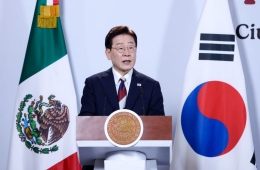
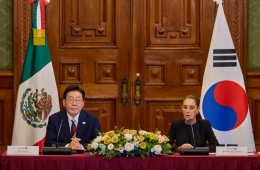
During his state visit to Mexico, President Lee explained his views on advancing reforms in some detail at a meeting with Korean expatriates held in Mexico City on the afternoon of the 24th (local time). He stated, “Within a limited timeframe, I am devoting every minute and second to accomplish as many tasks and promises as possible—both what I can do and what I have wanted to do.”
President Lee defined reform as “normalizing what is abnormal” and as “changing the system and mediating interests.” He further explained that although the number of people benefitting from the existing system may be small, those individuals strongly resist any change due to their potential losses. On the other hand, the majority who stand to benefit from reform tend to take those benefits for granted and, as a result, are less likely to speak out actively.
He further stressed that the approach to reform is just as important as the need for reform. President Lee once again cited the example of the French Revolution, which he had mentioned during his state visit to France, stating, “When revolutionary situations arise, there is a tendency to go overboard.” He added, “If you move too quickly, too far, or too abruptly, you may trigger a backlash.”
This time, he also referenced a past instance where amendments to the National Security Act failed. President Lee explained that at one point during debates on the National Security Act, there was an opportunity to remove certain toxic clauses first. However, demands for full abolition ultimately led to the collapse of the entire amendment effort.
President Lee then stated, “That is why, even recently, people have been subjected to searches and seizures because that provision is still in force.” He continued, “People make excessive claims to demonstrate their clarity; while it might look admirable, it rarely produces good results in practice.” This comment was interpreted as being directed at writer Yoo Simin, who was a strong advocate for the complete abolition of the National Security Act in the past. The previous day, the Blue House also expressed a critical stance towards Mr. Yoo’s recent remarks, in which he sharply criticized President Lee's direction on prosecution reform, saying, “It is regrettable that he is distorting the President’s determination for prosecution reform contrary to the facts.”
The current National Security Act, Article 7, stipulates punishment for so-called “praise and incitement” offenses—specifically, acts that praise, incite, or sympathize with the activities of anti-state organizations. President Lee commented, “It would be nice if we could make bold, sweeping changes at once, but that is not easy.” He continued, “It is best to minimize resistance as much as possible, minimize backlash, and create impactful results in an effective and practical way.” These remarks underscore that, for him, the strategy and process of yielding realistic outcomes are just as important as the reform direction itself.

In the final part of his address, President Lee once again touched upon the matter of his term in office. He pledged to strengthen support for overseas Koreans and said, “So that all of you do not need to worry about the Republic of Korea, at least during my tenure, I will make sure Korea takes good care of you.”
Hot Picks Today
![Micron Holds the Fate of Semiconductor Stocks After Chuseok, Could Trigger a New Rally for Samsung Electronics and SK hynix [Weekend Money]](https://cwcontent.asiae.co.kr/asiaresize/93/2026021209081439676_1770854893.png) Micron Holds the Fate of Semiconductor Stocks After Chuseok, Could Trigger a New Rally for Samsung Electronics and SK hynix [Weekend Money]
Micron Holds the Fate of Semiconductor Stocks After Chuseok, Could Trigger a New Rally for Samsung Electronics and SK hynix [Weekend Money]
- "450,000 Deaths Expected by Early Next Year"... World's Worst-Ever El Nino Forecast Spurs Global Alarm
- From 140 Million to 800 Million: The Turnaround Story of Gangwon's Sundial Once Criticized for "Wasting the Budget"
- From Mexico, President Lee Cites 22-Year-Old National Security Act Debate, Directly Challenges Yoo Si-min
- Who Is the Woman Next to Ivanka? Trump’s Granddaughter Who Sang in Chinese for Xi Jinping 9 Years Ago
President Lee, with a smile, then reassured, “There will absolutely never be a case where I remain in office beyond June 2, 2030. So, for those of you who may have concerns about such a thing, please put your minds at ease.” At a press conference on the 18th, President Lee had also stated, “I have absolutely no intention to serve a second term,” again drawing a clear line against the possibility of constitutional amendments for extension.
© The Asia Business Daily. All rights reserved. Unauthorized AI training and use prohibited.