Two Giant Pandas from China to U.S.: "Longtime Envoys of Goodwill"
From Four to Six Pandas in the United States
China Announces Plan to Invite 100,000 Young Americans
Chinese President Xi Jinping has announced that two giant pandas, often referred to as "China's envoys of goodwill," will be newly sent to the United States.

Giant panda Xiao Qiji at the Smithsonian National Zoo in Washington DC, USA. Photo by Yonhap News
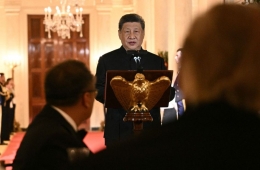
View original imageOn September 24 (local time), President Xi made this announcement during a welcoming ceremony speech preceding his summit with U.S. President Donald Trump at the White House. He stated, "I have some good news. In a few days, two pandas, 'Pingping' and 'Fushuang,' will find a new home at Zoo Atlanta and be introduced to the American public." He explained that giant pandas have long served as envoys of goodwill between the people of China and the United States. According to Zoo Atlanta, both pandas were born in 2020, with Pingping being male and Fushuang female.
Currently, there are a total of four pandas in the United States: two at the Smithsonian National Zoo in Washington, D.C., and two at the San Diego Zoo. Zoo Atlanta also has a long-standing connection with Chinese pandas. Since 1999, the United States and China have conducted joint panda research, and Zoo Atlanta once hosted "Yang Yang" and "Lun Lun," who gave birth to seven cubs. All of these pandas have since returned to the Chengdu Research Base for Giant Panda Breeding in China.

Chinese President Xi Jinping (left) and U.S. President Donald Trump. Photo by Reuters.
View original imageOn the same day, in addition to announcing the dispatch of pandas as goodwill envoys, President Xi also declared that over the next five years, China would invite 100,000 young Americans to the country, offering them opportunities for exchange and learning. He emphasized, "As two great powers, when we cooperate, we both benefit; but when we confront each other, both sides suffer losses."
China has long engaged in so-called "panda diplomacy," sending pandas abroad to help foster friendly relations. While there are various accounts regarding its origins, the practice is widely considered to have begun in earnest when Chinese authorities gifted two pandas to the United States in 1972 to commemorate the normalization of U.S.-China relations following President Richard Nixon's visit to China. Although the initial pandas were gifts, since the 1980s China has adopted a long-term leasing model and started charging rental fees, after it joined the "Washington Convention" in 1983, which prohibits the sale or donation of rare animals.
Hot Picks Today
![Micron Holds the Fate of Semiconductor Stocks After Chuseok, Could Trigger a New Rally for Samsung Electronics and SK hynix [Weekend Money]](https://cwcontent.asiae.co.kr/asiaresize/93/2026021209081439676_1770854893.png) Micron Holds the Fate of Semiconductor Stocks After Chuseok, Could Trigger a New Rally for Samsung Electronics and SK hynix [Weekend Money]
Micron Holds the Fate of Semiconductor Stocks After Chuseok, Could Trigger a New Rally for Samsung Electronics and SK hynix [Weekend Money]
- "450,000 Deaths Expected by Early Next Year"... World's Worst-Ever El Nino Forecast Spurs Global Alarm
- From 140 Million to 800 Million: The Turnaround Story of Gangwon's Sundial Once Criticized for "Wasting the Budget"
- Iran Proposes '7-Day Roadmap' to U.S. for Reopening Strait of Hormuz
- Defeated All Adult Competitors... 11-Year-Old Takes First Place in "Puyopuyo" Preliminaries
In 2023, the Chinese government recalled three giant pandas from the Smithsonian National Zoo in Washington, D.C., which had been leased to the U.S. capital. In recent years, the number of pandas in the U.S. declined due to the expiration of lease agreements, and as U.S.-China relations deteriorated, some speculated that the withdrawal of pandas reflected the current state of bilateral relations—suggesting China was using "punitive panda diplomacy." Foreign media noted that "since their arrival in Washington, D.C., pandas have symbolized the link between the U.S. and China," and assessed that the era of panda diplomacy has, at least for now, come to an end.
© The Asia Business Daily. All rights reserved. Unauthorized AI training and use prohibited.