President Lee’s State Visit to Mexico Breaks the Deadlock in Trade and Industrial Cooperation
President Lee Wraps Up Summit with President Sheinbaum
Seventeen MOUs Signed, Joint Press Announcement Issued
Seven-Year IPPA Renegotiation Concluded
Trade Agreement Talks Back on Track
$100 Million Finance and Crude Supply Cha
With President Lee Jaemyung’s state visit to Mexico, there are expectations that the long-stalled economic cooperation between Korea and Mexico will finally gain momentum. The two countries have concluded a revision of the bilateral Investment Promotion and Protection Agreement, negotiations for which had dragged on for seven years, and have also placed the issue of a trade agreement—previously at an impasse—back on the agenda. In addition, a new financial support scheme worth 100 million dollars for businesses and new channels for cooperation in crude oil and critical resource supply chains have been established. These developments are seen as laying the groundwork for expanding the bilateral economic relationship beyond trade, to include investment, supply chains, and advanced industries.

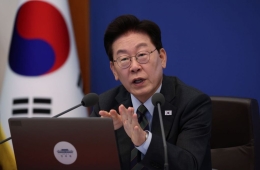
President Lee Jae-myung is speaking at a joint press conference with Claudia Sheinbaum, President of Mexico, held at the Presidential Palace in Mexico City on the 24th (local time). 2026.9.25 Yonhap News Agency
View original imageOn the 24th (local time), President Lee held a summit meeting with President Claudia Sheinbaum at the Presidential Palace in Mexico City, and the two leaders adopted the "Korea-Mexico Joint Action Plan 2026–2030." This marks the first state visit to Mexico by a South Korean president in sixteen years. The two leaders first held a small-group meeting from 10:05 a.m. for 44 minutes, which was then followed by an expanded meeting from 10:50 a.m. for an hour and fifteen minutes—amounting to around two hours of discussions in total. The visit comes as both nations seek to broaden their cooperation scope into trade and investment, energy, technology, and the aerospace and defense sectors.
The most significant economic outcome is the successful conclusion of negotiations to revise the Investment Promotion and Protection Agreement, which had lasted for seven years. The two countries have agreed to expedite the signing and parliamentary ratification process to bring the revised accord into effect promptly. The agreement serves to protect the assets of businesses and investors operating in each other’s countries from unfair expropriation or discriminatory measures, and sets standards concerning the remittance of investment funds, compensation, and dispute resolution. For overseas investors, it acts as a form of “safety net” that reduces uncertainty due to potential local policy changes.
Progress has also been made on the long-stalled trade agreement. Currently, in the absence of a Korea-Mexico Free Trade Agreement (FTA), bilateral trade is based primarily on World Trade Organization (WTO) rules. The Mexican side has also acknowledged that the two economies are not only competitive but also mutually complementary in structure.
During the joint press conference, President Lee stated, "I emphasized the importance of concluding a trade agreement to expand bilateral trade and investment and to create a stable business environment." However, the two countries did not immediately agree to resume formal negotiations. Instead, their respective trade authorities will first conduct a "joint study on mutual interests" to seek ways for mutually beneficial economic cooperation.
The Mexican side also expressed hopes for additional investments by Korean companies. Prior to the summit, President Sheinbaum said, "Korean companies wish to invest in Mexico," and stated her intention to directly address their questions and future investment plans. In the joint press conference, both leaders highlighted the shared vision of “joint prosperity” and announced their commitment to create mutually beneficial outcomes by combining Korea's industrial and technological strengths with Mexico's competitive advantages.
This agenda is closely aligned with the Sheinbaum administration’s industrial development initiative, “Plan Mexico.” The Mexican government is pursuing domestic production and investment expansion, as well as technological advancement, as key pillars of Plan Mexico. Indeed, President Sheinbaum recently highlighted Kia Korea’s investment of $649 million in Mexico and the expansion of local electric vehicle production as examples of increased local manufacturing.
Breakthroughs in Business Finance and Supply Chain Cooperation... Expansion of Advanced Industry Collaboration in AI, Aerospace, and Defense

President Lee Jae-myung and President Claudia Sheinbaum of Mexico are holding a private meeting at the Presidential Palace in Mexico City on the 24th (local time). 2026.9.25 Yonhap News Photo by Yonhap News
View original imageCooperation in business finance and supply chains has also been established. Korea Eximbank and Mexico’s National Bank of Foreign Trade (Bancomext) will open a new $100 million line of credit. This will support Mexican companies purchasing Korean goods and services, as well as Korean companies operating in Mexico with their financing needs. The two countries have also agreed to launch a bilateral dialogue channel to discuss cooperation in crude oil and critical resources.
President Lee said, "Since our phone call in May, President Sheinbaum has been instrumental in ensuring additional crude oil supply to Korean companies," adding, "We agreed to continue our cooperation for stable oil imports." The two leaders also recognized the urgent need to conclude a social security agreement to reduce the issue of double pension contributions imposed on overseas-dispatched companies and workers in both countries.
The scope of economic cooperation is also expected to expand into advanced industries, including AI and digital, aerospace, and defense. The two countries have adopted a "Korea-Mexico AI Cooperation Declaration," and a joint public-private delegation comprising representatives from the Korean government and industry will be sent to Mexico in November to discuss follow-up projects. The bilateral Joint Committee on Economic, Scientific, and Technological Cooperation, which had been on hold since 2015, will also resume.
In aerospace, Korea Aerospace Industries (KAI) and POSCO International, among others, will pursue partnerships with Mexican counterparts to operate and maintain FA-50 aircraft, unmanned aerial vehicles, and satellites, as well as to build local supply chains. They are also considering the potential for industrial cooperation with local companies in Mexico to produce aerospace products developed and manufactured by KAI.
Regarding the defense sector, President Lee said, "I look forward to President Sheinbaum’s interest and support so that Korea’s outstanding defense technology can lead to local production in Mexico, thereby strengthening Mexico’s defense capabilities and enabling both countries to jointly enter third-country markets."
However, not all outstanding trade issues were resolved in this summit. The trade agreement is just taking its first step through the joint study, and the Investment Promotion and Protection Agreement still requires signing and ratification. Nevertheless, with cooperative mechanisms in investment protection, trade agreements, finance and supply chains, and advanced industries all being activated simultaneously, the summit appears to have provided a framework for reinvigorating Korea-Mexico economic cooperation.
Hot Picks Today
![[Exclusive] "My paycheck fell short, and I couldn't get a card loan either" More people in their 40s and 50s turn to 'cash advances'; "debt-investing woes" put long-term delinquency among those in their 20s and 30s on red alert](https://cwcontent.asiae.co.kr/asiaresize/93/2026102011173167293_1792462652.jpg) [Exclusive] "My paycheck fell short, and I couldn't get a card loan either" More people in their 40s and 50s turn to 'cash advances'; "debt-investing woes" put long-term delinquency among those in their 20s and 30s on red alert
[Exclusive] "My paycheck fell short, and I couldn't get a card loan either" More people in their 40s and 50s turn to 'cash advances'; "debt-investing woes" put long-term delinquency among those in their 20s and 30s on red alert
- "Seoul Has Never Seen This Before"... Monthly Rent Hits 1.66 Million Won as 51% Share Signals a 'Seismic Shift'
- “I Thought It Was Just Inflammation”: 70 Men Have Died of Breast Cancer in This Country in 5 Years
- "Korean Beef for Dinner Tonight" - Drawn in by Half-Price Deals, but... "What Else Is There to Buy?" at 'Empty' Homeplus
Meanwhile, after exchanging MOUs, the two leaders met with major businesspeople from the Korean economic delegation to discuss expanding investment and industrial cooperation in Mexico. The delegation included Chey Taewon, Chairman of SK Group; Koo Kwangmo, Chairman of LG Group; Koo Ja-eun, Chairman of LS Group; Roh Tae-moon, President of Samsung Electronics; Song Hosung, President of Kia; and Lee Gyein, CEO (Vice Chairman) of POSCO International.
© The Asia Business Daily. All rights reserved. Unauthorized AI training and use prohibited.