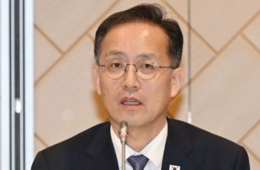
Prime Minister Carney of Canada Prepares for "Worst-Case Scenario" over Possible U.S. Military Action
Trump Pressures with '51st State' Threat
Emphasizes 'Tail Risk' Management
Presents Negotiation Cards: Starlink and F-35 Alternatives
Canadian Prime Minister Mark Carney revealed that he has considered even the worst-case scenario in which the United States could take military action against Canada and has been preparing countermeasures accordingly.
In an interview with The New York Times published on the 23rd (local time), Carney stated that he had closely examined the possibility of U.S.-led military action in response to U.S. President Donald Trump's threat to turn Canada into "the 51st state of America." Carney's statement officially confirmed that, as the nation's top leader, he is preparing for any contingency amid the rapidly deteriorating bilateral relationship since the launch of the Trump administration's second term.

In October 2025, at the White House in Washington D.C., U.S. President Donald Trump is greeting Canadian Prime Minister Mark Carney. Photo by Reuters·Yonhap News
View original image"Anyone in this position has a responsibility to consider extreme tail risks," Carney emphasized, adding, "This is merely risk management and not the base scenario, but not being prepared would be irresponsible." Tail risk is a financial and economic term for extremely unlikely but potentially catastrophic events. Carney, who previously served as governor of both the Bank of England and the Bank of Canada, has now applied this risk management framework to national security.
Carney also proposed specific measures to reduce Canada's excessive reliance on the United States in both security and economic spheres. He pledged to decrease dependence on 'Starlink', the low Earth orbit satellite internet network operated by Elon Musk's SpaceX, and instead to establish alternative satellite network partnerships in cooperation with allied countries such as those in Europe and Korea.
At the same time, Carney revealed a plan to revisit Canada's order for 88 F-35 stealth fighter jets from Lockheed Martin, and to consider alternatives such as Sweden's Saab Gripen fighter jet. He also disclosed intentions to procure aircraft optimized for Arctic operations, leveraging the increased defense budget.
Simultaneously, Carney presented diplomatic negotiation options to resolve trade disputes between the two countries. Despite the imposition of mutual retaliatory tariffs following the breakdown of trade agreements, he plans to leverage Canada's status as the supplier of approximately 90% of the potash imported by the United States. Potash is a key raw material for agricultural fertilizer, essential for crop growth and yield, and is regarded as a critical resource for food security.
Regarding President Trump's recent announcement to pursue the purchase of Belarusian potash—despite it being subject to sanctions—Carney responded that a comprehensive negotiation could be possible on the premise of North American fertilizer self-sufficiency, offering the United States special access to Canadian potash.
Hot Picks Today
 "I Should Enjoy It After Retirement": Prices Quadruple... Memberships Over 100 Million Won Popular, but Closures Mount
- "I thought getting into a big company was the goal"... The 'position' only 1 in 121 employees reaches
- "Jealous of Koreans" - Now a Must-Do on Every Trip... The Place Where Foreigners Spent KRW 229.8 Billion
- "People Line Up for 2 Hours Even for Plain Water"... After Crowds Flock from Across the Country, Gwangmyeong Bungeoppang Stall Suspends Business
- "Please Let Me Go Home"... Customers Trapped in Department Store Parking Lot for 5 Hours Vent Their Anger
Carney added that he continues to speak directly with President Trump by phone even after the breakdown of trade negotiations. "We maintain a good relationship in that we can call each other and speak directly on pending issues," he said. "He is straightforward, and I am equally candid about my position," Carney noted.
© The Asia Business Daily. All rights reserved. Unauthorized AI training and use prohibited.