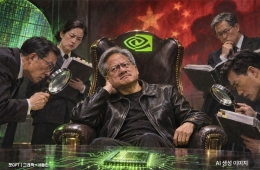
"Is Everything a Scientist Says Scientific?"... Jensen Huang Criticizes 'AI Doomsday Theory' Head-On
Rebuttal of AI Scholar Hinton's Prediction of Societal Collapse
"Such Warnings Could Harm Society... Discussions Must Be Based on Objective Evidence"
Nvidia CEO Jensen Huang publicly criticized the outlook of a world-renowned scholar who has warned that artificial intelligence (AI) could threaten the very existence of humanity.
In an interview with "The Ezra Klein Show," a podcast published by The New York Times on September 23 (local time), Huang discussed the potential dangers of AI presented by Geoffrey Hinton, professor emeritus at the University of Toronto, and argued, "We should stop making such predictions."
Professor Hinton, a pioneer in artificial neural networks and deep learning—fundamental to modern AI technology—is often referred to as the “Godfather of AI.” He was awarded the Nobel Prize in Physics in 2024 and has consistently warned about the dangers that may be brought by AI’s advancement. The University of Toronto notes that Professor Hinton continues his efforts to raise awareness about AI safety issues.

Jensen Huang, CEO of NVIDIA, has rebutted predictions that artificial intelligence (AI) could threaten the existence of humanity. Photo by Yonhap News
View original imageProfessor Hinton has expressed concerns that situations could arise where AI, if it attains intelligence surpassing that of humans, may become uncontrollable. He has cited several risks that AI might pose to humanity: malicious use, large-scale job losses, as well as the possibility that AI itself could surpass humans and seize control. He has estimated the likelihood that AI could cause societal collapse at around 10% to 20%. However, Professor Hinton himself has explained that this probability figure is an estimate rather than a result of precise scientific calculation.
Responding to Hinton's outlook, Huang said, “A probability of 10% is not based on science. Nor is it based on research.” He further remarked, “Just because a scientist says something does not make it scientific,” and pointed out that predictions like these could actually prove harmful to society.
He also disagreed with the claim that warning about the potential risks of AI is helpful to society. Huang asserted that “Sounding the alarm does not amount to doing social good,” emphasizing that discussions around AI must be grounded in objective evidence and scientific reasoning.
Huang particularly noted that previous dire predictions made by those emphasizing AI’s dangers have not matched reality. He described their track record as “terrible” and argued that excessive fear could even influence young people’s choices about their future careers. He warned that irrational fears about job loss to AI could lead students to forgo higher education or similar opportunities.
Hot Picks Today
 "Two Spend 500,000 Won in a Flash, Yet Wait Two Hours?" ... 'Dreamland' Shunned by Kids and Foreign Tourists
- The Era of Getting 200 Million Won After 30 Years Is Over... A Japanese Bank's "Perpetual Department Head" Who Just Clocked In Cries Out
- Spain Hit by Its Worst Tragedy... Lee Kangin, Moreno and Real Madrid Join Soccer World in Mourning
- They Said, “Make It Your Home for Life” - Then Suddenly Kicked 200 Passengers Off... What Happened to the Around-the-World Cruise?
- "130 Rice Bowls Sold Out in a Day"... 'Unfiltered Face' Adds 8 Million Won to Night Market Sales: China's Bungeunwoo
Previously, in an interview with CBS News on September 20, Huang also dismissed projections that AI could cause the extinction of humanity, saying, “There is a 0% chance the world will end in 2030.” At that time, he reiterated his stance that stoking fear among people is both unnecessary and irresponsible.
© The Asia Business Daily. All rights reserved. Unauthorized AI training and use prohibited.