Meeting Wall Street Heavyweights Again, Lee Says, "You'll Regret Not Investing in Korea Later" (Comprehensive)
Lee Hosts ‘Republic of Korea Investment Summit 2026’ in New York After a Year
Memory Production Capacity to Double in Five Years... "Aiming to Lead, Not Follow"
Major Leap in Advanced Industries with Three Mega Projects and Seven SEED Initiatives
Foreign Exchange Market to Operate 24 Hours; Ongoing Capital Market Reforms
Cooperation in Shipbuilding with Trump Disclosed
"Expecting More Tangible Results Ahead"
Wall Street ‘Big Shots’ Praise AI-Centered Growth Strategy
President Lee Jae-myung, who is visiting New York, USA to attend the United Nations General Assembly, stated on the 23rd (local time) that the Korean economy is demonstrating strong resilience and growth potential despite global trade and geopolitical uncertainties. He announced a significant expansion of investment in advanced industries—centered on semiconductors, physical artificial intelligence (AI), and AI data centers. Over the next five years, South Korea plans to double its memory production capacity and establish a "Future Response Fund." In addition, through capital and foreign exchange market reforms, the country aims to transform itself into a market where global capital can invest freely.
President Lee also publicly disclosed that he had discussed cooperation in the shipbuilding sector with U.S. President Donald Trump the previous day. He made clear his intention to expand the Korea-U.S. alliance into an industrial partnership encompassing technology, innovation, and economic security.

President Lee Jae-myung is speaking at the 'Korea Investment Summit 2026' event held at a hotel in New York, USA, on the 23rd (local time). From left: Timothy Geithner, Chairman of Warburg Pincus; Larry Fink, Chairman of BlackRock; President Lee Jae-myung; Jane Fraser, CEO of Citigroup; Emmanuel Roman, CEO of PIMCO. September 23, 2026, Yonhap News Agency.
View original imageDuring his opening remarks at the "Republic of Korea Investment Summit 2026" held in New York City, President Lee stated, "The Korean economy is advancing towards a new milestone" and that "even amid rapid shifts in the global economic order, our economy is showing strong resilience and future growth prospects." Just as in the previous year, President Lee organized discussions with prominent Wall Street investors again this year.
Citing recent export and growth forecasts, President Lee said, "Our monthly exports reached a record high of about 100 billion dollars for the first time ever in June this year," adding, "Annual exports are likely to reach 1 trillion dollars, which may put us among the world's top 5." He also noted that global institutions have raised their projections for South Korea's economic growth rate to the upper end of 3% this year, with next year’s growth expected in the high 2% range, saying, "What’s notable is how much the forecasts have increased compared to the first half of the year."
Additionally, he introduced the government’s drive to push ahead with three major megaprojects focused on semiconductors, physical AI, and AI data centers, along with seven key SEED projects to cultivate next-generation growth engines. In the semiconductor sector, he pledged, "We will expand production bases to double memory production capacity within the next five years," and stressed, "We will build a resilient core AI supply chain that cannot be shaken by any impact." He emphasized, "Rather than remaining a follower nation, we aim to be a leading country by connecting R&D, commercialization, mass production, and exports, pioneering new technologies and markets ahead of others."
Regarding the so-called "Korea Discount," which refers to the chronic undervaluation of the Korean stock market, President Lee assessed that it is now entering a resolution phase. He said, "In the past, people may have thought the Korean stock market was inherently undervalued, but I believe we are now moving past that stage," and added, "With further improvements, we can move toward a normal valuation that is much better than before."
He also promised that the government’s approach to industrial support would continue to evolve. Profits from the AI and semiconductor boom will be reinvested into foundational infrastructure for advanced industries and talent development, and a "Future Response Fund" will be established to provide stable support for these efforts. President Lee expressed his intention to move away from an investment structure for future industries that is vulnerable to economic and fiscal fluctuations.
He reaffirmed his commitment to capital and foreign exchange market reform to attract more foreign investment. President Lee explained that three amendments to the Commercial Act have introduced fiduciary duty for directors and the principle of retiring treasury shares, saying, "We are implementing plans to strengthen shareholder value." He added that the foreign exchange market will transition to a 24-hour trading system, enabling foreign investors to freely trade and settle won currency during key global market hours in London and New York, thus improving investment accessibility. "We will continue to lead changes that global investors can actually experience through ongoing capital and foreign exchange market reforms," he said.
On Korea-U.S. economic cooperation, he emphasized plans to expand the traditional security alliance to an economic security alliance that also covers advanced industries and supply chains. He said, "The evolving Korea-U.S. alliance toward the future is the foundation for shared prosperity," and noted, "With U.S. source technology, capital, and vast markets combining with Korea’s manufacturing and supply capabilities, the advanced industries and supply chains of both countries are now more closely connected than ever." He cited examples such as Samsung Electronics’ investment in Texas, SK hynix’s project in Indiana, Hyundai Motor’s investment in Georgia, and Samsung Biologics’ investment in Maryland as illustrative cases. He also predicted that cooperation in shipbuilding and the defense industry would become more concrete moving forward.
In particular, President Lee mentioned, "Last night, I also had various conversations with President Trump, one of which was cooperation in the shipbuilding sector, including constructing naval vessels," expressing hope for substantive results in the near future. President Lee and President Trump had a surprise summit the day before and discussed key bilateral issues, including progress in strategic investment projects between Korea and the U.S.

President Lee Jae-myung is taking a commemorative photo with attendees ahead of the 'Republic of Korea Investment Summit 2026' held on the 23rd (local time) at a hotel in New York, USA.
The event was attended by Jenny Johnson, CEO of Franklin Templeton; Emmanuel Roman, CEO of PIMCO; Jane Fraser, CEO of Citigroup; Larry Fink, Chairman of BlackRock; Timothy Geithner, Chairman of Warburg Pincus; John Lim, President of Samsung Bioepis; Sung Kim, President of Hyundai Motor Group; Yoo Jung-joon, Vice Chairman of SK; Hyun Shin-kyun, President of LG CNS; Jeong In-seop, President of Hanwha Ocean; Song Yong-jin, President of Doosan Enerbility; and Kim Byung-hoon, CEO of APR. 2026.9.23 Yonhap News Agency
President Lee repeatedly urged global investors to make proactive investments in Korea. He reminded them that just last September he emphasized the prospects for a reevaluation of the Korean stock market, and said, "I can confidently say you will almost certainly regret not investing in Korea when you look back later, wondering, 'Why didn’t I invest back then?'" He continued, "Please join us as investors in Korea’s growth and unprecedented advancement. I urge you to engage in bold discussions and make courageous decisions today."
Global investors attending the Korea Investment Summit praised South Korea’s competitiveness in AI, semiconductors, and advanced manufacturing, as well as its AI-centered growth strategy. According to a written briefing released by Hong Ki-hong, Senior Secretary for Public Communication, several investors shared their long-standing experience investing in Korea and collaborating with local firms, registering their high confidence in Korea’s technological capabilities, talent, and robust industrial base with the summit attendees.
There was also positive feedback on the recent capital and foreign exchange market reforms. Attendees said they expect initiatives, such as the transition of the foreign exchange market to a 24-hour trading system pursued by the Korean government, will enhance accessibility to the foreign exchange market. They also highlighted improvements in corporate governance and shareholder value as part of the government’s market reform efforts, noting that these have increased the market’s attractiveness and strengthened global investor trust, and commended the consistency and effectiveness of Korea’s policy execution.
Korean companies introduced examples of bilateral investment and industry cooperation across various sectors, including bio, mobility, AI, shipbuilding, nuclear power, defense, and K-beauty. They explained that the combination of U.S. technology and market access with Korea’s manufacturing and business development capabilities has mutually enhanced the industrial competitiveness of both countries, and predicted that future-industries-oriented cooperation opportunities will expand further in the years ahead. Lee Hyungil, Deputy Prime Minister and Minister of Economy and Finance, who attended the event, commented that with achievements in AI and semiconductors, macroeconomic variables such as exports, consumption, and investment are showing positive changes, and that Korea’s fiscal capacity has significantly improved. He emphasized that the Lee Jae-myung administration will continue its efforts to ensure these changes contribute to mid- and long-term economic growth.
At the conclusion of the event, President Lee once again called on global investors to maintain steady interest in Korea’s innovation and growth industries. Stating that Korea is undergoing positive transformation, he emphasized efforts to move from being a "catch-up economy" to a "leading force in the global economy." He appealed for continued foreign investment in Korea’s future, promising to further improve market accessibility and convenience while vigorously safeguarding investors’ rights and shareholder value.
Hot Picks Today
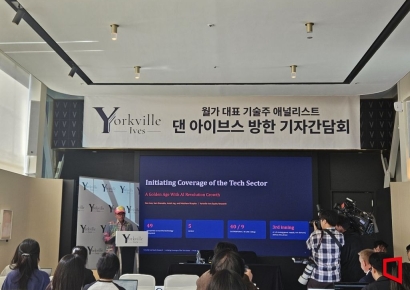 "Even New York Taxi Drivers Are Talking About the KOSPI; South Korean Market to Top 9,000 Again Within a Year"... 'Wall Street's Stock-Picking Ace' Names His Picks
- “Made 2 Billion Won in One Year in Prison,” PPP Lawmaker Retorts: “If You’re Jealous, Go There Yourself”
- "There's No Profit in Selling It"... Gimbap Disappearing from Menus
- “Washing Dishes and Folding Clothes 200 Times a Day”... China’s “Robot Trainers” Earn Up to 1.2 Million Won a Month
- "Shall We Grab a Drink?" KRW 30,000 a Round... Young Adults: "Prices Make My Hands Shake; I Can't Drink Out"
Also attending the event were John Rim, President of Samsung Bio; Yoo Jung-jun, Vice Chairman of SK; Sung Kim, President of Hyundai Motor Group; Hyun Shin-kyun, President of LG CNS; Jung In-seop, President of Hanwha Ocean; Song Yong-jin, President of Doosan Enerbility; Kim Byung-hoon, CEO of APR, as well as Lee Hyungil, Deputy Prime Minister and Minister of Economy and Finance, and Wi Sung-rak, Chief of the National Security Office. From the U.S. side, participants included Larry Fink, CEO of BlackRock; Jane Fraser, Chair of the Board and CEO of Citigroup; Timothy Geithner, Chairman of Warburg Pincus; Emmanuel Roman, CEO of PIMCO; Jenny Johnson, CEO of Franklin Templeton; and John Gray, President and Chief Operating Officer of Blackstone. In total, 30 key representatives from both countries attended.
© The Asia Business Daily. All rights reserved. Unauthorized AI training and use prohibited.