After Dramatic 30-Minute South Korea-U.S. Summit in New York, Lee Heads to Mexico for State Visit
Summit Achieved Between South Korea and U.S. on Sidelines of UN General Assembly
Talks Covered Wartime Operational Control, Nuclear Submarines, Shipbuilding, and North Korea-U.S. Dialogue
Hormuz Issue Not Brought to the Table
At the UN Multilateral Stage, Peace Vision and "K-Initiative" Outlined
Economic Diplomacy Wrapped Up with Major Wall Street Investors at Investment Summit
Next Stop: First State Visit to Mexico in 16 Years
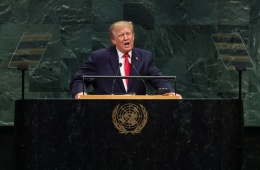
The highlight of President Lee Jae-myung's visit to the United Nations (UN) General Assembly was the last-minute summit between South Korea and the United States. As investment negotiations with the United States repeatedly encountered difficulties, the possibility of holding the summit was once considered low. However, following progress in those negotiations, the meeting was arranged in dramatic fashion, serving as an opportunity to coordinate stalled security and North Korea-related issues. On the global stage at the UN, President Lee presented his vision for peace on the Korean Peninsula and outlined Korea's role in the international community. For his final event in New York, he turned to economic diplomacy by promoting the South Korean economy to Wall Street investors.

President Lee Jae-myung, who is visiting the United States to attend the United Nations General Assembly, is having a summit meeting with U.S. President Donald Trump at a hotel in New York on the 22nd (local time). 2026.9.23 Yonhap News Photo by Yonhap News
View original imageOn the 22nd (local time), the two leaders moved to a separate space at the reception hosted by U.S. President Donald Trump and held a summit for about 30 minutes, starting at 7:20 p.m. According to the Blue House, due to uncertainty surrounding the outcome of investment talks with the United States, there were initially no concrete plans for a summit. However, as the negotiations saw last-minute progress, the South Korean side requested the meeting again, and the summit was confirmed for that morning. During the summit, the two leaders welcomed significant progress made in recent discussions regarding strategic investment projects between the two countries.
Security-related matters were also brought to the table. President Lee explained the South Korean government's position on the transfer of wartime operational control and called for swifter discussions on nuclear-powered submarine fuel, uranium enrichment and spent nuclear fuel reprocessing, and shipbuilding cooperation. President Trump reportedly expressed a particularly keen interest in shipbuilding cooperation. Both sides agreed to continue follow-up discussions on these matters as soon as possible.
The issue of restarting North Korea-U.S. dialogue also took on added significance. President Lee conveyed his hopes that President Trump would play a role in breaking the deadlock and paving the way for renewed talks between North Korea and the U.S., especially in light of the fact that inter-Korean contacts have virtually ceased. President Trump reaffirmed his willingness to engage in dialogue with North Korea and responded that he maintains good relations with North Korean leader Kim Jong Un. In contrast, the issue of the Strait of Hormuz—where the U.S. has called on South Korea to expand its contributions—was not discussed at the summit.
Previously, at the UN General Assembly podium, President Lee had unveiled his vision for peace on the Korean Peninsula. He presented three main blueprints for inclusive, stable, and responsible peaceful coexistence. He advocated a phased approach: first halting North Korea’s advancement of nuclear and missile capabilities, then working toward their reduction, and ultimately aiming for a "nuclear-free Korean Peninsula" in the long term. His plan calls for an early resumption of North Korea-U.S. dialogue, positioning South Korea as a "pacesetter" to help lay the foundation for talks.
On global issues, President Lee introduced the "K-Initiative." He outlined three key visions: a global AI foundational society, a green transition, and an international energy supply chain alliance. He also proposed forming a "coalition of constructive contributor countries" to address supply chain crises such as those affecting the Strait of Hormuz and the Red Sea. His message was that Korea hopes to expand its role to encompass not only issues on the Korean Peninsula, but also shared challenges faced by the international community—such as AI, climate, and energy supply chains.

President Lee Jae-myung is speaking at the 'Korea Investment Summit 2026' held on September 23 (local time) at a hotel in New York, USA. From left to right: Lee Hyungil, Deputy Prime Minister and Minister of Economy and Finance; Timothy Geithner, Chairman of Warburg Pincus; Larry Fink, Chairman of BlackRock; President Lee Jae-myung; Jane Fraser, CEO of Citigroup; Emmanuel Roman, CEO of PIMCO; Jenny Johnson, CEO of Franklin Templeton. September 23, 2026 Yonhap News Photo by Yonhap News
View original imageKorea’s economic diplomacy continued on the 23rd with the "Korea Investment Summit 2026." President Lee introduced three major megaprojects focusing on semiconductors, physical artificial intelligence (AI), and AI data centers to major players from global finance and investment, such as BlackRock and Citigroup. He announced plans to double Korea’s memory production capacity within the next five years. President Lee also highlighted capital market reforms and the planned shift to a 24-hour foreign exchange trading system as key factors increasing South Korea's investment appeal. He also made public the prior day’s discussion with President Trump about shipbuilding cooperation, including building naval vessels.
Hot Picks Today
!["Just by Parking Money at the Bank? Unusually High Parking Account Rates Lately [Practical Asset Management]"](https://cwcontent.asiae.co.kr/asiaresize/93/2026092308565839400_1790121417.png) "Just by Parking Money at the Bank? Unusually High Parking Account Rates Lately [Practical Asset Management]"
"Just by Parking Money at the Bank? Unusually High Parking Account Rates Lately [Practical Asset Management]"
- Kim Seui’s Apgujeong Apartment Enters Auction Over Unpaid 120 Million Won Legal Fees Amid Kim Soo Hyun Defamation Charges
- "I Worked Hard Throughout Chuseok"...Why Office Workers Are Quitting in Droves Right After the Holidays
- Explosive Response to Japanese User's Photo... 'Seoul Goods' Reimagining City Image Gain Popularity
- 'What Is This Craze?' As Global Demand Soars, Major Producer Suddenly Halts Exports Amid Domestic Shortage
After concluding his New York schedule, President Lee will continue the second leg of his trip in Mexico—marking the first state visit to Mexico by a South Korean president in 16 years. On the 24th, he will hold a summit meeting with President Claudia Sheinbaum to discuss trade and investment, energy and critical mineral supply chains, AI and digital issues, aerospace, and defense cooperation. On the 25th, he will attend a business forum and visit the K-Expo with plans to expand the scope of economic diplomacy from this trip into Central and South America.
© The Asia Business Daily. All rights reserved. Unauthorized AI training and use prohibited.